
Pages
Stay In Touch
More
© 2026 The Somerville Times. All rights reserved.


Comedian and journalist, Alexa Albanese, kicks off the night by introducing herself to the audience at The Rockwell in Davis Sq. — Photos by Matthias Gat
By Matthias Gat
Alexa Albanese hosts “Truth, Jest, and the American Way,” a comedy show inspired by “SNL’s Weekend Update.” A panel of comedians and journalists followed, discussing the way journalism and comedy act as a means of delivering the truth.
A journalist’s civic duty is to inform the public, and do so in an accessible and effective way. Unfortunately, in recent years, many Americans have turned away from traditional sources of news. According to a 2025 study from the Pew Research Center, 86% of American adults use digital devices to get their news; moreover, around 21% of those often use social media for news.
“We are trying to expose the truth,” Silvia Foster-Frau says, “but one of the flaws of (modern) journalism is that the way we try and deliver the news isn’t accessible.” Frau is a Nieman fellow at Harvard and an investigative journalist for the Washington Post. She was joined by other journalists and comedians on a panel that was a part of Alexa Albanese’s show, “Truth, Jest, and the American Way.”
In 2019, Albanese began her comedy career. Even with the COVID-19 pandemic, she continued performing on online comedy specials. She recently received a master’s in journalism from the Harvard Extension School.
Other people on the panel included Matt Shearer, a reporter for WBZ newsradio, Simone Iglesias, a Nieman fellow and political and economic reporter for Bloomberg, Daniel Strauss, another Nieman fellow and political reporter, and Nick A. Zaino III, a Boston Globe contributor and creator for the Boston Comedy Radio.
The panel focused on the state of American journalism and how comedy plays a role in shaping the political landscape.
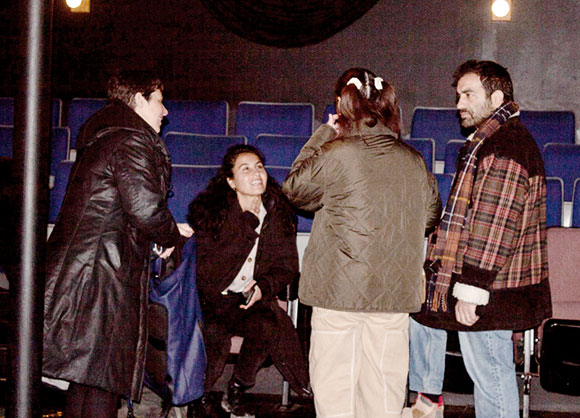
Seats start to fill up as more guests arrive. In the meantime, audience members excitedly chat before the start of the show.
With the increase in adults who turn to alternative information sources, more responsibility is put on public figures, especially those with big followings. Strauss worries that these responsibilities are being deflected, especially by those who started as comedians or entertainers, but transitioned into hosting podcasts.
“(Podcasters) will weigh in on politics in ways that commentators and news analysts would,” Strauss says, “and then say or do something ignorant but then try to hide behind their label as a comedian to dodge responsibility.”
This concern is not unfounded, as there are multiple instances of public figures pushing harmful rhetoric, if not full-on misinformation. A notable incident involves Joe Rogan, the host of the “The Joe Rogan Experience,” and questionable comments regarding the COVID-19 vaccine. Comments that were, no less, heard by his millions of listeners.
“When you have an audience that large, you have a civic duty to pursue the truth,” Strauss adds.
Still, there is no doubt that comedy does play as an effective means of communication, especially when it comes to current events.
Frau says that comedy and journalism parallel one another in the sense that the best of both “always reveal a truth.”
The following Friday, Albanese gave some of her own insights on comedy, journalism, and the overlap of the two.
Albanese says she made a conscious effort not to mention Trump by name in her comedy during Biden’s term. She noticed that comedy shows like SNL or late-night hosts “normalized” Trump as a public figure.
“He became a character,” she says, “I felt like we were in a chaotic cycle of presenting him as a threat, but also entertaining.”
She argues that the constant normalization by the media contributed to Trump’s re-election, as it allowed him to remain relevant even when he was no longer in power.
Still, echoing Frau’s comments from the panel, Albanese believes there is still a place for comedy to be used as an effective form of news distribution.
“Comedy has that gift of putting the comedian in a vulnerable position, and because comedy is a vulnerable experience, it lets the audience’s guard down,” Albanese explains, “this is why people can feel comfortable accepting information in that way.”

















Reader Comments