
Pages
Stay In Touch
More
© 2026 The Somerville Times. All rights reserved.

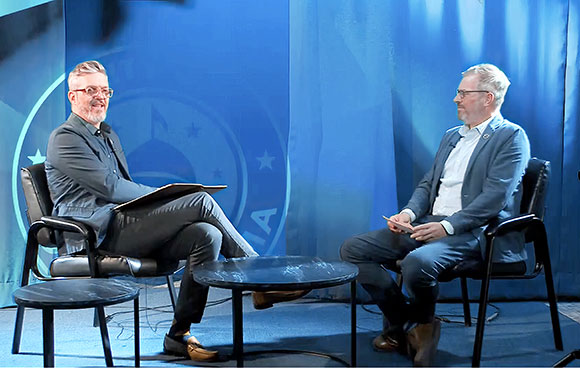
Chief Sustainability Officer Steven Nutter sat down with Mayor Wilson and outlined Somerville’s sustainability plans for the immediate future.
By Harry Kane
Creating a sustainable community and fighting climate change were at the forefront of Somerville’s agenda last week.
During SustainaVille Week – the annual celebration of sustainability and climate action in Somerville – Mayor Jake Wilson interviewed Chief Sustainability Officer Steven Nutter at Open Door Chats to reintroduce folks to Somerville’s plan to protect the community from pollution and climate impacts.
“We’re in a climate crisis,” said Mayor Wilson. “As our federal government abdicates its responsibility to move on these goals meaningfully, it’s increasingly falling to the state and local level. That’s where we come in here in Somerville. It’s a time for action.”
Nutter has lived in Winter Hill since 2010. He says climate work is part of his DNA. Since childhood, he has grown up seeing the effects coal mining and chemical production have had on communities.
“I’m just really blessed that I can do environmental work right here in the community that I live,” said Nutter, who joined the City of Somerville as the Chief Sustainability Officer and Director of the Office of Sustainability and Environment in January.
The community is the main pillar of climate work, he says, and working together is the key to dealing with challenging climate-related concerns. It requires community members to think globally and act locally.
Somerville’s Climate Forward plan – a community plan built on equity principles – includes goals for 2030, 2040, and 2050, explained Nutter. Its 77 actions across five different topic areas include buildings and energy, community health and resiliency, natural resources and waste, transportation and mobility, and leadership.
Building emissions are a top priority for the team, and the city has hired an energy adviser to administer a microgrant program to give residents up to $2,000 for their own energy efficiency projects. “We’re not talking about big renovations here,” explained Nutter. “We’re talking about smaller things that really make a difference.”
Somerville’s energy manager is doing a comprehensive analysis in school buildings and is working toward decarbonization, which will not only reduce emissions but also save taxpayers money, he said.
The city is expanding the number of electric vehicle charging stations, and has received three grants over the past year, said Nutter. “We expect to have almost 50 charging stations by the end of the year, including a level 3 fast charger over at Foss Park.”
In the goal for cleaner energy, Nutter said that the Somerville Community Choice Electricity (CCE) program allows residents to “opt up to 100 percent renewable … which is amazing.”
But he said it’s a “critical time” because the State House wants to cut $1 billion dollars from the Mass Save efficiency program, which Nutter says is “nuts.” Nutter encourages residents to contact the State Senator to save the program.
OSE is working with Eversource to figure out the “pain points” around neighborhood electrification. Nutter says they will continue to request to be included in the Fossil Fuel Free Demonstration Program.
The Commonwealth initially allowed up to 10 cities to be involved in this pilot program, which aims to restrict fossil fuel use in new construction and major renovations, but Somerville didn’t make it into the program this round.
One of the goals of the city is to increase the amount of green space, and de-paving would allow for more. Currently, some 87 percent of Somerville is either paved or has a building on it, according to Nutter. The removal of asphalt or concrete is a critical strategy utilized to reduce stormwater problems.
A pilot program for curbside municipal composting in East Somerville may eventually lead to a citywide program. “We’ve diverted 35,000 pounds of food waste since we started the pilot last fall. We have more than 350 families involved in the pilot right now. We have room for up to 1200 families,” said Nutter.
At the neighborhood level, Nutter says, curbside municipal composting can help reduce the rat population by removing the food waste from trash.
As part of SustainaVille Week, the city held its first-ever book club event on May 4 to build and strengthen relationships with sustainably minded residents. Somerville resident, activist, and author, Cate Mingoya-LaFortune, discussed her book, Climate Action for Busy People.
We’re working with the school department on standardizing the climate curriculum, he explained. Somerville was recently awarded a Bloomberg Youth Climate Action Award that Nutter says will fund a whole host of different youth-led initiatives happening across the city.
To sum things up, in terms of the resilience and climate preparedness work happening at the city level, Nutter says there are three main climate vulnerabilities: stormwater, coastal flooding, and heat.
“Our office is working on all three of those,” he explained, noting the city is focusing on stormwater flooding concerns by upgrading infrastructure to separate a combined sewer system into separate stormwater and wastewater pipes.
And to improve resilience to upcoming extreme heat events, Nutter highlighted a community-driven strategy to mitigate urban heat through resilience hubs and resilience corridors.
















It looks like Mayor Wilson is talking with himself.