
Pages
Stay In Touch
More
© 2026 The Somerville Times. All rights reserved.

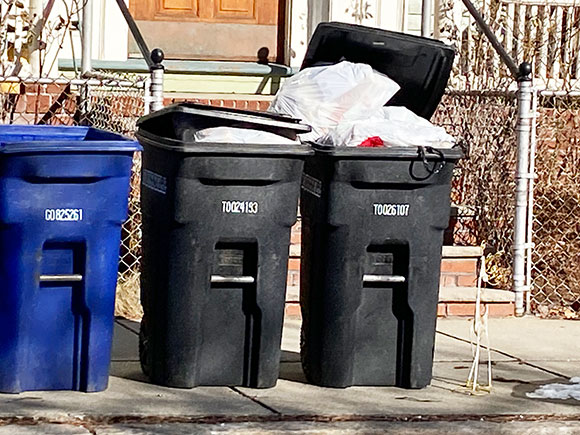
This year saw an increase in numerous violation types 2,875 violations were related to residential trash. — Photo by Bobbe Toner
By Jordan Pagkalinawan
The Rodent Issues Special Committee convened on December 1 to hear from the Inspectional Services Department’s Environmental Health Coordinator, Alicia Privett, and Environmental Health Manager Colin Zeigler, who updated councilors on the latest rodent control practices around Somerville.
Fertility control study and 311 complaint data
Privett first brought up a fertility control study currently underway at Somerville High School, where rats have been baited into traps containing peanut butter. She noted that there’s been a consistently high level of activity at the school, with nearly 60 rat events—instances where rats have gone into the boxes—reported earlier in August. Residents at Lincoln Park have seen similar levels of activity, according to Privett.
“Likely it is the same rat going into the box many times, because when I went and baited the traps, I would see the regulars in there once in a while,” she said.
Privett added that these numbers will be compared with 311 complaint data and numbers from SMART boxes—above-ground trapping units—to have more context for the product’s effects on the overall population.
When evaluating complaints made to the city’s 311 hotline, Privett noted there’s been a “steady decrease” of rodent-related complaints. As of Nov. 20, there were 529 such calls to 311 this year, marking a 14.8% decrease compared to 2024. She cautioned that the data isn’t perfect, noting that people’s tolerance and location affect those numbers.
As part of the city’s Rodent Assistance Program, Privett reported that 834 unique properties were visited this year in light of 311 complaints, higher than 2024 (723) and 2023 (761).
“It really shows how much work the inspectors are going out to all these properties,” she said. “We’ve also established more in our system. When we are doing outreach efforts, we are trying to get more properties in a certain block on the Rodent Assistance Program at the same time. It’s just more effective, we’re treating multiple properties at the same time.”
Since the Rodent Assistance Program requires four visits to each property, this year saw a total of 3,336 visits, a jump from the 2,892 made in 2024.
Rodent-Related Violations
This year saw an increase in numerous violation types except for vegetation and overgrowth. Privett mentioned that 2,875 violations were related to residential trash, “the highest rodent-related violation,” while 559 were for vegetation and overgrowth, and 490 were for commercial trash. There were also 228 rodent control violations, ones that include the presence of burrows on properties or excessive droppings.
Regarding a decrease in vegetation violations from 774 last year, Privett said it “might be a good sign that people are being more aware of this and taking care of landscaping.”
As for rodent control violations on public properties, Privett advised residents to call 311 to route the issue to the Department of Public Works and, eventually, a local pest control company. When Councilor Jake Wilson brought up a November 23 burrow sighting at Somerville City Hall, Privett said that building administrators should file a 311 complaint unless the general public does so first.
Integrated Pest Management Projects
Ziegler then highlighted future Integrated Pest Management projects by the ISD that “guide internal policy and procedure across departments” and “add a level of accountability to project managers” that are related to pest control measures.
The first project is a residential education campaign that aims to engage the public through yard signs and trifold mailers, telling them that some properties are “going the extra mile” to reduce rodent activity.
“It’s the added level of peer pressure and collaboration that we’re looking for in our communities,” Ziegler said. “And in many cases, we’ve seen successful situations where folks band together, they pressure each other, they work together, and ultimately reduce rats in their neighborhood.”
The project also hopes to educate landlords on proper pest control and explore resources to help low-income households with rodent exclusion and energy efficiency work.
A second measure would improve and expand the Residential Rodent Control Program. Those efforts include analyzing bait consumption, automating Residential Program reports and scheduling through Citizenserve, and monitoring rodent-related information in areas that participate in a curbside compost pick-up program.
The ISD’s third project is a “best practices” guide for commercial permit and license applicants, a joint effort with the city of Cambridge. Ziegler said the guides will be available on the CitizenServe permitting portal and included in various licenses, including vacancy, building, food, and outdoor seating. The department is also exploring incentives for restaurants and commercial properties with dumpsters.
The fourth project centers around increasing several types of trash bins and alternative treatments. The ISD is working to expand the number of Bigbelly Trash Receptacles—trash cans with horizontal doors that open when pulled down—as well as more SMART boxes in schools. They are also looking into purchasing a carbon monoxide machine with participatory budget funds, intending to place it away from buildings in order to kill rodents. Other efforts aimed at long-term mitigation are installing underground trash collection basins and public dumpsters for compost, recycling, and trash.
In addition to these projects, Ziegler said the ISD will develop a system to regularly monitor rat activity and the success of intervention efforts based on a variety of data, including 311 reports, CitizenServe baiting and tracking data, and tracking rodent-borne infections and diseases through 311 and Health and Human Services.
“We’re exploring these things, and if they can be deployed,” Ziegler said. “But all of it will be important information and data in the future.”

















Reader Comments