
Pages
Stay In Touch
More
© 2026 The Somerville Times. All rights reserved.

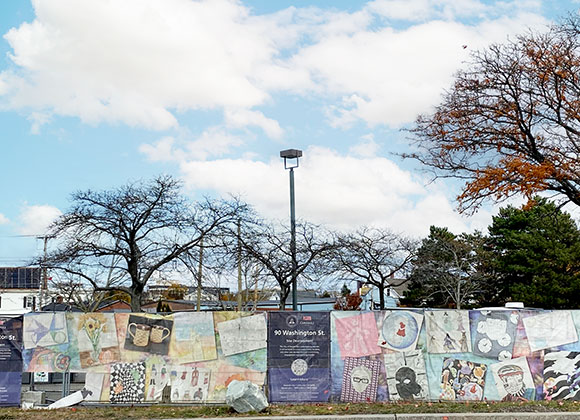
The city’s Land Use Committee, along with the Planning Board and Redevelopment Authority, recently met to discuss plans for the 90 Washington Street Demonstration Project. — Photo by Bobbie Toner
By Jordan Pagkalinawan
On November 6, the Somerville Land Use Committee held a joint session with the city’s Planning Board and Redevelopment Authority to discuss potential changes to the 90 Washington Street Demonstration Project plan. The committee also heard from several city officials requesting amendments to the Zoning Ordinance and upzoning classifications on various properties.
Proposed changes to 90 Washington St.
Ben Demers, a senior economic development planner from the Office of Strategic Planning and Community Development (OSPCD), presented several proposed changes to the 90 Washington Street development project.
The four-acre site, which the Redevelopment Authority took for roughly $39 million in 2019, was originally intended to house the city’s police and fire departments and a 911 dispatch center. However, a lawsuit by the property’s former owner significantly increased the project’s cost, rendering the city unable to continue with its original plan and instead shift toward private redevelopment, according to Demers.
The site’s Development Project Plan and Memorandum of Agreement, both signed in February 2019, had included goals to eliminate any negative property impacts, add the public safety component, and pair it with a transformative development opportunity. With the proposed changes, the OSPCD hopes to explicitly remove the public safety component from the planning documents, as well as recoup a significant portion of the funds used for the property’s taking.
“We understand that there’s still a need for improved conditions for the city employees, but that project has really been separated off from the disposition of this property and is on its own track,” Demers said. On the recouping of the project’s funds, he added: “We just want to make sure that we were explicit about this in the document,” citing the SRA’s commitment to doing so.
As for how the changes would affect the project’s progress, Demers proposed substituting a technical advisory committee for the 90 Washington Civic Advisory Committee, which “is a group of neighborhood stakeholders that have been meeting since 2023 to discuss project implementation.”
The second change would require developers to file for permits within a three-year time frame instead of breaking ground on the site in that same window. Demers said that change was meant to provide the SRA “more flexibility in the negotiation process, which can help them secure a higher value for the land or other benefits.”
After explaining the potential changes, Demers laid out the priorities for a Request for Proposal, which—in addition to the aforementioned recouping of funds—would require the land to be used for a combination of objectives: new housing and/or commercial, civic, or green space. Additionally, the RFP would have to meet certain design principles, including a mixed-use format, sustainable design, and Diversity, Equity and Inclusion in the development process.
Councilor Ben Ewen-Campen asked Demers for an “anticipated timeline” to approve the proposed changes, to which Demers replied, “As soon as possible.”
“I know there will be at least one more discussion within the Land Use Committee,” Demers said. “Depending on how that moves forward, the hope would be that they would come back to the city council in November, December for a vote of approval.” Based on those votes, he added, the city would look to release an RFP “early next year.”
“We want to make sure that we’re moving expeditiously on this,” Demers continued, “considering the city’s financial health and the impact of this project.”
Zoning Ordinance amendments and Gilman Square upzoning
Following Demers’ presentation, the Land Use Committee heard four items that sought to update certain amendments to the city’s Zoning Ordinance.
The first change requested to make pre-submittal meetings optional for special permits, site plan approvals, land variances, land platting, and wireless communications, according to urban planner Dan Bartman. Those meetings would still be required for subdivision plan approvals and master plan special permits.
Bartman said that 64% of this year’s pre-submittal meetings “involved people who were already familiar with the zoning ordinance,” a 22% increase from 2024. However, he added, these meetings would still be offered to “people who really need them.”
The ordinance also clarified language around the online licensing and permitting portal and made language around certain permit durations and extensions more consistent.
A second change updated a table within the Zoning Ordinance to allow Family Child Care Homes and Home-Based Child Day Cares “to be permitted by right in all districts
that allow housing,” according to an attached presentation. The update removed any previous discrepancies within the ordinance’s Use Table, which indicates what activities are allowed on a property versus those that require special permits.
Real estate attorney Adam Dash then led a presentation around two properties—363 Highland Avenue and 110 Willow Avenue—requesting that they be changed from a Mid-Rise 4 classification to Mid-Rise 5 and Mid-Rise 6, respectively. He said that both buildings, designed for a mix of commercial and residential use, have “tremendous potential” to link together “the main features of Davis Square,” mainly Highland Avenue and the Community Path.
Peter Kim-Santos, the treasurer of the Davis Square Neighborhood Council, read a planned statement supporting the zoning change at both properties, welcoming the need for transit-accessible housing at 363 Highland Avenue and hoping for “more desirable development” at 110 Willow Avenue.
The committee quickly approved an amendment to change the zoning district of 321 Washington Street from Fabrication to Commercial Industry.
The final item was a presentation by Land Use Analyst Samantha Carr, who shared four potential scenarios of upzoning around Gilman Square.
While the committee was receptive to each of Carr’s proposals, Councilor Ewen-Campen brought up a memo from Mayor Katjana Ballantyne’s Office of Housing and Stability. The office raised concerns over a lack of public engagement and the potential for displacement related to upzoning in the city. Other councilors agreed on the need to communicate with residents and protect them from displacement risks associated with upzoning procedures.

















Reader Comments