
Pages
Stay In Touch
More
© 2026 The Somerville Times. All rights reserved.

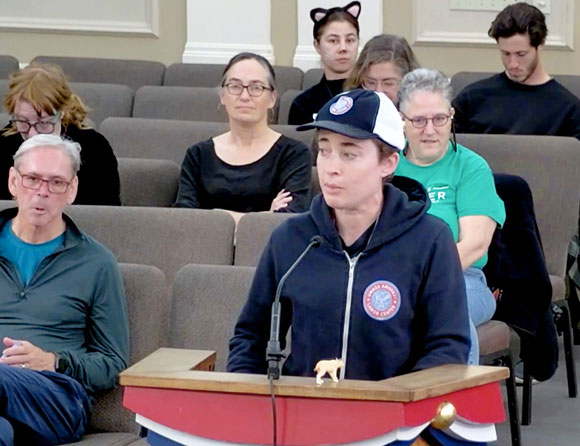
Somerville resident Marissa Fried addressed the council, advocating for the resolution.
By Harry Kane
Federal cuts for public higher education are deeply concerning, which is why the city council is supporting Governor Maura Healey’s DRIVE Act, which hopes to offset recent federal funding reductions.
A resolution was passed at the city council meeting on October 23 that supports a new state initiative to allocate $200 million for public higher education, which would be dispensed from the Fair Share surtax on annual incomes over $1 million.
“This resolution affirms our city council’s strong support for Governor Healey’s DRIVE Act,” said Councilor Wilfred N. Mbah. “The DRIVE Act represents a bold commitment to stabilizing and strengthening our state’s community colleges, state universities, and the University of Massachusetts system.”
Councilor Mbah sponsored the resolution at the October 23 meeting, and all the other city councilors signed on in support.
“This council calls on the legislature to dedicate at least $200 million towards stabilizing public higher education funding and to continue expanding long-term investment to reduce dependence on tuition fees and privatization,” said Councilor Mbah.
The Massachusetts Discovery, Research, and Innovation for a Vibrant Economy, or DRIVE Act, is a proposal for $400 million in state funding. Half of that would go towards “Massachusetts public higher education campuses doing research, cross-regional partnerships and joint ventures,” according to the DRIVE Initiative October 30 press release.
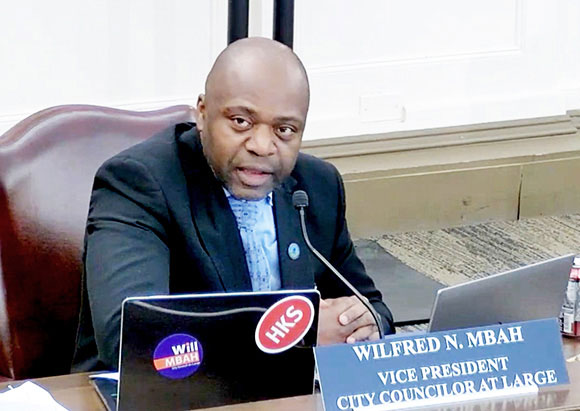
Sponsor of the DRIVE Act resolution, Councilor Wilfred N. Mbah.
Councilor Mbah sponsored three community members to testify in support of the new legislation during the city council meeting.
“The slashing of this funding by the Trump administration is an all-hands-on-deck emergency for higher ed.,” said Daniel Rourke, a Somerville resident and PhD student in the renewable energy engineering program at UMass Lowell.
Rourke says he has seen his co-workers’ grants get canceled, well after they’ve been awarded, and he’s seen emails saying no more PhD students will be admitted for the following year, which he explained essentially freezes all research going forward.
“This not only jeopardizes the jobs of UMass Lowell workers, but tens of thousands of jobs that ripple out from there in the sectors of higher ed,” said Rourke.
Joy Solon, graduate program manager at UMass Boston in the sociology department, testified in support of the resolution.
“As the program manager, I work closely with graduate students and faculty members who have been directly affected by these federal cuts to research,” said Salon.
Students who work in research have lost grants and tuition waivers, putting their education in jeopardy, she explained.
“I’m here to lift up the importance of ensuring that access to free and affordable higher education is provided for all members of our community,” said Marissa Fried, a Somerville resident and teacher in the Cambridge Public School District. “We must raise up the importance of providing for my higher education colleagues, because without them, higher education students such as myself would not have access to the resources necessary to ensure that our studies lead us on a pathway to a lifetime of success.”
Fried says that Somerville can help by supporting the proposed DRIVE Act and assisting the Commonwealth as the first state in the nation to address the Trump administration’s politically motivated attacks on higher education.
“The Trump administration is sowing chaos in our state’s public higher education system by freezing and canceling federal funding used to support research and other academic programs. So, hundreds of millions of dollars are at stake,” said Fried.
Councilor Mbah thanked the three speakers and said, “We all reaffirm our vision for debt-free public higher education that ensures affordable access to all students while providing fair compensation and professional support for faculty and staff. Supporting this higher education resolution expresses our collective commitment to maintaining strong, equitable, and inclusive public higher education in the Commonwealth.”

















Reader Comments