
Pages
Stay In Touch
More
© 2026 The Somerville Times. All rights reserved.

 *
*
Review by Off the Shelf Correspondent Dennis Daly
Generally, I try to avoid political poems as well as anti-war poems. Not because they don’t have an important place in those overlapping genres – they do. Or because they can’t effectuate changes in belief systems with their emotional and sometimes rational appeal – they can. But even so, overcome with their own self-importance or consumed with the certainty of true believers, the poets, who write them usually fail. Brilliant exceptions like Sigfried Sassoon (First World War), Wilfred Owen (First World War), and Michael Casey (Vietnam War) prove the rule. Therefore, when confronted with reviewable collections of this verse type, I walk, nay, I run in the other direction. But not today.
Carl von Clausewitz, a Prussian military strategist, once claimed that “War is merely the continuation of politics by other means.” Well, he got part of that right. But war does more. In its classic form, the
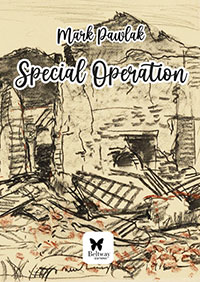
Special Operation
By Mark Pawlak
Beltway Editions, Rockville, Maryland
ISBN: 978-1-957372-22-8
41 Pages
clashing of grounded armies, it transforms patriotism and high-minded glory, and common hospitality into human rage and bloody slaughter. It highlights an awful history of horror, bloodletting and the much darker and deeper and bestial nature of mankind. Great conquerors, like Alexander the Great, Genghis Khan, T’ien Wang (leader of the Taiping Rebellion), Napoleon, et al, celebrated by many in modern nation-states, brought untold suffering and death to their fellow man.
Special Operation, Mark Pawlak’s new collection of war poems, set in the god-awful Ukrainian-Russian quagmire, focuses not on who is winning and who is losing but what, euphemistically, the military class calls collateral damage. And in wartime collateral damage unerringly refers to the very old and the very young. In fact, Pawlak addresses Babusya (meaning grandmother) in a number of his more poignant pieces.
In Pawlak’s opening poem (doubling as his title piece), Prologue: Don’t Worry, his narrative details two sisters, one in Moscow and the other in Kharkiv discussing the war. The Moscow woman assures her sibling that Vladamir Putin’s war machine in his “special operation” targets only military installations. The second sister responds this way,
“Good,” she says. “So please ask him
why his Operation’s missile struck
your niece’s kindergarten.”
Erasure, Pawlak’s poem lamenting the historic looping of war and regret since time immemorial, uses a well-worn slogan to great effect. The phrase Never Again seems to have been popularized during the First World War and later associated with Elie Wiesal, a Holocaust survivor and Pope Paul VI in his 1965 address to the UN. Pawlak relates how survivors of the last war painted this slogan on bricks of newly constructed buildings only to later have those same two-word slogans altered to a single word by modern munitions. The poet concludes his dirge with not a little irony,
… “Never Again.”
But when artillery shells and missiles
demolish buildings,
they create by erasure—
as this new war demonstrates—a new slogan
on brick facades and survivors’ lips:
“Again.”
When everyday life mixes with murderous technology on warfare’s tableau, it causes the observer (or reader) to question the very fabric of ethical reality. Pawlak’s The Gift conjures up this juxtaposition for all to see. The poet/narrator councils his grandmother on the degraded condition of her home and garden. He tells her to consider the advantages of the recent bombardment of her property (Is this a Monty Python skit?) and to consider the bright side of things. Indeed, low comedy has a way of merging with tragedy in these dire situations. Here the poet, in a kind of despair, winks at the devastation,
Come summer, the shattered door, burst windows,
shell shocked walls
will provide ventilation.
And your garden plot, Babusya,
won’t need digging: already cratered, trenched,
it’s well prepared for spring planting.
Elderly refugees from the Ukrainian meatgrinder understand all too well humankind at its worst. All illusions long since vanished, they plod ahead because they must. This is also man’s nature. In Pawlak’s poem Survivor, the reader follows the dreadful trek of a 98- year- old woman, having already experienced Stalin’s man-made famine (ten million dead), and now seeking existential comfort in her piety and prayers. Her footwear, contrasted with the bombastic and grisly landscape surrounding her, tells the tale in, alas, horrendous detail. Here’s the heart of the poem,
Rifle fire, explosions, occupation.
One Russian soldier shoots the family’s barking dog.
“What have you done? That was our protector!”
“I’m your protector now,” he says.
Rifle fire, explosions.
Separated from family, fleeing west alone,
no food, no water, on foot,
in house slippers.
Exploding artillery shells, cratered roads…
she steps over dead bodies,
walks past cars, trucks:
blasted, smoldering.
My favorite poem in Pawlak’s collection, The Gardener, sneaks up on you with its candor and calm in the midst of devastation. Yet another elderly woman continues on with her ordinary life in spite of everything. She keeps to her routine and ignores what she cannot change. She endures in spite of the madness that surrounds her. Pawlak explains,
Her son is at the front.
Now the only resident of her block,
she tends her garden,
the one she’s kept for 30 years:
her hands weeding,
spade and pitchfork turning earth—
in the bomb craters
she plants new flowers.
All around: destruction;
in her apartment, order:
Czech crystal displayed
on top of her dresser.
Rules of war are laughable. William Tecumseh Sherman, a commanding general during the Civil War, once argued that “War is cruelty. There is no use trying to reform it. The crueler it is, the sooner it will be over.” That very recognition causes shame. And shame can be efficacious. We need to be reminded in painful detail of war’s essence and humanity’s capacity for barbarity. Poets like Mark Pawlak serve as essential mitigating forces. He deserves our thanks.

















Thank you Doug Holder for a good and well-written review, and your comments about politics, poetry, and the confluence of the two. In War, and especially modern warfare, it always seems like the Poets, the Artists, the Musicians, and perhaps the philosophers, are always the first to go, to the front lines, as fodder for the ‘War Pigs’– the Politicians, Generals, and Hawks who plan, manifest, and revel in mass destruction and human suffering. Is it because the poetic and artistic ones are also the most dangerous to the culture of barbarity, depravity, and the torture of the human Spirit, both collectively and individually? And of course now there are no front lines, per se, for the entire planet has become the battlefront, and all places are the battlefields, and all civilians–and children–are the enemy! “Collateral damage” is now the centerpiece of every ‘Special Operation’, the venting of anger/hatred/rage at every place, person, and People. The war-torn mind of modern Kings, pawns, and victims alike is put in perspective by the words, thoughts, and actions of those who refuse to accept it, and thus strive in their own way to rise above it. That all of these words and feelings are brought to light by the poetry of Mark Pawlak is indicative of the power of poetry, to invoke feelings of shame and simultaneously sincere and certain Hope and Belief in, and appreciation of, the Triumph of the ‘Human Spirit’. Yes, would like to thank Mark Pawlak, for his feelings and expressions. I can’t wait to read ‘Special Operation’, sure that I will then thank him again, in a more knowing and meaningful way.
Mark the review is by Dennis Daly