


Hodgkins-Curtin Park meeting canceled, to be rescheduled

On March 4, 2009, in Uncategorized, by The News Staff
 
 
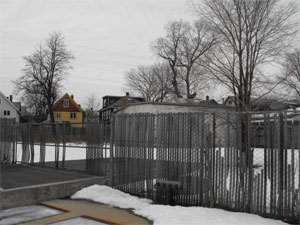
Renovation plans to be discussed for Hodgkins-Curtin Park. ~Photo by Bobbie Toner

By Ben Johnson

The
few brave Somerville residents who hazarded fierce cold and deep snow
on Monday night to attend the community meeting regarding the
Hodgkins-Curtin Park renovations were met with an unexpected surprise –
the Tufts Administration Building, where the meeting was to take place,
was locked and closed.

Since other government buildings in
Somerville were open during Monday's massive snowstorm, it was expected
that the Hodgkins-Curtin Park meeting would go forward as planned at
6:30pm on Monday evening. But unbeknownst to the meeting's planners,
the Tufts Administration Building was closed due to the weather.

Ellen
Scheider and Arn Franzen, both from the Mayor's Office of Strategic
Planning & Community Development came to the Tufts Administration
Building with their presentation for the park restoration in hand, only
to find the building locked and inaccessible. Also in attendance were
two representatives from the landscape architect firm Weston &
Sampson, who have been involved in the planning and development of the
park's restoration.

The four of them waited in the Tuft
Administration Building's vestibule to inform interested residents that
the meeting was canceled due to circumstances beyond their control.

But
in spite of the cold, Schneider and Franzen were still very willing to
talk informally about the plans for renovating Hodgkins-Curtin Park
with anyone who was willing to stay and discuss. They were also quick
to reassure everyone in attendance that a new meeting for the plans
would be scheduled promptly.

The renovation of Hodgkins-Curtin
Park is one of many projects that Mayor Joseph A. Curtatone and the
Office of Strategic Planning & Community Development has undertaken
to preserve and improve existing parks and other open spaces in the
City of Somerville.

The Office of Strategic Planning &
Community Development oversees all park renovations and expansions
within Somerville by managing and utilizing a budget that includes
federal, state and city funds. "We are committed to enhance the City's
built environment and create outdoor spaces for active recreation,
relaxation, and environmental health in Somerville," explains the
Office's website.

The City of Somerville currently manages a
total of 41 parks and fields and there may be more in coming years.
With the help of Mayor Curtatone, the Office of Strategic Planning
& Community Development, and concerned residents of Somerville,
community parks have been experiencing a considerable transformation in
recent years.

Since Mayor Curtatone took office, the city has
renovated 11 parks and added four new ones. These four new parks alone
have added 1.5 acres to the city's recreational areas.

"Somerville
parks and playgrounds are seen by residents and business persons as a
valuable community resource," says the Office of Strategic Planning
& Community Development's website. Somerville's representatives and
residents commitment to attending the ill-fated Hodgkins-Curtin Park
meeting on Monday night only confirm this statement.

Even in the
cold, dark Tufts Administration Building vestibule, a dialogue between
a community member and Somerville representatives was begun about the
future use and restoration of a baseball diamond in the park. So in
spite of the impromptu cancellation of the meeting, a dialogue was
begun and will hopefully continue when the Hodgkins-Curtin Park meeting
is rescheduled.

Updates concerning the rescheduling of the
meeting will be found on Somerville's website. All interested residents
and stakeholders are invited to attend. "We hope to reschedule and have
the meeting as soon as possible," said Schneider.

In the end,
no one in attendance for Monday night's meeting seemed especially
discouraged or frustrated by the locked building. Most everyone seemed
slightly amused by the mishap, knowing that last Monday was indeed no
day for a park.


Parking permits may be adopted city-wide

On March 4, 2009, in Uncategorized, by The News Staff
 

By Tom Nash

Somerville's
streets without parking permit requirements have drawn the ire of the
Board of Aldermen, with an initial step taken at last Thursday's
meeting to find out what would happen if all streets were taken into
the system.

The board cited concerns about the parking
competition that would be brought by the MBTA through the city and
Cambridge residents who poach spots during the work day. Roughly one
third of Somerville has unregulated street parking, a majority of which
lies in the area that would be serviced by the green line extension.

"The green line is coming to the middle of Union Square," Ward 4 Aldermen Walter Pero said, noting

that
the red line extension to Davis Square brought permit restrictions to
protect residents from encroaching commuters. "We need to be preparing
the citizens. We might as well start training them now."

The unanimously approved order asking Director of Traffic and Parking James

Kotzuba
to examine the effect of unifying all streets within the permit system
was submitted by Ward 5 Alderman Sean O'Donovan and Alderman-at-Large
Bruce Desmond.

In addition to concerns that the green line would
bring more cars into Somerville, Ward 2 Alderman Maryann Heuston said
her constituents are constantly fighting for parking space with
Cambridge residents looking to avoid that city's stringent enforcement,
especially on Beacon Street.

"Ward 2 is essentially a parking lot for the city of Cambridge," she said. "People who live in Ward 2,

they can't park near where they live at all during the day."

Ward
7 Alderman Bob Trane, chairman of the Traffic and Parking Committee,
said Somerville residents are also avoiding permit regulations by
parking halfway across the city. He added that out-of-state plates are
also frequent on unregulated streets.

"We're losing a lot of revenue that should be coming into the city," Trane said. "These are people

that
our roadways and not paying their fair share. We need to roll out
parking city-wide, and we should stop this practice of our city being
abused."


Proposed Revision to Condo Ordinance Tabled, More Outreach Needed

On March 2, 2009, in Uncategorized, by The News Staff
With Conversions and Sales Slowing, Supporters Emphasize Continued Efforts to Educate and Build Awareness
Mayor
Joseph A. Curtatone and Ward Six Alderman Rebekah Gewirtz today
announced that they were temporarily tabling the revised condominium
conversion ordinance recommended this past August by a task force
created by Mayor Curtatone and chaired at the request of the mayor by
Alderman Gewirtz.

"This is a good proposal that's come out of a
very inclusive process, but it's clear that a cooling real estate
market has reduced the impetus and the urgency for updating the current
ordinance," Curtatone said. "It's also clear that future prospects for
the proposals will be improved by a renewed community outreach and
education effort. Many residents still don't understand why we need to
make the condo conversion process clearer and more predictable for both
property owners and tenants. We will continue that education process
and revisit this issue when the time is right."

"On the one
hand, I'm eager to move forward with this proposal since it was the
product of so much hard work by both tenant and landlord advocates who
spent sixteen months hashing out a compromise within the Condo
Conversion Task Force," said Alderman Gewirtz. "However, I think the
long-term chances for success are enhanced by tabling this measure for
now and engaging in more outreach and education about the proposal's
benefits to small property owners, in particular."

"Alderman
Gewirtz did an outstanding job of bringing together the broad-based
task force, which involved all of the stakeholders, including tenant
advocates and property owners. Working together, they came up with a
proposal that covered the concerns of owners, renters and the community
as a whole," said Mayor Curtatone. "But it's clear that we have more
work to do to explain the benefits of a new ordinance."

The task
force included tenant advocates, representatives of the real estate
community and staff from the Mayor's Office of Strategic Planning and
Community Development. The ordinance they proposed would expand upon
the existing state statute that governs conversions throughout the
Commonwealth, and would add the following key provisions:

•
For two and three family homes, the proposed ordinance provides for a
shorter notice period than the current Somerville ordinance – namely, a
6-month notice to all tenants. The proposed ordinance also provides for
a lump sum reimbursement for relocation costs of $2,000 for elderly,
handicapped, and low/moderate income tenants and $1,000 for all other
tenants.

• For buildings of four or more units, the proposed
ordinance provides for the same notice period as the current Somerville
ordinance and the state statute – namely, a 2-year notice to elderly,
handicapped, and low/moderate income tenants and a 1-year notice to all
other tenants. The ordinance also provides for a lump sum reimbursement
for relocation costs of $4,000 for elderly, handicapped, and
low/moderate income tenants and $2,000 for all other tenants.

"Both
Alderman Gewirtz and I remain committed to advancing a fair and
balanced condo conversion ordinance in the future," said Curtatone.

"There
is still a fundamental need for an ordinance that protects the
interests of our landlord community and provides protections for low
income, disabled, and elderly tenants in Somerville. We will continue
to work together to meet that need," said Gewirtz.


Drives provide relief to local organizations

On February 28, 2009, in Uncategorized, by The News Staff

Jennifer McInnis

Local
community organizations that provide necessary assistance to families
will be receiving their own form of relief this season through several
local drives that have developed in response to the urgent and
unprecedented demand for essentials. This year's economic climate
coupled with an especially chilly winter season has placed a great deal
of strain on organizations whose resources are already stretched thin.
From the larger February Food and Boot Drive to the smaller school and
church drives, many organizations are stepping-up-to-the-plate to
address the growing demand for essential items in these bleak economic
conditions.

The February Food and Boot Drive, developed by
Boston Cares, a volunteer service organization, in partnership with The
Boston Globe, Building Impact and the Corporate Volunteer Council of
Greater Boston, aims to raise 10,000 pounds of protein and 500 pairs of
children's boots in twenty-eight days to benefit two non-profit relief
agencies: Cradles to Crayons and the Greater Boston Food Bank.

"This
is a new drive developed specifically in response to the stories we
were hearing about skyrocketing requests for food and clothing that
agencies throughout the region were getting from people in their
communities," said Rick Wallwork, Associate Director of Boston Cares.
"Clearinghouse agencies, including Cradles to Crayons and the Greater
Boston Food Bank, were reporting greater demand than they've seen
previously, and were having difficulty keeping certain items stocked.
Canned protein and children's warm boots were two of the priorities
identified where we felt we could make a significant contribution. This
drive supports Cradles to Crayons, which ensures that the boots will go
to agencies across the state, and the Greater Boston Food Bank's Brown
Bag program, which provides supplemental food to 6,500 seniors and
families each month. There are so many grass-roots agencies serving so
many communities in Greater Boston, to reach them all would be
difficult."

While the February Food and Boot Drive primarily
supports the state-wide agencies, Cradles to Crayons and the Boston
Food Bank, many organizations in Somerville are putting together drives
to address local demands, here in Somerville. During the month of
March, Curves of Somerville will be waiving its service fee for any new
members who bring a bag of non-perishable groceries between March 2nd
and March 28th. The Curves of Somerville's promotion is part of the
national fitness chain's 11th Annual Curves Food Drive, which has
distributed about fifty million pounds of food to local communities
over the past five years.

"The Curves Food Drive is always exciting," said Betsy Tsichlis, the owner of the Somerville club.

We
have a chance to help so many people at a time when food banks are
lowest. Especially during these uncertain times, this food is needed
more than ever. It's a win-win situation for everyone, and we're very
proud to participate."

One Somerville agency that will be
benefiting from local drives this year is the Project Soup Food Pantry,
a service provided by the Somerville Homeless Coalition.

"Project
Soup is seeing more and more unemployed families and individuals due to
job cuts, high rents, utilities etc… and I anticipate this to go even
higher," noted Project Soup Food Pantry Coordinator, Sandra Harris. "In
May is the Post Office Food Drive, which the agency benefits greatly
from. Also, the schools are running more food drives for us which is
always a great help. Churches are also pitching in with food
collections. Many individuals bring bags of food to the pantry and say
that they know it is very hard for individuals at this time. It makes
me feel good to know that there are so many caring people willing to
share with all of us."


March 3rd Hearing on Condominium Conversion Ordinance CANCELLED

On February 26, 2009, in Uncategorized, by The News Staff


Notice from the City:

Alderman
Thomas Taylor, Chairman of the Committee on Legislative Matters, has
CANCELLED the Committee Meeting & Public Hearing previously
scheduled for Tuesday, March 3, 2009 at 7:00 PM.


Local aid amendment shot down

On February 26, 2009, in Uncategorized, by The News Staff

State Representative Provost votes on bills and resolutions based on their merits, not purely by political party preference.


By Cathleen Twardzik

On
February 11, State Representatives voted on House rules and joint
rules, including "a local aid resolution," requiring annual adoption by
March 15, 2011. However, the amendment, which would have required the
state to provide each city and town with a fixed amount of aid by
mid-March, each fiscal year, did not pass. In the immediate area
surrounding Somerville, Representative Denise Provost who represents
the twenty-seventh Middlesex District, was the sole member of the House
to support its passage.

The issue of local state aid is
paramount to Provost. "It's important for cities and towns to know what
their local aid is going to be when they are building their budgets. I
would venture to say that the reason there were so many votes against
the amendment is because it was brought by a member of the minority
party," she said.

However, the last two budgets were secured,
according to Provost. Therefore, "we have adopted local aid resolutions
in a timely way, without it having to be a rule, but I think that it is
a fine thing to impose upon ourselves, a rule that we will have a local
aid resolution every year in time to allow cities and towns to plan
their budgets," she said. The matter is especially pertinent in
Somerville because of the amount of state aid which the city receives.

Interestingly,
Massachusetts House Speaker Salvatore DiMasi resigned in January 2009.
Therefore, the adoption of rules by the House was postponed until
February.

Although this local aid resolution was not slated to
go into effect until 2011, because the legislature has two year
sessions, voting for various pieces of legislation can take place well
before they would actually take effect.

Why did other members
of the Democratic Party vote "no," on a rule to require that a specific
date be set for local aid? It is quite common for votes in the House to
"break along party lines." Provost predicts that chances are high that
"most of the amendments that were offered by Republicans were voted for
by the Republicans." A few Democrats may have also voted for
Republican-offered amendments, she suspects.

"Many, many
members, I would guess, vote by party, and I always take my votes on
the merits. If you look at the other amendments, I voted for several
other amendments that day that were offered by Republicans, which most
of the Democrats voted against, and which did not pass," she said. It
is clear that she followed that sentiment during the last vote. "If I
think that a bill or a rule or an amendment or a person has merit, I
will vote for them."


The View From Prospect Hill

On February 25, 2009, in Uncategorized, by The News Staff


Last
week, we half-heartedly remarked that it would be the last straw if
under the less than intelligent leadership of the ZBA, they gave Dakota
Partners their extension. After all, the point was that the developer
has a less than stellar relationship with the community as a whole – it
has been well documented – and they should be told to go pound sand and
make their money off the backs of some other community instead of
litigating their way to the bank.

City boards and committees are
there to safeguard the community – to act in a way and manner which
preserves the public interest – and those appointed to these various
entities are there to make decisions which follow the letter of the law
in a way that protects our community.

This city has had its own
cast of characters over the years as appointed and elected members
entrusted with vital roles on behalf of the community, but the Chairman
of the ZBA has set the bar at a new depth. That's right, not new height
– new depth.

To listen to the Chairman of the ZBA tell people
assembled at a public meeting that if they want to stay in the
chambers, that they had better keep their mouths shut unless they're
granted permission to speak is outrageous. To then allude to police
officers outside the chambers, stationed there to ensure public safety
and stave off outbursts was a shameful display of disregard for the
community.

If you are angry reading that, wait until you read what comes next.

Later
on, this very same individual led the charge in giving the developer
the extension they were after and then actually used the silly excuse
that he was afraid that the developer would personally sue the members
of the ZBA if they didn't grant the extension. And then one by one the
rest of the members of the ZBA followed right along.

Think about
it for a minute – when a city board or committee that makes decisions
which affect the entire community treats members of that very same
community like they're the enemy and then tells every developer that
might have been thinking of coming to Somerville that they're afraid of
making a decision based on the probability that they will be sued –
then you just gave away the keys the city. The entire Zoning Board of
Appeals and its members should be ashamed of themselves and the
Chairman of that board should resign, plain and simple – before they
are given the chance to give any more of this city away based on their
own personal fears.


ZBA issues permit extension over aldermen, residents objections

On February 25, 2009, in Uncategorized, by The News Staff


343 Summer St.~Photo by Bobbie Toner

By Tom Nash

With
a police detail on hand to quell any protest, the Zoning Board of
Appeals ruled in favor of allowing a heavily opposed condominium
development a one-year extension to begin construction at its Feb. 18
meeting.

The ruling is the latest chapter of a seven-year legal
battle waged by both residents abutting the 343 Summer St. property and
its owners, the Dakota Partners, who came before the ZBA to ask for a
permit extension because of hardship – a loosely defined term that
became the center of the debate.

"I think the decision was made
one month ago," Evdokia Nikolova, a leader of the opposition to the
project, said after the vote. "They just put up a show for the
neighbors."

Dr. Mohamed Hanif Butt — who unsuccessfully sued
the developer — and a dozen other residents came to raise their
concerns about the project, primarily that the developer had ignored
concerns about the development's size. The project is planned to have
14 units.

Dakota Partners' attorney Richard DiGirolamo
reiterated that the request for an extension stemmed from the
difficulty faced during Butt's litigation against the developer and the
refusal of the city to allow them to cut down a shade tree to place a
required fire lane, which is the basis of a suit by Dakota against
Mayor Joseph Curtatone and Ward 6 Alderman Rebekah Gewirtz.

ZBA
Chairman Herbert Foster informed the crowd that two police officers
were on hand to prevent the outbursts that occurred at the Feb. 4
hearing on the permit extension. Several occurred anyway.

"If
you want to stay in this chamber, you keep your mouth shut unless
you're granted permission to speak," Foster said after the crowd jeered
DiGirolamo. "I've been on this board almost ten years, and it's
unprecedented that this board has ever taken the measure to have public
safety here because of those outbursts."

In an attempt to
minimize the disruption,Ward 6 Alderman Rebekah Gewirtz took a poll of
the residents' questions and grilled the board on why a developer who
is suing the city can claim the suit as a hardship. To be eligible for
an extension, the Dakota Partners had to prove it could not begin
construction within the two year permit length and show a good faith
effort to move forward.

At the Feb. 4 hearing, four Aldermen and
most of the neighbors on hand at the following meeting rejected the
developer's claim. A ruling was delayed while Assistant City Solicitor
decided if the request was valid. Shapiro explained at the Feb. 18
hearing that Dakota Partners did have the right to an extension despite
questions about the term of the original request.

Both
DiGirolamo and Shapiro agreed that no further extensions are possible
under Somerville's ordinance, although a day after the meeting Shapiro
sent an e-mail to the ZBA explaining the one-year limit was susceptible
to legal challenges based on a 2002 decision by the Massachusetts
Attorney General's rejection of a similar proposed ordinance in Swansea.

"While
the Attorney General opinion does not constitute case law," Shapiro's
e-mail stated, "I do agree with the rationale that an ordinance may not
limit the number of extensions where there is good cause to extend the
permit."

Under the Somerville ordinance, "good cause" is defined
as hardship faced by a builder including weather, "acts of God" and
labor strikes, although Shapiro said the law allowed for any
justification suitable to the ZBA. DiGirolamo made no attempt to
explain where the request fit into the listed categories.

As the
board approached a vote, Foster noted the Dakota Partners' pattern of
litigating adverse outcomes. "I personally think they would sue us if
we don't grant them the extension," he said. "Whether we give it to
them or not doesn't alleviate them of the responsibilities of the
permit."

After the unanimous vote approving the extension, Gewirtz said the ruling did not bode well for the city.

"(The
ZBA) probably had reason to be concerned about that, because (Dakota
has) sued everyone in their path. That is, quote, their 'good faith
effort,' " she said. "To me, a good faith effort is working with
neighbors. They only want to use a stick."

DiGirolamo said he
was pleased with the outcome. "We're happy (the ZBA) made the right
decision," he said, adding that the city's position is still
obstructing the project. "Seven years later, we don't even have a stick
in the ground."


Letter to the Editor

On February 25, 2009, in Uncategorized, by The News Staff


(Readers
are invited to send letters to the editor to The Somerville News.
Please email your letters to News@TheSomervilleNews.com or mail them to
21A College Ave., Somerville, Mass., 02144. The Somerville News
Reserves the right to edit letters for style , grammar and length. All
letters must include an name and contact information. Contact
information will not be shared with the public. We look forward to
hearing from you.)

To the Editor:

The time for denial
and evasion is over. For the first time in a long time, Congress has
taken steps to heal the environment by passing the stimulus bill and
approving $80 billion to be spent on clean energy solutions to global
warming. I thank Congress and my Representative, Michael Capuano, for
starting us on this road to recovery.

I feel compelled to act
for the environment because of the innocent bystanders; the infamous
polar bears and penguins, starving, the birds shifting migration
patterns north to survive, swaths of forest succumbing to disease and
drought, frogs warning of dire changes to the ground we walk on. Each
death, each extinction quiets another voice. Perhaps because they don't
share the responsibility, perhaps because they have to suffer the
consequences without the understanding we are privileged to enjoy or
alternatively to dread, perhaps this is why I feel sorrow.

I
have always believed in the wisdom of older cultures that treasure the
past as well as the future, remembering ancestors and lessons learned,
celebrating where you have come from and what history lends to who you
are. With this celebration, comes a sense of responsibility, to take
the gift that our ancestors have left us and to protect it for those
who follow. We need to stop ignoring science and our consciences and
listen to these voices, and remember what we want the voices seven
generations from now to say about us. Ask yourself, what legacy do you
want to leave?

Michele Gielis


State Transportation Reform: Serious Leadership for Serious Times

On February 25, 2009, in Uncategorized, by The News Staff


By Joseph A. Curtatone

(The
opinions and views expressed in the commentaries of The Somerville News
belong solely to the authors of those commentaries and do not reflect
the views or opinions of The Somerville News, its staff or publishers.)

Last
Friday, Governor Patrick rolled out his comprehensive plan to
reorganize and refinance the state's transportation system. To no one's
surprise, most of the subsequent media coverage has focused on the
Governor's call to raise the gas tax by 19 cents a gallon (meaning the
average driver will pay about $2 more per week at the pump).

I
had a chance to talk to the Governor and to Transportation Secretary
Jim Aloisi before the announcement of their plan and I can assure you
that they expected a firestorm. Neither of them wants to increase taxes
on anyone – especially during an economic downturn. As the Governor
said on Friday, "this is a crummy time to ask people to contribute
more."

But anyone who has followed this issue seriously already
knows that there's really no way around the need for new revenue. To
get our troubled system back on track – a necessary step toward
revitalizing our overall economy – it won't be enough just to cut or
consolidate (although we have to do that, too). If we want roads,
highways, transit, rail and bus services that can support a 21st
Century economy, then we have to pay for them – and raising tolls and T
fares is neither the smart way to do it nor an adequate way to meet the
need.

.

Here in Somerville, we know that good
transportation facilities are crucial to our future economic and
physical health. We know that the Green Line Extension, a new Orange
Line station at Assembly Square, the long-delayed repaving of
Washington Street, the thorough renovation now underway along
Somerville Ave – and all of the other state-supported transportation
projects in our city – will make this a better, stronger community in
which to live, work and raise a family. We know and understand that
transportation isn't just good for economic development: it's essential.

But
here's something you might not know unless you read the fine print: the
Governor's transportation reorganization and refinancing plan is a
model of how to deal with a fiscal crisis in government. It strikes a
fair balance between the need to, on one hand, achieve meaningful
reform and savings and, on the other, put new revenue into the system
so that it stops accumulating debt and starts doing its job for the
people of Massachusetts.

If you read the plan (which is online
at http://www.youmovemassachusetts.org/ ), you will find out that it
abolishes the Turnpike Authority, eliminates 300 jobs, ends the special
provision that lets MBTA workers retire on full benefits after 23 years
of service regardless of age; curbs health insurance costs; and
increases transparency and accountability across the entire system.

Of
course, all of these things could have and should have been done long
ago, but before Governor Patrick, no one did. No one could be bothered
to ask the citizens of the Commonwealth to wake up and face the true
cost and true value of their transportation system until these reforms
were made part of the package. But now Governor Patrick has done just
that, setting the stage for a fair and reasonable effort to reinvest in
our essential transportation infrastructure.

Like President
Obama with the economic crisis, the Governor is taking responsibility
for a problem he inherited. For nearly two decades, as the state
steadily deferred essential maintenance and as the budget for the
spiraled out of control, our Commonwealth dug itself into an
ever-deepening hole of wishful thinking. All of us – the public, its
elected leaders, the business community – pretended that someone else
was going to reform the system. Someone else was going to repair the
roads and bridges, and build the new transit links that would reduce
congestion and pollution. Someone else would work with unions to manage
their health care and retirement costs. But now – with our economy in
decline, our debt s soaring and our infrastructure in tatters – that
wishful thinking has to stop. It turns out that the "someone else" is
us.

The gas tax hasn't been increased by so much as a penny
since 1991. To paraphrase Secretary Aloisi, can you think of any other
major commodity that hasn't seen a price increase in eighteen years?
During the same period, the real buying power of the gas tax has
decreased by one third. Is our transportation system one third less
important to our economy than it was in 1991? Is it one third less
essential to our daily lives?

Governor Patrick deserves enormous
credit for his courage in taking on this vital reform. And, when you
add them up, the advantages offered by his proposals – for Somerville
and the entire Commonwealth – far outweigh the costs. Whether you're
interested in a stronger economy, or cleaner air or more livable
neighborhoods, I urge you to join me in supporting every element in
this reform package.