
Pages
Stay In Touch
More
© 2026 The Somerville Times. All rights reserved.

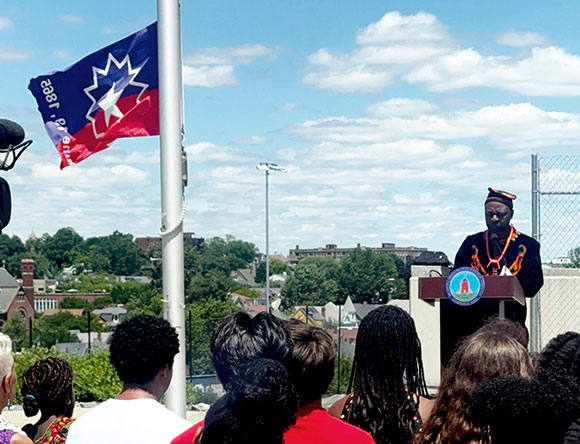
The City of Somerville invited all community members to the City’s annual Juneteenth flag-raising ceremony on Tuesday, June 16, on the City Hall Concourse. The following remarks were delivered by Councilor At-Large Will Mbah:
Good afternoon, everyone,
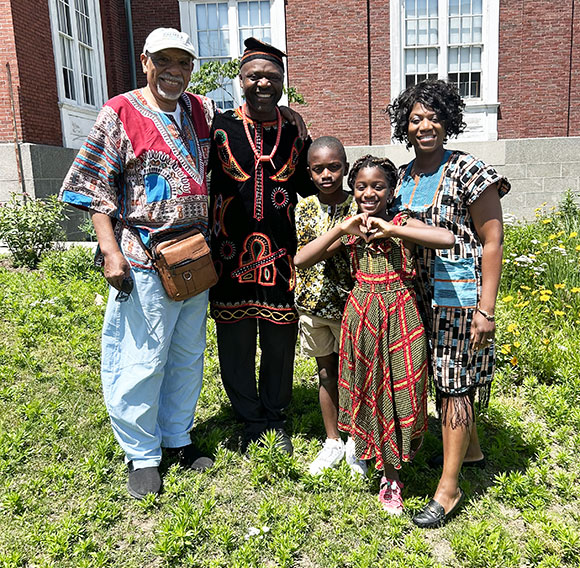
It is an honor to join you with my family as we commemorate Juneteenth, a day that marks both a celebration and a warning.
On June 19, 1865, more than two years after President Abraham Lincoln signed the Emancipation Proclamation, enslaved African Americans in Galveston, Texas, finally learned they were free. Juneteenth reminds us that freedom declared is not always freedom delivered. Rights written on paper do not automatically become rights realized in people’s lives.
As an immigrant from Cameroon, standing before you today, I feel a deep connection to this history.
I came to America because I believed in the promise of this nation, a promise that people are not defined by where they were born, the color of their skin, or the circumstances of their birth. Like millions before me, I was drawn to the idea that America is constantly striving to become a more perfect union.
But Juneteenth teaches us that progress is never automatic. It is won through struggle, sacrifice, and courage.
The history of Black America is often told as a simple story of oppressors and oppressed. Yet history is more complicated than that. Consider Anthony Johnson, a Black man who arrived in colonial Virginia as an indentured servant, gained his freedom, accumulated land, and later owned white and black slaves himself. Consider Robert Smalls, born into slavery, who courageously commandeered a Confederate ship to freedom, became a Civil War hero, and later served in Congress.
These two men represent very different paths. One adapted himself to an unjust system. The other dedicated his life to transforming it.
Their stories remind us that the struggle for justice is not about race alone. It is about power, morality, and choices. History asks each generation a question: Will we simply accept the world as it is, or will we work to make it more just?
That question is before us again today.
Across our nation, we are witnessing growing political polarization. We see efforts to divide Americans into opposing camps. We hear rhetoric that treats immigrants as threats rather than neighbors. We see anti-Blackness persist in new forms, from disparities in housing, education, health care, and criminal justice to attacks on honest discussions of our history.
Too often, fear is being used as a political weapon.
But Juneteenth teaches us that fear cannot be the foundation of a democracy.
The enslaved people who waited for freedom in Texas did not know when liberation would arrive. Yet they maintained hope. The civil rights activists who marched across bridges and sat at lunch counters faced violence and intimidation, yet they persisted. The immigrants who crossed oceans and borders seeking opportunity believed that tomorrow could be better than today.
Hope has always been America’s most powerful resource.
And hope requires action.
We honor Juneteenth not merely by remembering history but by continuing the work that history demands.
That means defending voting rights.
It means standing against racism, antisemitism, Islamophobia, and every form of hatred.
It means ensuring that every child, regardless of race, zip code, or immigration status has access to quality education and opportunity.
It means building communities where people can afford to live, work, and thrive.
It means rejecting the politics of division and embracing the politics of human dignity.
As an immigrant, I know that America’s story is not finished. As a Black man, I know that the journey toward equality remains incomplete. And as a public servant, I know that our future will be shaped by what we choose to do right now.
The generation that celebrated the first Juneteenth passed the torch to us.
The question is: What will we do with it?
Will we leave behind a society that is more divided, more fearful, and more unequal?
Or will we build a future worthy of those who fought for freedom before us?
I believe we can choose the latter.
I believe we can build bridges where others build walls.
I believe we can replace fear with understanding.
I believe we can create a City, a Common-wealth, and a country where every person belongs, and every person matters.
And so today, let us leave here with a commitment not merely to celebrate freedom, but to expand it.
Not merely to remember history, but to make history.
Not merely to honor those who came before us, but to become worthy ancestors for those who will come after us.
That is the promise of Juneteenth.
That is the work of our generation.
And together, that is the future we will build.
Thank you, God bless you, and Happy Juneteenth.

















Reader Comments