
Pages
Stay In Touch
More
© 2026 The Somerville Times. All rights reserved.

By Harry Kane
Water and sewer rates are rising across Massachusetts as a result of EPA-mandated infrastructure upgrades and operational costs. In the City of Somerville, both water and sewer rates are likely to increase by 15 percent this fiscal year.
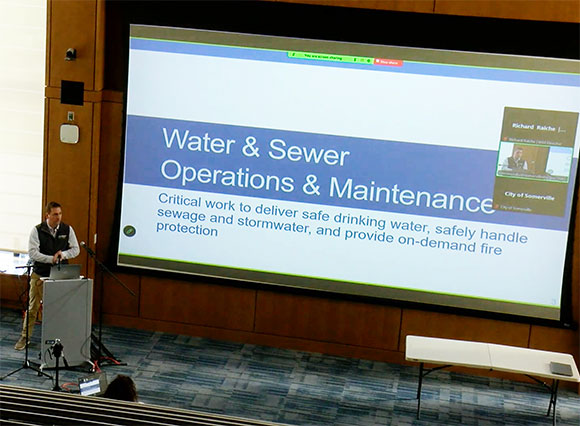
A public hearing was held on May 28 to present the FY 2027 water and sewer rate proposal and discuss the impending impact on Somerville’s system.
“This is critical work that our field teams deliver,” said Michael Richards, Director of Finance and Administration for the Department of Infrastructure and Asset Management.
A 15 percent increase to water and sewer volumetric usage charges is determined on actual consumption, but the base charges will remain the same static rate. Those charges are calculated by meter size.
At the hearing, Richards talked about the dedicated teams for both water and sewer, who are in the field attending to calls from constituents and monitoring water samples for contaminants. Their mission is to provide vital life-sustaining services that include delivering safe drinking water, safely handling sewage and stormwater, and providing on-demand fire protection.
There are 116 miles of water mains, 183 miles of sewer mains, 4,800+ manholes, 3,600+ catch basins, 1,600+ fire hydrants, and 29,000+ water and sewer connections.
Richards said a “substantial” part of Somerville’s sewer infrastructure is very old, which is resulting in rising maintenance and material costs.
After the initial presentation, Richard Raiche, Director of Infrastructure and Asset Management, spoke about the city’s capital investment plan, which is the primary driver for future rate increases.
About 90 percent of the pipes are over 50 years old and 70 percent are over 100 years old, he explained. “That gives rise to a couple different problems,” said Raiche.
Many of these old pipes pose a risk, he said, and with an outdated system, the city would fail to achieve regulatory and service goals. Addressing these concerns is now crucial to fulfilling regulatory requirements, improving the level of service, mitigating flooding, and reducing risk.
The city’s goal is to stabilize rates and make them predictable for ratepayers, he explained. Capital projects and the resulting debt service have become the primary driver for these rate hikes.
The debt service coverage ratio and the debt service-to-revenue ratio are closely monitored core financial metrics. “As we project out what our capital projects are, we have to keep those metrics within certain parameters for us to keep our bond rating,” said Raiche.
EPA-mandated infrastructure upgrades will aim to eliminate combined sewer overflows in order to protect waterways. The combined sewer overflow (CSO) control plan will cost an estimated $1.29 billion, according to the city. The large-scale infrastructure overhaul will include sewer separation, new storage tanks, and upgraded conveyance systems.
“The combined sewer overflow is going to be the biggest driver for sewer rates for essentially the next generation,” said Raiche.















Reader Comments