
Pages
Stay In Touch
More
© 2026 The Somerville Times. All rights reserved.

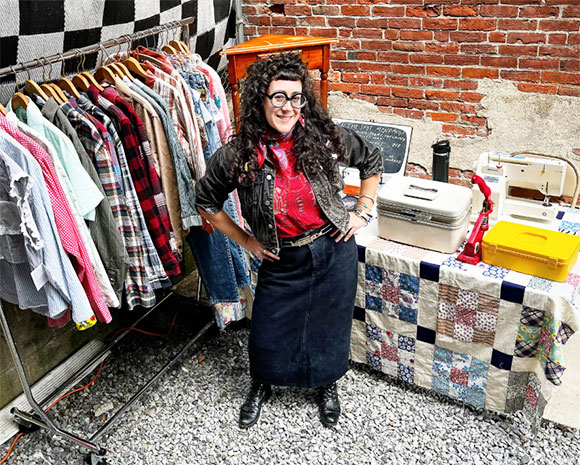
Jessamy Shay Kilcollins wants you to love your clothes, and she’s getting you there one garment at a time. — Photo courtesy of Jessamy Shay Kilcollins
By Regina Arana
Choosing to repurpose something instead of throwing it away sounds simple, but in reality, we would prefer to toss an old shirt and buy a new one instead. This consumerist culture has become a big problem today.
Jessamy Shay Kilcollins understands. She’s a textile artist and sustainable fashion designer from Somerville, Massachusetts, and her business is to give clothing a second life through her mending services, her amended upcycled clothing label, and the workshops she holds for people to learn how to do it themselves. It isn’t only a matter of putting a hole in your jeans. It’s a whole attitude of mind to how we relate to our possessions.
The problem with how we treat clothes
The truth is, 85 percent of all textile waste is sent to a landfill or incinerated. This amounted to approximately 17 million tons of clothing and textiles in the USA alone in 2018 (US EPA). A lot of items that people purchase, use a few times, and then throw out.
This was worsened by fast fashion. Brands learned how to turn garments into such low-cost items that it was simpler to replace them than to repair them. The world is moving so fast that whatever you purchased six months ago seems old already. The entire system is designed to make it easy for you to purchase, rather than wear. But Jessamy wanted to make a change.
What Visible Mending is all about
The idea of “fair mending” is a modern one. Traditionally, mending had one rule: you shouldn’t be able to see it. The practice of “visible mending” is the exact opposite. It makes the repair (and repairing) the center of the action. A patch of color made by hand, embroidery over a hole, and darning threads in several colors through a hole in a sweater. The only thing that matters is to see the repair.
Jessamy patches denim with vintage quilt fabric and/or old tea towel pieces. She fills in the worn areas with designs to make them look decorative. The completed work not only reminds us that it was fixed, but it looks like it got better. It’s got a bit more personality to it than when it left the factory.
That’s sort of the statement, right? If you see that something has been repaired, you are saying: “Yeah, that got worn down, and I cared enough to do something about it.” It’s not merely the purchase of new clothes that counts. It’s a new way of thinking about clothes.
She actually knows what she’s doing
Jessamy has a BFA in Fibers and a Certificate in Fashion Design from the Massachusetts College of Art and Design. So this isn’t just a hobby – she’s trained. She knows machine darning, hand embroidery, seam repair, and vintage garment restoration (using the right buttons and zippers for the era, which is a cool detail). Whatever your garment needs, she’s probably done it before.
She also makes her own one-of-a-kind pieces under the AMENDED label, creates textile jewelry and fabric collages from leftover scraps – basically, nothing goes to waste. And she co-owns High Energy Vintage in Union Square, Somerville, which also serves as a drop-off spot for mending clients.
On top of all that, she teaches. She’s run workshops at the Harvard Art Museums, the Farnsworth Art Museum, Patagonia, and the Boston and Cambridge Public Libraries. Because if you really want to make a dent in textile waste, you’ve got to get more people knowing how to fix their own stuff.
Why it actually matters that you love your clothes
The things that show up at Jessamy’s mending table aren’t just random garments. They’re pieces people are attached to. The jeans that fit perfectly, the sweater you’ve had forever, the vintage find you were so excited about. These things mean something to the people bringing them in.
When she repairs one of those pieces, she’s not just fixing fabric. She’s helping someone hold onto something that matters to them. Fast fashion basically trained us to think that’s irrational — why fix it when you can just buy another one? But that question misses the point. The value of something isn’t just what it costs to replace. It’s also what it means to you and how long you’ve had it. She puts it pretty simply: “If you loved it enough to buy it, love it enough to keep it in your closet.”
The bigger picture
Mending alone isn’t going to solve the fashion industry’s problems. The issues are big, systemic, and global. But what Jessamy does matters anyway — not just because it keeps clothes out of landfills, but because it shows people a different way of thinking.
You can have a relationship with the things you own. You can choose to fix instead of replace. You can value craft and skill and the story a garment carries. Those aren’t radical ideas, but somehow they got buried under decades of cheap, disposable fashion. Jessamy is digging them back out, one mend at a time.


















Reader Comments