
Pages
Stay In Touch
More
© 2026 The Somerville Times. All rights reserved.

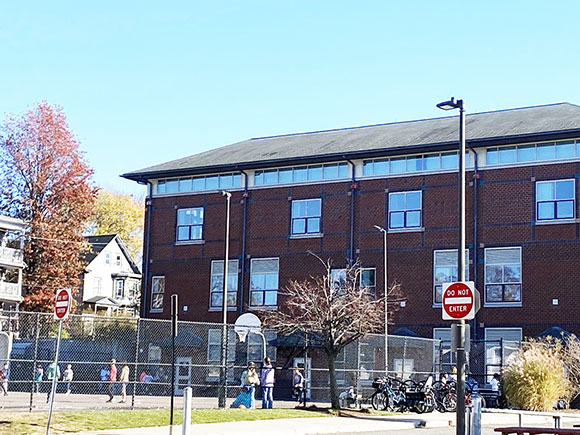
Funding appropriations for the Kennedy Schoolyard Renovation Project were approved at the latest meeting of the Somerville City Council.
By The Times Staff
The Somerville City Council meeting on February 26 included funding appropriations for the Kennedy Schoolyard Renovation Project.
Mayor Wilson’s request for the appropriation of $1,000,000 from the Community Preservation Act Open Space Reserve for construction of improvements to the Kennedy schoolyard was voted on and approved by attending members of the City Council.
An additional request by the mayor for an appropriation and authorization to borrow $2,000,000 in a bond for financing a portion of the Kennedy Schoolyard Renovation Project,
as recommended by the Community Preservation Committee, was likewise approved.
Finance Committee Chairman Councilor Ben Wheeler spoke of the appropriations as part of his report on the latest Committee meeting said, “We recommended approval for two distinct items for the Kennedy schoolyard, a $1 million appropriation from the Community Preservation Committee and a $2 million bond. The cost covers an expanded school yard that will have numerous elements of accessibility for the full student body of all the academic programs at the Kennedy, as well as an extensive stormwater parking lot and surface permeability work that will count towards the city’s overall burden of stormwater mitigation.”
Wheeler elaborated further on the funding, saying, “The intention is to solicit contractor bids for this project soon, and to complete a first phase of this work during the summer recess this year. I’m excited. And regarding public safety, we considered a series of items that involve grants. After consultation with city staff and discussion on the committee, the committee was satisfied that these grants are in line with the city’s values and the law.”
Also taking place that same evening, the Kennedy School Playground Renovations Community Meeting was held virtually, covering the project overview and key goals, proposed design and phasing activities, followed by questions and discussions involving anyone who joined the meeting.
Attending the presentation were City of Somerville Department of Public Space and Urban Forestry Senior Planner Jon Bronenkant, Ward 5 City Councilor Naima Sait, and Kennedy School Principal Steve Marshall. Representing CBA Landscaping Architects LLC were Principal-in-Charge D.J. Chagnon, Landscape Architect Preston Hollman, and Landscape Designer Chaitrali Doke.
In the presentation, the project was explicitly framed as Somerville’s first inclusive playground, going beyond ADA and universal design to full inclusive design. All ages, all abilities, all along social/communication spectrums. Shared play, not segregated “special” equipment.
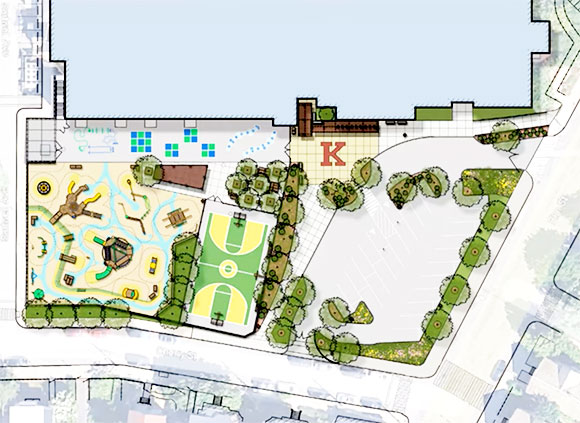
John F. Kennedy School overall site plan. ~ Graphic courtesy of CBA Landscape Architects LLC
Phasing for play
Phase 1 (Summer 2026):
Keeping most existing play space open, plus the addition of a new full basketball court in its permanent location, with temporary asphalt and line striping.
Phase 2 (Summer 2027):
Building of the fully inclusive playground with all permanent surfacing, equipment, fencing, and seating.
Final layout plans include:
A court placed at the bottom-right corner of the site to:
Three hoops total:
Adjustable hoops:
Strong interest from the community was noted. The team was aid to be actively investigating durable, adjustable, or semi‑adjustable options.
Treatment of the wall
Decision to fully “activate” the wall:
Play equipment mix
Intentional mix of play styles:
Swings and motion
A decision was made not to install traditional swings (belt, adaptive, dish/friendship swings) due to:
Motion and vestibular play will be provided instead by:
Group spinner.
A 4‑foot-high embankment mound with:
Ramped access along a gentle path with play events along the route.
Sensory and social inclusion
Planned inclusive/sensory elements include:
Seating, shade, and gathering
Modular seating blocks (“Lego” style, fixed in place):
Shade structures:
One larger plaza shade canopy:
Stormwater and play environment
Use of light-colored coatings (e.g., white or light-toned under playground graphics) to:
Ongoing inclusive design process
Decision to continue working with:
Goal: refine final choices of equipment, surfacing patterns, communication supports, and detailed layouts so the playground functions equitably for all users once built.
Questions and discussion by those in attendance followed the presentation.
The full meeting can be viewed on YouTube at: https://www.youtube.com/watch?v=jOGVLdwdctU&t=1196s.

















Reader Comments