
Pages
Stay In Touch
More
© 2026 The Somerville Times. All rights reserved.

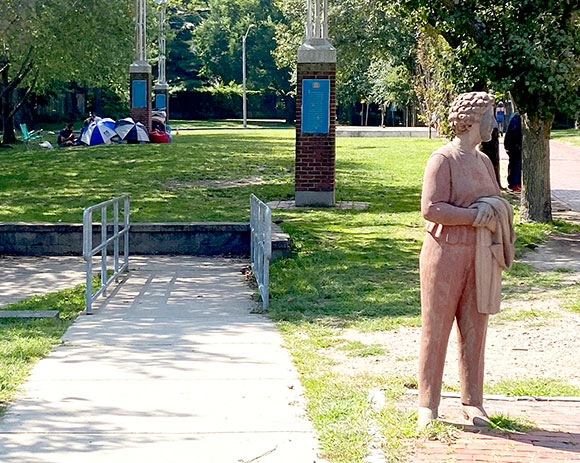
Homelessness and public safety in the Davis Square and Seven Hills Park areas were the topic at a public meeting held on October 6. ~Photo by Bobbie Toner
By Jordan Pagkalinawan
Dozens of residents joined Mayor Katjana Ballantyne, Deputy Police Chief Jim Donovan, and other city leaders inside the Somerville Community Baptist Church on October 6 to discuss concerns over homelessness and public safety around Davis Square and Seven Hills Park.
In her opening remarks and during a “Frequently Asked Questions” section, Mayor Ballantyne said the city has followed “evidence-based” practices in assisting the unhoused population around Davis Square, which include a “core compassion” for all residents without tolerating violence. The city has also worked with numerous public health services and nonprofits, including the Somerville Homeless Coalition, to assist in providing resources and shelters to the unhoused, as well as monitor and clean up trash and needles in Davis Square.
According to Ballantyne, the city has hired three outreach workers to patrol Davis Square, added a social worker in the library, and continued operating an overnight winter warming shelter. Over the last year, the Somerville Homeless Coalition has found 65 people permanent housing.
“We also have close to 800 housing units in the housing pipeline, including affordable housing units, which is critical because housing first is the absolute best practice for addressing homelessness,” Ballantyne added. “These are all resources that lay a foundation for better addressing the root causes of this challenge in a lasting way.”
However, the mayor also acknowledged the issues that have come with a rise in homeless populations—including a five-year jump in the Commonwealth from 33,000 to 56,000—and abrupt cuts to federal funding, which caused the 58-bed Transition Wellness Shelter in Cambridge to shut down in June. A lawsuit against the Somerville Homeless Coalition’s expanded overnight shelter has further complicated matters.
The Somerville Police Department has also stepped up patrols around Davis Square, engaging in direct patrols, park walk-and-talks, and business and citizen contacts—all of which have increased significantly. According to Donovan, there were more than 2,500 patrols over a three-month period in the summer, leading to around 24 patrols per day. Donovan added that SPD works closely with community outreach partners, communicating concerns and writing up weekly reports about activity in Davis Square, mainly regarding “non-violent calls for service.”
Donovan also discussed concerns over drug dealing in the area, adding that narcotics detectives frequently patrol the area and take action when needed. However, as Donovan says, the city cannot “arrest ourselves out of the situation.”
The community also heard from Steve Craig, the city’s Director of Constituent Services, who oversees the city’s 311 program. Craig noted how the Department of Public Works has actively monitored Davis Square for trash and needles, cleaning trash cans three times a day and removing needles nearly every business day. Among the city’s efforts toward the latter, Somerville installed a first-in-the-nation dual sharp disposal container.
“The top drawer is for syringes and sharps, with the bottom drawer for containers and other related items,” Craig said.
Chief of Staff Nikki Spencer addressed concerns regarding encampment sweeps and the removal of belongings. She said that sweeps—unless they are carefully planned—are counterintuitive and “not necessarily an effective strategy” since they can “prolong homelessness,” with individuals losing items needed to stay safe or documentation that gets them closer to finding permanent housing.
Spencer said that belongings could be removed if they pose concerns to public safety, such as being close to a playground or heavy machinery. In those cases, the city will work with community partners to store items in city buildings and later return them to the individual.
“This is an ongoing process to improve these protocols,” Spencer continued, “and make sure we have clear coordination and communication across all partners.”
An open question-and-answer session followed the leaders’ remarks, featuring tense moments between community members and city leaders. Residents echoed public safety concerns while recounting late-night confrontations with unhoused individuals. After initial confusion about why the homeless couldn’t be arrested for trespassing, as was the case at one woman’s apartment complex, Donovan clarified that arrests could be made if they violated specific “no trespassing” signs put in place.
Some business owners criticized the mayor’s office and police department for a lack of action, claiming the mayor’s office has the department’s hands “tied.” The inaction led to some businesses choosing not to call the police when homeless individuals were causing disturbances near their doors.
In response, Ballantyne invited the city’s two mayoral candidates, councilors Jake Wilson and Willie Burnley Jr., to discuss their ideas for addressing public safety. While both of them said they didn’t want to turn the meeting into a campaign event, Burnley mentioned the Municipal Industrial Financing Authority, “which I don’t think the city’s used enough of. That’s something where we can actually help fund some of these shelters, help people get off the streets more quickly.”
Ballantyne also emphasized the city’s approach of giving people “a place to go” before guiding them toward available resources and developing their relationships with community partners.
Donovan stressed the need for community members and businesses to “call us,” adding: “We base everything on calls for service. So it really bothers me to hear the apathy that bothers me. … I want to hear that, especially from our businesses in Davis Square, because that is the lifeblood.”
“I will communicate that to my officers to stop in,” Donovan added. “And please tell your managers, residents, call the police department. It may seem like we’re not doing anything, [but] please, please, please call us.”
Despite various calls to extend the meeting, the session ended just after 7:30 p.m., with some city leaders staying afterward to answer further questions from community members.


















Reader Comments