Pages
Stay In Touch
More
© 2026 The Somerville Times. All rights reserved.

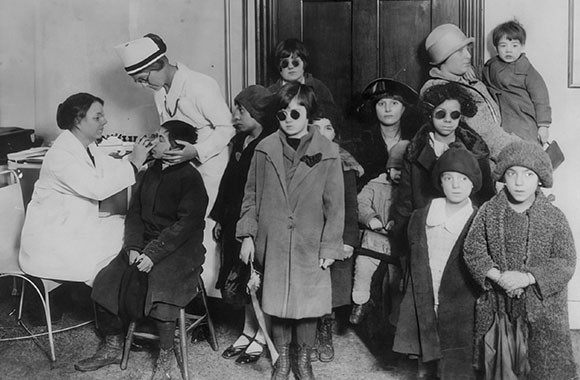
Maud Carvill examining patients in 1923 at her clinic. — Photo courtesy of Massachusetts eye and ear social portals
By Annamarie Hoey
On October 26, 1915, Somerville’s campaign for women’s suffrage had thousands of signatures behind it. The Somerville Equal Suffrage League, led by Dr. Lizzie Maud Carvill, reported that between 4,000 and 5,000 voters had signed a statement supporting women’s right to vote. Its members were going house to house, asking their neighbors to help change who could participate in democracy.
This October 26 marks 111 years since that campaign report, recounted by historian David Dismore in Ms. magazine. It is an opportunity to remember the Somerville woman who helped lead that work, and to consider how Somerville will preserve her name.
I began researching Carvill in middle school, searching newspaper archives and assembling a presentation for Somerville’s Memorialization Committee. The clippings revealed a woman whose work reached across medicine, education, and civic life.
Carvill grew up on Bow Street in Union Square. She earned her medical degree from Tufts in 1905 and became the first woman on the professional staff of the Massachusetts Eye and Ear Infirmary in 1914. She specialized in ophthalmology, including the treatment of children’s eye diseases.
An earlier chapter of her career offers another glimpse of her outlook. She taught physical training at Tufts; a 1909 course description listing her as an instructor included “fearlessness” among its goals.
Her public life gave that word particular resonance.
The suffrage campaign required persistence. Despite its organizing, the proposed Massachusetts suffrage amendment lost at the polls on November 2, 1915. The Somerville Journal reported that it had lost in every precinct in the city.
The Nineteenth Amendment was ratified in 1920, prohibiting the denial of voting rights based on sex, although racial discrimination continued to keep many women from the polls.
Carvill’s civic work continued. A 1922 newspaper notice announced a League of Women Voters meeting at her home at 28 Highland Avenue. Later notices recorded discussions of child labor and public health. Her home was a place where neighbors gathered to consider the responsibilities of citizenship.
Today, there is a path toward recognizing that legacy publicly. In a recent telephone conversation, Jesse Moos, the mayor’s public liaison who has staffed the Memorialization Committee since 2020, confirmed to me that Carvill had been approved for memorialization. He said that only the selection of a site remains.
Choosing that site would give residents a lasting way to encounter her story. A name on a public place can prompt a child to ask who someone was. It can lead a neighbor to discover that the struggle for voting rights once unfolded along familiar streets.
As Somerville considers where to honor Carvill, I hope this anniversary brings her work renewed attention. She helped women claim a place in public life. Giving her name a place in the city would help future generations understand how that change was made.