
Pages
Stay In Touch
More
© 2026 The Somerville Times. All rights reserved.

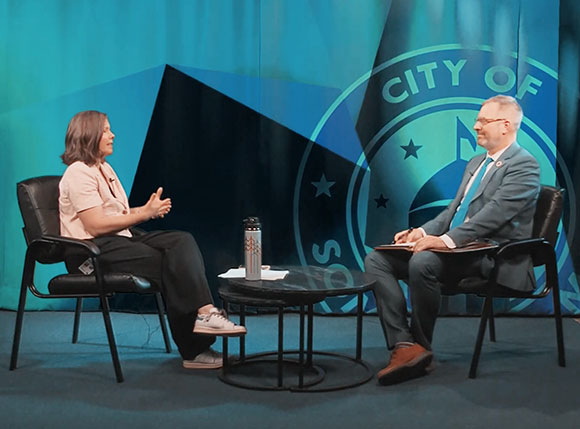
Mayor Jake Wilson welcomed Senior Urban Forestry and Landscape Planner, Dr. Vanessa Boukili, to a recent episode of “Open Door Chats” to discuss Somerville’s canopy cover.
By Harry Kane
Planting more trees and expanding the canopy cover in Somerville was the focus of a recent episode of Open Door Chats hosted by Mayor Jake Wilson.
The mayor sat down with the city’s Senior Urban Forestry and Landscape Planner, Dr. Vanessa Boukili, to learn about the work that is being done to increase the canopy cover, which in 2018 was 14.6 percent. The city’s goal is to increase the canopy cover to 16 percent, explained Boukili.
“We have to remember we’re the densest city in New England, so we are limited to where trees can go,” said Boukili. “We think this is a reasonable and attainable goal that will increase the spread of our urban forest canopy cover.”
Boukili, an ecologist and certified arborist, has been with the city almost 10 years now, and she leads the three-person team, referenced by The Boston Globe as the “Tree Amigos,” who work collaboratively to manage Somerville’s urban forest.
New data collected in 2024 provides the public with the species, location, and size of each tree, she said.
When looking at a map of trees, it becomes clear that there is a “tree equity gap” from one neighborhood to the next.
Ward 1 has an 8 percent canopy cover while Wards 6 and 7 have a 20 percent canopy cover. “So, there is a huge disparity,” she said. And finding places to plant trees in East Somerville has been challenging.
Boukili said climate change is another factor affecting tree health, which may be creating “stressful conditions” for trees in the city.
As well, pests and invasive species, such as the emerald ash borer, found in 2018, had a major impact on all ash trees. “We’ve been proactively treating our healthy ash trees to keep them around.”
Survive and Thrive
The team plants at least 350 trees per year and divides the planting into two different seasons, spring and fall.
“We want to put the right tree in that can survive in the long run and thrive,” said Boukili.
Planting contractors will plant and maintain the tree for two years. The most important thing for new trees is to get enough water. Green irrigation bags that hold 20 gallons of water with holes at the bottom provide a deep soak to the soil at the base of the new trees.
“Filling up the gator bag one time a week from a resident can really make or break the tree’s health,” said Boukili. “We do have the tree watering for two years from our contractors, but after that they’re kind of on their own, so we encourage people to water.”
Weeds growing out of tree wells can be competing for water resources that are already limited for the tree, so if residents want to help by weeding tree wells, that would be much appreciated, she explained, but the team wants residents to make sure intentional plants aren’t weeded out.
Residents can sign up to adopt a tree officially through the city’s adopt a tree program that the urban forestry committee designed.
Building Biodiversity
The Callery pear tree is the most common species just after the Norway maple.
“We definitely work to increase the species diversity across the city and within each street,” said Boukili.
An urban forestry rule, explained Boukili, is never to plant more than 10 percent of any one species, 20 percent of any one genus, and 30 percent of any one family. “That sort of gives you some resiliency if there is an issue.”
The city aims to plant a diversity of species with 20 to 30 different species every planting season.
Boukili’s favorite tree right now is the Kentucky coffeetree. It grows large and provides a lot of shade. But in the colder months, she said, “It looks kind of weird and gangly in the winter when it loses its leaves. It looks kind of like a Dr. Seuss tree, especially when it’s young.”
















Reader Comments