
Pages
Stay In Touch
More
© 2026 The Somerville Times. All rights reserved.

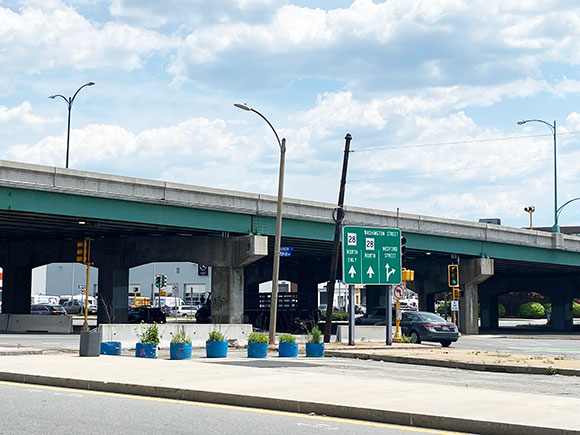
Somerville’s Pedestrian & Transit Advisory Committee recently weighed in with its suggestions on the McGrath Boulevard project. — Photo by Bobbie Toner
By Harry Kane
Enthusiasm is building among motorists who look forward to MassDOT’s McGrath Boulevard project, which aims to transform Route 28 from an elevated highway to a ground-level boulevard, but feedback from Somerville’s Pedestrian & Transit Advisory Committee surrounding specific details in the design of the project has City Councilors expressing a desire to create a consensus among stakeholders to reduce confusion when communicating with state officials at the transportation department.
Lawmakers on January 8 expressed support during the Somerville City Council meeting for the project slated to start in 2028, basing their comments on Somerville’s mobility staff recommendations from a comment letter.
“There are some areas where there is a trade-off between the convenience of drivers from outside Somerville and the safety of Somerville residents,” said At-Large City Councilor Ben Wheeler, citing specific crossings and places where children play.
With the construction of the new boulevard project, the McCarthy Overpass will be demolished, and the new street-level multimodal boulevard will reconnect neighborhoods, including Union Square, East Somerville, Prospect Hill, Winter Hill, and Brickbottom, from Broadway to Third Street in Cambridge.
Councilor Wheeler said he would like to begin a conversation with City Councilors to focus on areas of refinement for the project.
MassDOT held an Open House meeting on December 4 and a 25 percent design level hearing on December 9. PTAC held its meeting on December 18 and drafted the recommendation letter that City Councilors were discussing.
“There are a lot of people who have really important feedback,” said Ward 3 City Councilor Ben Ewen-Campen. “What we really need to do is speak with one voice.”
When speaking with a state agency like MassDOT, he says having a unified response is better than having multiple opinions coming from various parties.
“I’m looking forward to having this conversation in traffic and parking with the mobility department, who have a lot of expertise working with state agencies,” said Councilor Ewen-Campen.
PTAC submitted the comment letter on January 5 to the McGrath Boulevard project team, expressing “unequivocal support for this once-in-a-generation project” and calling the current McGrath Highway “one of the deadliest corridors in Somerville.”
At the top of the list of recommendations, PTAC would like MassDOT officials to reinstate the full signalization at the Otis Street intersection.
“We are exceptionally grateful for the work you have done to propose a raised crossing at Otis Street, but are concerned not to have the added layer of signal-based protection at such a vulnerable intersection,” as stated in the letter.
The full signalization has now been changed to either the Rectangular Rapid Flashing Beacons (RRFB) or HAWK beacons under the current 25 percent design.
“I do not like HAWK lights at all,” said Ward 4 City Councilor Jesse Clingan. “Especially not for there.”
At-Large City Councilor Jon Link and Ward 2 City Councilor J.T. Scott both agreed that the proposed HAWK signal at the Otis Street interstation should be reverted back to full signalization, like in an earlier iteration of the plan.
Councilor Scott kidded that HAWK signals are one of his favorite topics of discussion, and added, “I was told it was too late to make a change, but I’m going to keep holding on to Councilor Niedergang’s advice: ‘It’s never too late to correct a mistake.’”
“If reinstating full signalization at Otis Street is impossible, we encourage the project team to consider narrowing the corridor to a single lane approaching Otis Street in both directions,” the letter explained.
Additionally, the PTAC team asks for a 25-mph speed limit instead of the selected 30-mph speed limit. They would like to continue working to shorten the distance between crossing segments at Cross Street, consider further reductions in the median width to support wider sidewalks, and ensure the design is flexible enough to support future north-south bus service.
















Reader Comments