
Pages
Stay In Touch
More
© 2026 The Somerville Times. All rights reserved.

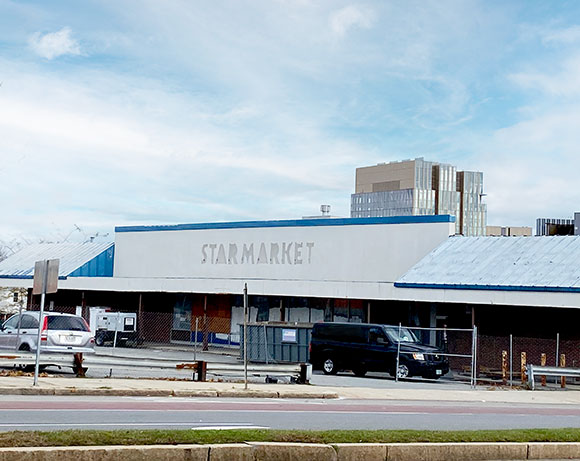
136 affordable housing units are slated to be constructed at 299 Broadway, the site of the former Star Market. — Photo by Bobbie Toner
By The Times Staff
The housing affordability crisis in Massachusetts is a growing challenge and a hot-button issue. Home prices are rising much faster than incomes. The shortage in affordable housing is a result of restrictive zoning laws, lengthy permitting processes, and high land and labor costs.
Mayor Katjana Ballantyne presented the city’s plan to create more affordable housing in the years to come at a Somerville virtual community meeting on October 14 for all city wards.
“It’s no surprise to any of us in Massachusetts that we are in the midst of a housing crisis,” said Mayor Ballantyne.
Median home prices are rising much faster than incomes. Home prices in Massachusetts rose 73 percent from 2000-2024, while household income rose only 4 percent during the same years when adjusted for inflation, according to Zillow and reported by the Massachusetts Executive Office of Housing and Livable Communities.
Households in Massachusetts spent nearly 40 percent of their take-home pay on their rent or mortgage. For residents in Somerville, just under 20 percent spend over half their income on housing, explained the mayor in the presentation.
“That means that over 7,000 Somerville families are one emergency away from displacement,” said Mayor Ballantyne.
While job creation draws workers to Somerville, there isn’t enough housing to meet the demand.
The housing crisis in Massachusetts is driven in part by a significant disconnect between the rapid rise in home prices and the stagnant growth in incomes, leaving many Somerville residents housing burdened and at risk of displacement.
“The need for housing is a statewide issue,” said Mayor Ballantyne. “Massachusetts needs 222,000 new homes by 2035 to meet the demand, according to the state data.”
Key takeaways
Somerville is purchasing homes with nonprofits through its Inclusionary Zoning Program and the Affordable Housing Trust Fund to create and preserve affordable housing units. The Somerville Community Corporation and Somerville Community Land Trust work to fund these efforts.
The city launched the Consolidated Rental Waitlist to streamline the application process, which means a single application can be submitted for many of the inclusionary rentals.
Somerville has close to 800 new housing units in the direct pipeline, said Mayor Ballantyne.
The Community Preservation Act funding doubled from $3 million to $6 million per year, and of that, 55 percent goes to affordable housing initiatives.
There will be 319 units, including 136 affordable units at 299 Broadway, the site of the former Star Market in Somerville’s Winter Hill neighborhood.
“In August, we adopted the Assembly [Square] Neighborhood Plan, which aims to create between 3000-5700 new housing units, of those roughly 600-1100 will be affordable apartments,” said Mayor Ballantyne.
The City of Somerville Anti-Displacement Task Force developed programming and policy recommendations to reduce the displacement rate in Somerville. As of June 2025, the city has put more than $5.6 million into direct rental assistance, serving 892 people across 677 households.
“As we build and preserve housing units, we need to ensure access for people who need them most,” said Mayor Ballantyne. “Our inclusionary housing program is one of the strongest tools we have for that.”
Any new building with four or more units must set aside 20 percent as affordable, said the mayor. Since 2021, some 500 new affordable homes have become available as a result of this policy.
Housing for older adults is a top priority for the Ballantyne administration. The Older Adult Bridge Subsidy Campaign is a pilot program that was launched to help vulnerable, low-income older adults.
“Given the gap between the escalating rents and the fixed income of many older adults, it was clear that additional resources and creative thinking were needed to prevent their displacement,” said Mayor Ballantyne.
The City of Somerville’s Office of Housing Stability’s Municipal Voucher Program provides rental assistance to the most vulnerable, low-income families who aren’t eligible for federal or state support. Participating families’ rent and utility costs are capped at 30 percent of their income, with the voucher covering the remaining costs.
The mayor said that Somerville’s advocacy efforts have secured important policy changes to address the housing crisis, including greater tenant protections.
“We helped pass the Affordable Homes Act,” said Mayor Ballantyne.
The Affordable Homes Act, signed into law on August 6, 2024, was a $5.16 billion bill that authorized spending over five years and is the largest investment in housing in Massachusetts history.
A statewide coalition was formed in support of a bill to allow cities such as Somerville to enact a local real estate transfer fee on high-value properties that could potentially raise $6-10 million per year to fund affordable housing, explained the mayor.
A rent stabilization home rule petition, recommended by the Anti-Displacement Task Force, was sent to the state legislature. The legislation proposed a yearly cap on rent increases limited to the rate of inflation plus 2 percent, totaling no more than 5 percent in any year.
“We’ve invested in a historic level to advance housing affordability and stability goals, a total of roughly $62 million in three years,” said Mayor Ballantyne.
















Dear Somerville Times Staff,
Thank you for this interesting article and highlighting the work of Somerville Community Corporation to support housing in our City of Somerville. One of the questions that I get asked a lot and which is not covered by this article is: what is affordable?
We should start with the premise that Somerville only has 8.93% of the 10% Subsidized Housing Inventory (SHI) that is required by Massachusetts State Law, so we are significantly lagging behind.
Additionally, private housing development is focused on smaller 1-2 BR units that are supporting the new demographics of Somerville that are younger, college educated and have a significant higher income than families that have long resided in Somerville and are being displaced and gentrified out of the city.
But then, there is the inequity of the system that bases “affordability” on the percentage of the median income of the city that it resides. The current Median Income in Somerville for a household of 4 is $160,900, so in order to qualify for “affordable” housing which are units at less than 80% HUD Median Income, your income needs to be below $132,300 when in reality families are making significantly less than that.
So while the state designates affordable as units that are less than 80% HUD Median Income, it is important that we know who those units are really targeting and whether or not the families that are receiving are going to continue the displacement of what existed in Somerville.
Either way, we are very appreciative that you keep supporting the work of housing, but wanting to make that distinction for the future.
Cheers,
Gonzalo