
Pages
Stay In Touch
More
© 2026 The Somerville Times. All rights reserved.

 *
*
Recently, I caught up with Somerville poet Michael Franco. Michael Franco is a poet, playwright, and artist. His publications include: The Marvels of David Leering (Pressed Wafer 2017), A Book of Measure Volume One: The Journals of the Man who Keeps Bees (Talisman House 2017), How To Live (Zoland, Cambridge, MA 1998). He was the founder of the Word of Mouth Readings Series in Cambridge, MA, and was a board member for the Pioneer Valley Poetry Festival. He is currently a Visiting Writer for the University of Coimbra, Portugal, and curator of the Xit The Bear reading series in Somerville, MA.
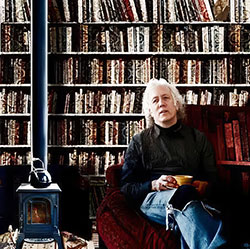
Doug Holder: How has it been for you as a poet and writer living in Somerville?
Michael Franco: I got lucky in our move to Somerville. It has given and allowed me to construct a sense of place, always missing from my Navy Brat life. I have now lived here longer than in any of the residences my parents and I had. We moved 11 times before I graduated high school. In 5th grade I went to 3 different schools. Somerville has been a grand location to work in, raise a child in, and to attempt acts of community in.
DH: Tell me about the genesis of your the XIT The Bear Room Series. Your first readers were William Corbett, Fanny Howe, and Gerrit Lansing. All have passed, Howe most recently. What kind of legacy did these poets leave? Who did you identify with the most?
MF: The new reading series, Xit the Bear: Readings in The Press Room, was planned before we started looking for a home in the late 90’s. I wanted to create a space, away from a campus, library or bar, that might be inviting for writers to read in and so then to respect the readers and their work and the audience as well.
I ran the Word of Mouth Series in Cambridge for close to ten years, in the Henderson Carriage Building beneath Tapas restaurant at 2067 Mass Ave., 1987-95 and then at various locations until ‘97, Originally with artist Katha Seidman who lured the artists – who were shown with each reading – and Andrea Stover who read manuscripts with me and dealt with the bar. Over the years Joseph Torra and Angie Mlinko would follow her on the bar, each in their way essential to the atmosphere created. But it was always by the generosity of Polly Guggenheim and Glen Matsura who handed me the downstairs bar to use for free on Sundays. We had a great run, Readers from Bill Corbett to Diane di Prima and Robin Blaser, Nathaniel Tarn, Lee Harwood, David Rattray, Kenward Elmslie, CD Wright nd Forrest Gander, Fanny Howe of course, Nate Macke, Ken Irby and Robert Creeley; basically everyone I could hope for in between. I did afternoon readings of Stein and Spicer texts which I scored for the voices of poets whom I admired, plays, a text built from the combined correspondence between Olson, Creeley and Cid Corman (Bill Corbett reading the Olson part) held benefits and hung art by local artists.
I even convinced Mike Mazur to hang reproductions of his Dante prints when Robert Pinsky read (and wonderfully) from his then new Translation. Bill Corbett recorded his grand book On Blue Note for Cambridge’s Zoland Books and Roland Pease down there. But it all hinged on the restaurant and when they closed up we got maybe two weeks notice. The last reading was a jazz band made up of Clark Coolidge and David and Tina Meltzer with Andrew Schelling and Anne Waldman the week before – it was a grand place to stop – but it left a lot hanging and I vowed a better place if there was a next time where only I could pull the plug.
In projecting a new series I wanted to both continue my original proposal for Word of Mouth which I kept calling “an Oral Magazine” that I was editing and a “A Place to Practice.” But I wanted now to be in control of the space and to make it a place in the imagination where one might actually want to read sans Saturday Night’s stale beer overtones! So the Press Room was built in our former Somerville Garage (slightly delayed by the joyous intrusion of our son’s birth and life). I started putting away $25 a week from tips so that eventually I could actually pay the readers, and from that the Xit The Bear reading series emerged which takes place there along with other events (Somerville poet and filmmaker John Mulrooney recently brought his Rusty Doves band in for a small and wonderful show and I have the occasional writer in residence out there.
All of this I have to say (to get back to your actual question) was grounded by Bill Corbett (who I describe nowadays as a silent partner to the first series (a concept which would make him flinch I think), but Bill sent people my way whom I would not have been in touch with and Bill respected what I was doing, even if he disagreed with it, because he sensed my intention at work, and he never complained if I took a pass on a writer. He was indeed Word of Mouth’s and Xit’s first reader: Solo at Word and then for the Xit reading I paired him with Gerrit Lansing as an Opening.
At Xit putting him up with Gerrit Lansing was a conscious declaration of the poetics of the series: No Masters no manifestos, as indeed lift had quietly proposed: Just Poets of deep commitment, at work at the height of their capabilities… whose example was boundless Curiosity and Joy – Nothing more nothing less:
DH: You were involved with the Somerville based Lift Magazine, founded by Joe Torra. Can you tell us about the germ of the idea that started this? What was unique about this publication?
MF: As to what was “unique” – nothing! It was a magazine without funding or any institutional authorizations made at a dining room table (the early covers were printed on my big hand press by myself with the artists present and instructing me), and the Xeroxed pages were hand sewn by the editors (this before it was taken glossy). And I think that was its most important mark. Anyone with the time and energy can do this. You don’t need a university or a patron or any other authorization, you need people to gather together and make it. And the energy from this act will in turn start a circulation. The good or bad or “importance” or “uniqueness” of it have little to do with the act of making it, which is the genuine gesture.
DH: In an article I read, your community involvement was fostered by the Grateful Dead. Please explain.
MF: That was not so much the Dead as it was Bill Graham who ran the Fillmore West Ballroom in San Francisco in the 60’s and who I clearly saw even at 17 as creating the sense of place I was talking about earlier and which brings us back to Composing the life in which we are living.
What I learned from the energy centers of Bill Graham or The Grateful Dead was to respect those other energy centers at work around us. Out of going to Dead shows in the period I was exposed to Bach, Jazz, Blue Grass, Blues, New Orleans jams Bakersfield Country, experimental music and so on and wonderfully on. All on the basis that it was a sincere music. Graham did the same thing (Miles Davis whom I had barely heard of billed with the Dead for example). All of this was the community at work around us. All of this equalized the form(s) being pursued and actively so by people slightly older than I was. One had the sense that you should “know” (which so deeply instilled in me wanting to know), while being repeatedly schooled that there was so much grand creating going on around us that we had no notion about. Rolland Kirk, Virgil Fox doing a night of Bach and so on and on. It was a magnificent gesture of Inclusion and that inclusion started a circulation of creative intents and joy which I am still chasing.


















Reader Comments