

Pages
Stay In Touch
More
© 2026 The Somerville Times. All rights reserved.


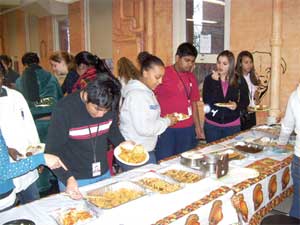
Somerville students celebrated Thanksgiving in worldly fashion Tuesday as they enjoyed a Thanksgiving lunch with delicacies from around the world, including Brazil and Asia, at the Cowboy Cafe inside Somerville High School. |
||||
| Support families in Union Square Dear Editor, I What are the stakes here? Neighborhoods surrounding The proposed zoning plan does Appropriate It has taken 150 years to create Please join me on Dec. 4 and together we can save our Somerville. -Adam Rich Readers are invited to send letters to the editor to The Somerville News. Please email your letters to News@TheSomervilleNews.com or mail them to 21A College Ave., Somerville, Mass., 02144. The Somerville News Reserves the right to edit letters for style , grammar and length. All letters must include an name and contact information. Contact information will not be shared with the public.. We look forward to hearing from you. |
|
| City must help Union Square biz grow
To the people of Somerville, Picture Union Square can be all The Board of Union Square Main Streets is For the past four years, our organization has worked Helping Union Square recapture its status as a thriving For decades Somerville has failed in many of its Union Square, once our Now, • • Historic architecture and In-Fill • • • Affordable & Additional • Community Health РMore intense Over the last four Because The new zoning proposal will remove these barriers, While The zoning proposal before the Board Additional strategies beyond inclusionary For too long, it's been Sincerely, The Board of Directors, Union Square Main Streets
|
|
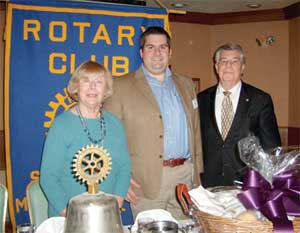
Rotary president Phillip Cantor, Kiwanas president Ellen O'Brien and Lions president Tim O'Malley presented contributions to charities such as Project Soup, Somerville Homeless Coalation and CASPAR as part of Tuesday's Thanksgiving lunch at the Mount Vernon. |
||||
Kudos to the cast of characters responsible for the Arts Armory on Highland Avenue. Joseph When the brothers bought the Instead of Thank you Sater brothers, for enhancing the Somerville community with your project, instead of just capitalizing off it. And This is how it's supposed to be done. Let's use this experience as a model for future projects in residential neighborhoods. |
|||
By Mary Jo Rossetti – School Committee – Ward 7
(The
opinions and views expressed in the commentaries of The Somerville News
belong solely to the authors of those commentaries and do not reflect
the views or opinions of The Somerville News, its staff or publishers.)
The following is Ward 7 School Committee member Mary Jo Rosetti's testimony to the mayor's Charter Review Committee.
My
name is Mary Jo Rossetti, as an elected school committee member I serve
and represent all children of our city, I happen to reside in Ward 7.
In my near 10 years of service I have never been more opposed to a
recommendation. The thought of appointing anyone to a body of
government is illogical.
Couple that with the audacity of
"requiring" these appointed bodies to have "educational expertise and
diversity" is more than disturbing to me. At one of your committee
meetings last month, I asked that you note our current annual and long
range goals. I hope you have found the time to do so.
I note
that the only recommendation you have requested of our current Board of
Aldermen is to rename this legislative body as City Council, and in
your Chair's words, this is to allow them to be "gender neutral."
With
no disrespect intended to these current elected officials, what makes
them "experts" to manage all areas of our city? Need I remind you that
we, as elected School Committee members, have the ability to hire and
fire the school's Superintendent, and furthermore that this position
pays greater than $160,000 per year! Is it your opinion we are not
being advised by an "educational expert" for this amount of money?
School
committees are at the heart of civic engagement in the United States.
In fact, the last general school district (besides Boston) to use
appointed board members is shifting back to elected representatives
effective this month (Southern Berkshire Regional).
A recent
study by the National School Board Association noted that "elected
school boards compromise an overwhelming majority" throughout our
country. Exactly what data did you use?
This smells like an
attempt of control by taking over the schools and taking it from the
hands of the community. Do we believe that the voters do not deserve to
select their elected officials and public policy makers?
What
is the problem here in the first place and why the change? Do you just
want to do something different because somebody told the presidential
candidates that "change" is the new buzzword for 2008?
Appointed
members smacks of both elitism and politics. Does this mean people can
lobby or deal their way onto the School Committee rather than seeking
the support of the people?
One of our local newspapers
recently gave a "Thumbs Down" to Question 5. As they stated, an elected
official "seems to have worked for over the last few hundred years."
In
closing, I will refer to a quote of Governor Patrick in a recent
statement of his dated October 31, 2008: "In a successful democracy,
the currency of government is integrity. We in public office are not
entitled to our positions. We are placed here by voters to do the best
we can on their behalf. And we are expected to conduct their business
honestly and openly."
 |
Jimmy Del Ponte On The Silly Side |
What
do you think of when you think of Thanksgiving? For me, it's giving
thanks, then eating a huge turkey dinner with the family. Before the
actual day, it's the preparation ritual, which includes going in stores
and seeing overflowing displays of foil cooking pans, gravy master,
stovetop stuffing, Bell's Seasoning, frozen Butterballs, endless pies
and endless lines. On Wednesday afternoon you won't be able to get near
McKinnon's or Lyndells. The big grocery chain stores will be jammed as
well. That's when we become thankful just to find a parking space, so
we can be part of the lines.
I remember when my mother was in
her "all hands on deck" mode the day before Thanksgiving. I can still
see my dad sharpening that big knife in the kitchen. It was understood
that he got the neck, the giblets and all the parts no one else wanted.
I was the one who had to run down to Stop and Shop in Davis Square on
Wednesday for last minute items. And every year there is that 11th hour
Thanksgiving Day frantic trip to a Store 24 for something – usually
more butter. You look at the other customers who are there and agree
that you all should be at home instead of at a convenience store. I am
thankful that I overbuy and stockpile cranberry sauce, butter – and
Lipitor.
On Thanksgiving I think back to when we were at the
kiddie table. A time when our parents, grandparents and all of our
aunts and uncles were still alive – and we didn't have a care in the
world. Losing a cousin at an early age was unheard of – ours was an
invincible family. We never ever thought that there would be a time
that some of them would not be with us. Now, as we get older there are
less of them still here, so we use our memories to bring us back to
those happy times – not that these times aren't good, because they
certainly are.
I for one always try to be thankful that we have
reasonably good health and the kids are all happy and thriving. What
works for me is the phrase: "it could always be worse…" I feel lucky
and grateful for my family and friends – both of them!
Thanksgiving
means that it's almost time to get serious about Christmas shopping and
more endless lines. Every year I tell myself that it's no use to panic
because it always turns out fine. We are conditioned to go into the
frantic Christmas mode the day after Thanksgiving – just think of all
the Christmases we have survived – why should this one be any
different? We will survive. Stay home on Friday and have a turkey
sandwich. Thanksgiving means football (go Highlanders!) and settling in
after dinner to watch endless college and NFL games. If we are lucky we
will get one of those balmy Thanksgiving days where the temperatures
are in the 50's.
It's funny how the things I am thankful for now
are different than the things I was thankful for 25 years ago. I used
to be thankful that I had enough beers left for the next day – today I
hope we don't run out of milk and juice boxes. I used to be thankful
Kay and Chips stayed open until the wee hours of the morning serving
breakfast – today I am thankful if I stay awake for a TV show that's on
at 8pm. I used to be thankful for days off from school – now I am
hoping they approve the extended school day.
I remember being
thankful that I completed a 2-mile jog – I thank heaven today if I can
go up the stairs to my bedroom without getting winded. I remember being
thankful for my Camaro Z28 convertible – today I am thankful to rest on
my Castro convertible sofa. I used to check out chicks, now I check out
library books (ok, and chicks while at the library). I used to thank
God for my long rock n' roll hair – today I am thankful if the drain
doesn't clog up with hair after I shower. I used to be thankful that I
was thin and I had big hair – now my stomach is big and my hair is
thin. I remember I thanked the Lord when my daughter graduated from
College – I later thanked God, Allah and Buddha when she decided to
take that hideous nose ring out and let the hole close.
Here are
some more things I am thankful for today: my pillows, my bed, my remote
controls and my dog. I am thankful for my big TV, sports on TV, The
Three Stooges, Seinfeld, The Honeymooners, birthday cakes, my camper in
NH and pizza to name a few more. I used to yell out "yippie" when I'd
come home and discover my parents had left for the cape for the weekend
– today I'd give anything to spend an hour with them. Wouldn't I love
seeing mom scurrying about the kitchen and dad snoring in front of the
TV. This year we will be making more memories that we can use at a
later date.
So, stock up on butter, cranberry sauce and don't
forget the pies – be sure to appreciate the aunts, uncles, cousins,
grandparents and parents you still have in your life. I am truly
thankful for all the blessings I have. And dad, we'll be saving the
neck, heart, giblets and all your other favorite parts for you.
Please e-mail your comments to Jimmy at: jimmydel@rcn.com
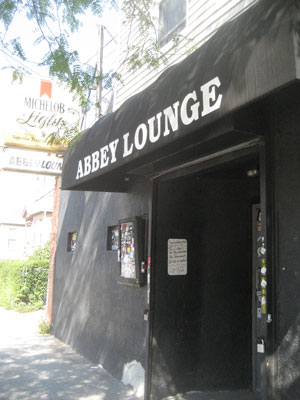
Dive will close today By Tom Nash Tonight the Abbey Lounge will host a final evening of cheap beer and rock'n' roll before shutting its doors forever. Last week, patrons of the gritty Beacon Street watering hole crowded around the TV set to watch a live news broadcast on the club's closing, with the reporter standing just outside the door. Just an hour before, bartender John Giannino had told the news crew how it felt to see his father's business closing for good. "It's disappointing," he said later. "What else can you say?" The club entered the year struggling, laying off three of its employees in the face of a shrinking economy and dwindling audiences. Contrary to a report in the Boston Herald, Giannino said the bar will not be reopening as an Irish pub. "We're closing our doors on Wednesday and that's it for us," he said. The Wednesday show will feature bands that got their start at the Abbey Lounge. The night will feature sets by Acrobrats, Auto Interiors, Jay Allen,Coffin Lids, Curses, Konks, Muck and the Mirers, Spitzz, Sprained Ankles,Tampoffs and Triple Thick. "It's going to be unforgettable, but also a little somber," Giannino said. "It's the last show. It's going to be a great memory, but in the back of our minds we'll know it's the last time we'll be able to party here." The show begins at 7 p.m and has a $5 cover. |
||||
William C. Shelton
(The
opinions and views expressed in the commentaries of The Somerville News
belong solely to the authors of those commentaries and do not reflect
the views or opinions of The Somerville News, its staff or publishers.)
To the Charter Review Committee,
I
sincerely appreciated the opportunity to give testimony at your Nov. 10
public hearing. I hope you are not discouraged that, from mildly to
passionately, all but one person who spoke was critical of your
preliminary recommendations. That may explain why the hearing, which
was scheduled to be broadcast at least five times on the city's cable
channel, never was.
I respectfully suggest that you might have
begun the work of your committee by gathering evidence on how
Somerville government is benefiting or injuring its citizens and,
therefore, how it should be changed. In just five meetings, you covered
a truly remarkable range of topics. Yet I detect scant mention in your
meeting notes of the Somerville-specific historical context and
conditions that inform your judgment. So please consider my own view.
There
were times when Somerville's government was more explicitly rife with
patronage than it is today. It has been over two decades since city
officials went to jail. But even then, citizen watchdog groups, a
vigilant local press, and extensive, diverse, and politically active
relationship networks helped keep city government honest. They have
faded away. In their absence, the executive branch has steadily
accumulated more power. The legislative branch has disappeared in all
but name.
For as long as anyone can remember, our mayors
withheld city services from the wards of disobedient aldermen and
worked for the election of obedient ones. But in the absence of
vigilant watchdogs, aldermen have become more vulnerable to such
pressure.
This parallels and is fed by the enormously increased
size and volume of donations going to mayoral campaign funds,
particularly from interests living outside of Somerville. The current
mayor won his position by spending $35 per vote, more than any
municipal campaign in Massachusetts. By comparison, aldermen seldom
spend more than $2 per vote.
The resulting autocracy expresses
itself in many ways. The current administration refused to release
elected officials' ethics statements as required by law. In response to
a Freedom of Information Act action, they released them with key blocks
of information blacked out. They offer the laughable excuse that the
Massachusetts Ethics Commission does not require the release of
officials' phone numbers.
From 1975 to 1985, the Board of
Aldermen vigorously debated and passed legislation regarding at least
twenty major issues, often with five to six votes. In the last ten
years, I count two significant pieces of legislation originating from
the Board. The rest were the mayor's initiatives, submitted by a Board
member. Dissenting votes were rarely more than two or three.
The
eclipse of aldermanic power, trends in campaign financing, and the deal
making that takes place outside of the public eye are, taken together,
troubling. So many significant decisions over recent mayoral tenures
flaunted the best relevant evidence, suggesting the extent to which
they were influenced by political considerations. Their outcomes speak
eloquently to their quality.
Over the past century, the response
advocated by the likes of Teddy Roosevelt and Louis Brandeis to such
conditions was a council/manager municipal charter. So I was
disappointed by your easy dismissal of it. At your July 9 meeting, you
had "agreed to research and discuss a city manager [i.e., a
council/manager] form of government." Then at your Sept. 10 meeting,
"the committee agreed that there is no desire to move away from a
mayoral form of government."
When I asked what your research on
council/manager government had involved, your response was that some
committee members read the book, The Adapted City. When I asked what
your discussion had involved, you said that committee members had made
these observations: there is a trend among municipalities toward a
mayoral form of government; some committee members believe that an
elected mayor is more responsive to the voters; some believe that
council/manager government is more appropriate for homogenous, suburban
cities, while strong-mayor government is better for diverse urban ones;
and some believe that our strong-mayor government is working well, so
there is no need to change it.
I would suggest that
•
trends mean little without understanding the historical reasons for
changing governmental forms specific to each municipality that
comprises the trend;
• over the decades, our own strong-mayor government has become unaccountable to the voters;
• you should actually examine objective conditions before you pronounce Somerville government to be working well;
•
and Lowell, Worcester, and Cambridge are all larger and more diverse
than Somerville, but have done quite well with council/manager
governments.
Lowell and Lawrence had very similar economies
when Lowell adopted council/manager government, as did Cambridge and
Somerville when Cambridge did the same. It is fascinating to compare
the subsequent trajectories of these two pairs of cities' fiscal
health, political participation and general wellbeing.
And
then there is diverse and urban Chelsea, whose strong-mayor corruption
and incompetence made it the first U.S. city forced into receivership
since the great depression. In fact, only about 10 percent of
Massachusetts' municipalities have strong/mayor governments, but they
account for all but one of the Commonwealth's significant municipal
corruption scandals. I imagine that your colleague Gerry McCue can
describe how Chelsea has steadily come back since it adopted
council/manager government.
Somerville citizens now have no
real means of redress other than by voting for a mayoral challenger.
Without an incumbent's bulging campaign coffers and patronage-based
army, a challenger's chances are miniscule. If you summarily dismiss
consideration of council/manager government, then I am astonished you
have not recommended initiative and referendum, which do not exist in
our charter.
I do applaud your recommendation to
finally grant the Board of Aldermen authority to appoint their own
staff. How about their own counsel? Your fiscal and financial
recommendations are very much appreciated as well.
The notion
that a person of color appointed by the mayor could effectively
represent fifty ethnic groups is dubious, however, as is the notion
that School Committee members should possess some kind of "expertise"
other than speaking for their constituents.
Taken together, the
recommendations you have made thus far are feeble in the context of our
history and objective conditions. Council/manager government is not
intrinsically superior in every situation. But its adoption would
leaven an inertial, old-boy-network political culture that excludes the
recruitment of fresh and diverse talent, perpetuates patronage, and
fails on your criterion of benefiting all citizens. Somerville's
structural fiscal deficit is one of its products.
When our
nation's founders decided to change their form of government, they
began the Declaration of Independence by stating that "a decent respect
for the opinions of mankind" required them to state their reasons for
doing so. They defined the values that would guide the transformation
of their political institutions. And they cited the history and
resulting conditions that compelled that transformation. I would
encourage you to do the same.
There are many among Somerville's
citizens who would simply like unpoliticized consideration of their job
applications and performance, impartiality in service distribution and
zoning decisions, or a city government that tells the truth, the whole
truth, and nothing but the truth. Most do not enjoy the luxury of
dispassionately discussing forms of municipal governance.
Do
you believe that the conditions they experience are unworthy of your
consideration? Do you believe that the recommendations you are offering
will transform those conditions?













Reader Comments