



Residents speak out against surveillance cameras

On April 8, 2009, in Uncategorized, by The News Staff


Nearly
eight months after Homeland Security-funded surveillance cameras were
installed throughout Somerville, residents and aldermen widely
criticized the move at a March 31 public hearing as city officials
tried to assuage privacy fears.

Eight cameras were installed at
seven locations throughout Somerville last August as a part of a $4.6
million Homeland Security grant to nine localities in Massachusetts.
Alderman At-Large Bill White, who chaired the hearing, said the board
had not been consulted before the cameras were put in place.

"Why
wasn't this public hearing conducted prior to the installation?" Ward 4
Alderman Walter Pero asked. "I think the board has been disrespected in
this process by not being involved at the front end. It's going to be a
lot harder to put the genie back in the bottle now that the cameras
have been installed."

Some communities have reacted with
hesitation to the federal funding. The Cambridge City Council has
refused to allow eight cameras installed there to be turned on, while
the Brookline Selectmen approved a one-year test period in January.

Police
Chief Anthony Holloway and Fire Chief Kevin Kelleher were on hand to
explain how the city has used the cameras, citing potential evacuation
situations and crime prevention as the primary benefits. Neither had an
estimate on how much maintaining the system would cost.

"I
couldn't put a price tag on it," Holloway said, "but if it help saves
one life, helps identify one person, then it pays for itself."

Thirteen
people spoke against the cameras, including State Rep. Denise Provost
and American Civil Liberties Union of Massachusetts staff attorney
Sarah Wunsch.

"This is not the kind of camera police departments
have used for a number of years," Wunsch said, noting the chief of
police in Brookline outlined the surveillance camera program to the
Selectmen prior to installing the cameras for the trial period.

"With all respect to the chief, I know people feel like these cameras must deter crime, but they don't," Wunsch added.

Holloway
said the cameras in Somerville are 75 feet above ground and transmit
wireless color video images to Somerville Police Headquarters 24 hours
a day. Camera recordings are kept for 14 days and erased on the 15th.

At
the meeting, Assistant City Solicitor David Shapiro said the recordings
are public record. Tapes will be available from the Police Department
for a fee.

Holloway added that a password is required to zoom
in on people, which nine officers have. If a crime is occurring, those
without access are allowed to zoom in if an authorized person can't get
there in time.

So far, according to Holloway, the zoom-in
feature has been used once, when officers spotted vandals on the
community bike path. The suspects made an escape before any
higher-resolution images could be taken.

Ward 6 Alderman Rebekah
Gewirtz, who initiated the inquiry into the cameras' installation,
challenged Holloway on his assertion that the cameras were not part of
a regional network. Localities will be allowed to request feeds of the
cameras but will not be able to take control.

"We could let
(other localities) look at the camera," Holloway said, " but we
wouldn't let them record anything because they wouldn't have access to
that."

As for the locations of the cameras, Holloway said they
would remain secret until receiving approval from Harvard University,
which has two cameras posted on a Somerville property. A list of
locations was distributed to Aldermen. The Davis Square LiveJournal
community has posted locations and photos of several cameras.

The
public comment period is open until April 15. A report on the cost of
dismantling the surveillance system is being prepared for the BOA
Committee on Public Health and Safety.


Third annual Peace Conference more popular with the community than ever before

On April 8, 2009, in Uncategorized, by The News Staff
 
Spirit performs a dance routine.
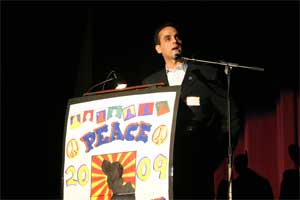
Mayor
Joseph Curtatone addresses the audience at the third annual Somerville
Peace Conference, sponsored by Teen Empowerment. ~Photos by Meghan
Frederico

By Meghan Frederico

A
crowd of nearly 700 youths gathered at Somerville High School on
Saturday to take part in the third annual Somerville Peace Conference,
sponsored by Teen Empowerment, along with Mayor Curtatone and the City
of Somerville.

The highlight of the day was the two-hour
performance put on by the teens, in which they boldly laid out a host
of issues they face through dramatic skits, spoken word pieces,
speeches and song. The audience was alternately moved to hollers and
silence by the powerful presentations, which once again touched on
issues such as gang violence, teen pregnancy, drug abuse, and
immigration.

The recession was one notable new theme that
snaked its way through the skits and performances. While the bulk of
media coverage seems to cover the issue from an adult perspective, the
teens on stage made clear just how much the economic downturn is
affecting them.

One skit depicted students losing a young,
promising teacher due to lay-offs. Another showed a young girl forced
to look after her unemployed, drug-dependent mother. When the mother
finally does seek help, she discovers the shortage of substance abuse
resources available in Somerville. The skit referenced the closing of
the detox unit at Somerville Hospital, which will shut down in June due
to the Cambridge Health Alliance's significant loss of state funding.

In
a spoken word performance, Bendhjy Nazaire illustrated another problem
faced by teens in a down economy: competing with adults for menial
jobs.

"Application after application,

But still no replies,

Turns out all that stuff in the news wasn't just lies.

Jobs that used to go to teens,

Is now being taken by college grads with degrees?

Degrees? How we supposed to battle with degrees?

When most of us don't have high school diplomas or even GEDs?

Can't even get a job at Mickey D's.

Now I'm not telling stores who to hire or who to deal wit,

But the thing is their biggest customers are kids,

So why aren't we first on their hiring list?"

As
Nazaire's story shows, the spike in layoffs in recent months has
translated to newly laid off workers and recent college graduates, who
may face a shrinking pool of job opportunities in their own fields,
going after jobs traditionally held by teenagers. Nationwide, teenage
unemployment has grown twice as fast as overall unemployment in the
past year, reaching 21.6% in February, compared to the overall
unemployment rate of 8.1%, according to the Bureau of Labor Statistics.

What happens when teens find themselves with fewer activities
and jobs to keep them busy after school? Students' sketches depicted
the pressures to skip class and wander the streets, and their personal
battle to stay engaged.

When Tyler Holmes, an SHS freshman,
asked the audience members to stand up if they had "ever experienced
violence in East Somerville", you could feel auditorium rise to its
feet. They rose again to their feet moments later when asked to "stand
up if you are proud of where you live."

"Because of the actions of a few," Holmes said, "East Somerville has gained a reputation for being associated with violence."

A
hush fell on the crowd when Terrell Walton took the microphone. Walton
was only 15 years old when he left paralyzed by a gang-related shooting
in Boston. "I thought I was invincible," he said, addressing the
audience from his wheelchair. The boy who shot him was sentenced to 14
years in prison, but his life as he knew it was gone, Walton said,
urging those in the audience to learn from his poor choices of gang
involvement.

Tension over the Somerville Police force's handling
of gang and youth issues also emerged as a significant issue among
youths. SHS student Nick Texeira spoke about how the trust he developed
through police-youth dialogues was eroded by a recent experience with
the police. He said that even though he was respectful to the officers
and admitted wrongdoing, he was sworn at, charged with assault, and
wrongly accused by police officers of being in a Latino gang.

"I
am not and never have been a member of a gang," Texeira said. "And I am
not even Latino, I am Portuguese," he said, evoking chuckles from the
crowd.

Texeira is also friends with the six SHS students who
made news in March when they were falsely accused by Somerville Police
Officers of being gang leaders, with no other cause than that they are
young and Latino.

When Mayor Curtatone took the stage to
speak, he addressed the issue of police relations, admitting to the
audience that "clearly, after what we've seen in recent weeks, we still
have a long way to go." When Curtatone urged the audience to
acknowledge that the police are trying to do a good job and protect
them, he was met with some loud jeers, highlighting the tension and
skepticism present in the young crowd.

With the struggles that
teens face, the necessity of a support system was made clear at the
conference, but this is something that may prove elusive for the many
new Somerville immigrants. Felicia Affua Abbuah spoke of the struggle
of adjusting to a new land in a spoken-word piece titled "Foster Care".

"Friends
and family made it easier to cope with the hardships of life," she
said. "Now we're here, in a place where the seasons change and the wind
blows cold as ice, where the doors are locked and windows closed, where
there's no sight of a friend or family, to help us cope with starting a
new life."

With such candid personal narratives, the event
fostered a sense of community and disclosure. During the Hope and
Healing Ceremony that followed the performances, the microphone was
open to anyone who wanted to dedicate a rose to those who have been
lost, and those working toward positive change. Youths approached the
microphone, some declaring their aversion for public speaking, to share
their personal struggles, from teen parenthood to poverty to just
fitting in. Speaking in front of a large crowd about these issues might
have been unthinkable for these students without the dialogue that the
performance had opened, allowing them to open up to their peers and
flout taboos.


Ribbon
is cut for the grand opening of the VNA’s second Assisted Living
Project and the groundbreaking of the Somerville Housing Authority’s
Capen Court Redevelopment. ~Photo by Keith Cheveralls

By Keith Cheveralls

The
range of housing options available for low- and middle-income seniors
took a giant leap forward Monday with the simultaneous grand opening of
the Visiting Nurse Association's second Assisted Living Project and the
groundbreaking of the Somerville Housing Authority's Capen Court
Redevelopment. An array of speakers-including Somerville's mayor, Joe
Curtatone, US Congressman Michael Capuano and State Senator Pat
Jehlen-praised the projects, explaining that the "mixed financing"
model used to fund the projects, together with the developments' unique
juxtaposition of assisted and independent senior living, make the two
projects a model for innovative approaches to public housing.

"This
campus is unique in the country," Mayor Curtatone said, adding that the
two developments make Somerville "a model for affordable housing."

"These
projects are incredibly complex. Lots of these types of projects never
get finished," Congressman Capuano said, adding that this project's
success is a reflection of the commitment of those involved. "I think
the results speak for themselves."

The projects, by relying upon
an array of public and private institutions for funding, are among the
first to successfully use the so-called "mixed financing" approach to
public housing, in which the public and private sectors cooperate to
fund new public housing projects. While it is innovative, the financial
complexities of this approach make it difficult to implement,
especially in the current economic environment.

"We had to face
the worst time to borrow money," said Joe Macaluso, the Executive
Director of the Somerville Housing Authority (SHA), in reference to the
economic recession. "The fact that we held it together when we thought
it was doomed to market forces is a testament to all those who
supported us."

The SHA and the Visiting Nurse Association (VNA)
created a unique partnership by working together on both developments,
which are located right next to each other on Alewife Brook Parkway in
Somerville. The completed 99-unit Assisted Living Project, modeled
after the VNA's successful Lowell Street assisted-living community,
will provide an affordable assisted-living alternative to seniors for
whom private-and often expensive-assisted-living communities are
currently the only option.

"We knew, after we built the first
one, that we'd have to build another," Linda Cornell, president of the
VNA, told the audience at Monday's event, held in the dining room of
the new facility. "As a combination of senior housing and public
housing, it had to be done," she explained.

The second
building-construction of which is to begin soon-will replace 64
antiquated, now-demolished affordable housing units for seniors with 95
units of affordable housing for low- and middle-income seniors who wish
to live independently. Its completion will mark the first new
affordable housing for seniors in over thirty years, according to
Macaluso.

In what Monday's speakers hailed as yet another
innovation, a bridge will eventually be constructed between the two
buildings, enabling seniors living independently in the Capen Court
development to interact with the seniors at the VNA's assisted-living
facility next door. Capen Court residents will also have access to the
dining area and nursing staff at the VNA building.

"We need more
and more to have a spectrum of ways for people to live and get care,"
said Pat Jehlen. "There is a need for alternatives in between
independent living and nursing homes."

To round out a dizzying
array of accomplishments, speakers said, the new building incorporates
a range of environmentally-friendly building technologies. Solar panels
on the roof will help offset energy consumption, and rainwater,
collected in a 10,000 gallon tank, will be used to irrigate the lawns
and flush toilets, Cornell explained.

"What we've done,"
Macaluso said, reviewing the quality and innovations of both projects,
"is set a standard for how we're going to treat our seniors."


Sixth annual Opiate Speak Out continues community dialog about drug awareness

On April 8, 2009, in Uncategorized, by The News Staff
Police
Chief Tony Holloway along with four young recovering adults share
information at the Sixth Annual Opiate Speak Out presented by SCAP.
~Photo courtesy of SCAT TV

By Vladimir Lewis

Four
Somerville young adults recovering from drug and alcohol abuse shared
their experience ,strength, and hope in a televised community forum
Wednesday night, April 1st. Police Chief Tony Holloway was also present
and he shared information about controversial Question 2. The Sixth
Annual Opiate Speak Out was presented by SCAP, Somerville Cares About
Prevention, and produced at Somerville Community Access Television in
Union Square.

The group shared their stories of the progression
of their disease from a seemingly harmless pastime that helped them
"fit in, have fun, and be cool" to each individual's nightmare. They
all expressed gratitude of being able to clean up and wanted to give
back to other addicts still out there suffering.

"It is
unfortunate for the people I know who are doing life bids (prison
terms) for doing things they wouldn't do if they weren't under the
influence," said Danielle Rogovich, 23. "It starts off very calm.
You're just having fun, hanging with your friends. It was something to
fit in. It starts out with one joint (marijuana cigarette) and it went
on from there."

Mark McLaughlin, 23, from Save Our Somerville,
said he wants to help. He's seen a lot of people die. By the time he
started high school in 2000, he said 16 local youths had already died
due to drugs and related suicides.

"If someone can get clean
because of a death, then we can say they didn't really die in
vain…their death can have a meaning," McLaughlin said.

The panel discussion was led by Nancy Bacci, Youth Programming Coordinator for the City of Somerville.

Mayor
Curtatone spoke before the discussion expressing his concern.
"Substance abuse is a community issue that needs a community response,"
he said.

Chief Holloway shared important facts about Question 2.
"There's a lot of misinformation about Question 2 out there…if
someone is caught with under an ounce, you'll get a civil penalty of
100 dollars…and as of January 1 this year, this will not show on
someone's CORI…but you can be charged with distributing if you have
under an ounce and it's packaged for sale, and you can be charged and
detained if you're operating a motor vehicle under the influence (of
marijuana)," he said.

Holloway said for people under 18 they
must pay a 100 dollar fine and complete a required education program.
If someone doesn't complete the program, they can be fined 1,000
dollars.

"We don't interpret the law. We just enforce it," he said.

Mitchell
Tutein, 23, has lived his whole life in Somerville. He started out at
age 13 hanging out with the older kids smoking pot and drinking. This
led him to "ecstasy," acid and cocaine.

I went from a simple
joint to jail – I thought I could handle things. I could not. It took
me 10 years to realize this," he said. Tutein said he had lost 4
friends to drugs by age 19, and 8 of his friends had died by the time
he was 21.

Tutein's been clean about six months. The time when
he was doing his first "bid" was the first time he'd been clean in ten
years. "While I was locked up (for 45 days) this made me think about
all the people I had hurt – my parents, people I robbed – and I was
looking at Billerica (prison) time. When I was using my future didn't
cross my mind once. When I was high I thought I was unstoppable, but I
wasn't – it was embarrassing. I felt like an idiot. I was in the paper
in Somerville and Medford."

Charlie Litopoulos, 23 , started at
age 12 with alcohol and "weed." "I always wanted to fit in," he said.
These gateway drugs led to klonopin, ecstasy, vicodin and cocaine. Then
his habit progressed to oxycontin and heroin. "All the dead ends of my
life were due to (starting with) alcohol…my drugs were more important
to me than anything. I do regret, now, who I hurt, but at the time I
didn't care. I didn't have arrests, so I thought I was on top of the
world, but the arrests came…I had to go through a lot of pain to get
to where I am now in my life."

An audience member asked if it
was hard to get a job with a criminal record. The group agreed things
could be tough, but there are community members out there willing to
help. "I understand (about jobs), but I've found people out there
willing to help. There are ways around things," Litopoulos said.

For
a strong recovery, the four stressed staying positive, going to
meetings, going to therapy, asking for help, being honest with
themselves and others, staying with clean and sober people, staying
away from old using people and places and remembering the pain when
they hit their bottoms. They all expressed gratitude for being in
recovery and a desire to give back by helping others.

A video
was shown depicting a teenage kid being pressured by his peers into
smoking marijuana with them. They all seem to think it's harmless fun.
Later in the video the boy is happy about being hired for a job. But
he's required to take a drug test. The next day he is humiliated when
he's told he won't be hired because he failed the drug test. "Weed is a
gateway drug. That's how it all started for most of us," said Rogovich.

An audience member asked if they thought the new marijuana laws would encourage people to smoke the drug.

Tutein
said he was in jail when it was voted on, but he would not have voted
for it. He said he would never had gotten clean if he hadn't been put
in jail.

Chief Holloway complemented Tutein, "The 'expert' is absolutely correct. I agree with this young man here. I voted 'no' on it."

Tutein said, "Stay clean, stay strong, it's hard, but don't give up."


Dakota Partners propose ‘new concept’ for Summer Street

On April 7, 2009, in Uncategorized, by The News Staff

New
plan for Dakota Partners will be to "swap land" with Veterans of
Foreign Wars Dilboy Post, freeing up a parking lot for a 30 to 36-unit
apartment complex. ~Photo by Bobbie Toner

By Tom Nash

(The Somerville News Exclusive)

The
developers of a long-contested condominium project on Summer Street
held a meeting with neighbors Monday to announce a series of changes
that would completely reshape the development.

If the new plan
moves forward, the Veterans of Foreign Wars Dilboy Post will "swap"
land with Dakota Partners, freeing up a parking lot for a 30 to 36-unit
apartment complex to be built by a potential new developer, the
Cambridge-based Oaktree.

The VFW could have a new two-story
building built by Oaktree on land owned by Dakota that had
been slated for the original 14-unit condominium development, which has
been in legal limbo since 2002.

"I think it's fair to say a
number of abutters were concerned with this building being somewhat
ominous," Dakota Attorney Rich DiGirolamo said, noting the project is
pending final approval from the VFW and has not been submitted to
Inspectional Services. "What we really wanted to do is talk to you
about what's going on rather than show you."

Along with
DiGirolamo, Dakota Principal Roberto Arista explained the new approach
to 13 residents invited by Ward 6 Alderman Rebekah Gewirtz, who also
attended the meeting.

The plan calls for a four-floor, 35,000
square foot building with the first level occupied by commercial space.
An underground parking lot will serve residents, the VFW post and
retailers. Preliminary architectural drawings were shown of both the
VFW post and the apartment complex, but DiGirolamo and Arista stressed
they were only conceptual.

Residents expressed cautious optimism
about working with a new developer and being allowed to give their
opinion of the design, which was still widely panned as too many units
for the neighborhood to handle.

"Generally, I'm happy to see any change in the plans at all," Carol Dempkowski said. "This is what we wanted seven years ago."

Since
2002, the legal battle among abutters, the developer and the city left
Dakota's construction permit on the brink of lapsing. The Zoning Board
of Appeals gave the project an extension in February, which set off the
most recent round of legal wrangling.

Four of the 13 residents
gathered have sued Dakota during the past seven years, including Dr.
Mohammed Hanif Butt and three abutters, including Dempkowski, who
recently filed a suit challenging Dakota's permit extension. An ongoing
fight between Dakota and the city over a public shade tree has also
kept the builders from breaking ground.

Despite the two lawsuits
embroiling the current plan, DiGirolamo said it will remain in place
until the new proposal moves forward. He said a review of the new
concept by ISD was "months away" and that until then Dakota intends to
continue its legal action against the city.

Gewirtz said more
meetings on the new plan will be held, with a larger group of people
sought out — including abutters to the proposed VFW site who were not
invited.

"I think what we wouldn't want to see at the next
meeting is the exact same thing," Gewirtz said of the new apartment
proposal. "We need to have a different building that takes in our
constituents (concerns)."

Responding to residents' primary
complaints that the new development would have too many people in too
small of an area, and that a new VFW hall may disrupt abutting
neighbors, Arista assured meeting-goers the developers are listening.

"I think we've heard you loud and clear," Arista said. "We're not looking for a fight."


Rezoning Broadway from Winter Hill through E. Somerville discussed

On April 7, 2009, in Uncategorized, by The News Staff


Plans
to rezone Broadway with the hope to help restore Somerville's economy
and create a place for new jobs. ~Photo by Bobbie Toner

Martin Levenson

On
Tuesday, March 24th, at the Cross Street Senior Center, city officials
from the Office of Strategic Planning and Community Development (OSPCD)
held an informal information session with constituents. The goal of
this community meeting was to garner wide support for the OSPCD's
desire to rezone Broadway in East Somerville. "We're not looking for
sweeping change," Madeleine Masters, the city's planning director,
says. These changes will be moderate and done with the best intentions
of restoring Somerville's economy and creating a place for new jobs.
These changes will include a new Green Line T station, more retail
development, and safer streets for pedestrians.

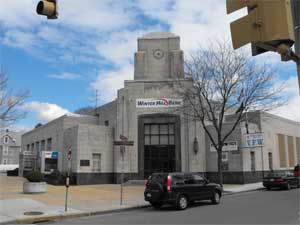
An important
motivating factor behind this rezoning plan is the Winter Hill Star
Market which has been closed for more than a year. Since this time, no
business has taken its place. "We did hear that a Dollar Store was
coming in," remarks Ms. Masters in passing. However, instead of a
Dollar Store, Ms. Masters and her Office in City Hall are planning to
create retail shops that will attract people from all over the
community, renewing the community's economy and spirit. Walter F. Pero,
alderman for Ward Four – where the Star Market stands – is very pleased
with this plan, saying, "This is an opportunity to have some real
positive development on Winter Hill."

Broadway is losing worth
each day. "The value of the building [in Broadway] is less than the
value of the land it stands on," says Ms. Masters. The OSPCD wishes to
change that with their new vision for East Somerville. As part of this
vision, Broadway will be safe, day and night, and stores will have
pleasing storefronts and access to parking garages. A store with parked
cars right in front of its entrance, according to OSPCD officials,
lessens the likelihood of a person shopping there. The new retail
shops, office buildings and restaurants will be as aesthetically
pleasing as the city of Somerville can muster. To make sure most of
these new businesses operate in a way that's healthy for the planet,
there is an incentive to build green, OSPCD tells us. Developers will
be given more area and more height to work with if they include green
energy or use green building materials, or both.

Sections of A.
Alfred Lombardi Street, near the existing Orange line T station, will
under this plan, be turned into a Transit Oriented District 70 (TOD
70). This means that many of the buildings in the area will be seventy
feet high, either commercial or residential structures. One resident of
Lombardi, shares his concern with us. "I admit a lot of that area has
to be redeveloped," says Jeremy Bowman, but Mr. Bowman is not sure that
tall buildings, overshadowing existing residences like his, are a
solution.

Any questions or comments for the OSPCD are
encouraged. There will, in time, be a public hearing on the rezoning of
Broadway. East Somerville residents not in attendance at this meeting
are asked to visit the city's website (www.somervillama.gov) for access
to the zoning maps and handouts given out at this meeting. The OSPCD
can be reached at 617-625-6600, ext. 2500.


Protesters outside Rite Aid in Davis Square Friday, April 3. ~Photo by Bobbie Toner


(Press Release)

Boston
— Protesters converged on seven Rite Aid drugstores in Massachusetts
on Friday, April 3 to condemn the company's abuse of workers' rights
and urge Congress to pass the "Employee Free Choice Act" — a law
backed by President Barack Obama that would better protect employees
who want to form unions by limiting employer interference in the
process.

"Right Aid and other companies think it's fine to
threaten and fire workers who want a union," said Sylvia Estrada, a
48-year-old mother of six, who has worked at the Rite Aid distribution
center in Lancaster, CA, for almost 10 years with more than 500 other
employees. "After all the threats and firings, we still voted for the
union, but the harassment continues and now they won't negotiate a
contract with us."

Rite Aid is a textbook example of why
workers need the Employee Free Choice Act," said Russ Davis, Director
of Massachusetts Jobs with Justice.

The Employee Free Choice
Act would make it easier for workers to form unions to bargain with
their employers for better wages, health care, and job security. The
legislation would also help employees secure a contract in a reasonable
period of time and toughen penalties against employers who violate the
law.

"Today we are sending Rite Aid managers a message that we
expect this company to comply with the law and respect workers'
rights," Davis added. "We want an economy that works for everyone —
including the warehouse workers in Lancaster. Winning the employee free
choice will help spread prosperity to more working families."

In
2007, the federal government was prepared to charge Rite Aid with 49
labor law violations for threatening and firing employees at the
Lancaster distribution center. Flaws in federal labor laws allowed the
company to evade the violations with only a slap on the wrist and
promise to behave in the future.

Massachusetts protests were
held yesterday in Amesbury, Boston (Gov't Ctr. and Kenmore Sq), East
Boston, Everett, Methuen and Somerville and by the Western Mass. Jobs
with Justice chapter in Springfield, Easthampton, and Greenfield on
April 2. They were part of dozens of similar actions organized by Jobs
with Justice coalitions at Rite Aid stores in Albany, Bangor, Buffalo,
Nashville, New York City, Portland, OR, Providence, Richmond, and
Tacoma. Fifteen similar protests took place on February 13 in
California, Oregon, Washington and Pennsylvania.

Photos from
today's events can be seen at:
http://picasaweb.google.com/randwilson.aflcio/ProtestsAtRiteAidShowSupportForTheEmployeeFreeChoiceAct?feat=directlink

Jobs
with Justice is a community-labor coalition that links workers'
struggles to help build a larger movement for social and economic
justice. Learn more at www.massjwj.net

For more info contact: Rand Wilson, (617) 803-0799


A healthy way to get out and talk about issues

What
better way to identify issues and discuss solutions in your
neighborhood, meet your neighbors and experience the Ward on foot.

Alderman
Heuston has scheduled a series of walks in Ward 2 aimed at doing just
that. After a tough winter it's a good time to walk around and figure
out what needs attention and how neighborhoods can be improved.

Walks
have been scheduled by neighborhood meeting up at specified locations,
usually one our fabulous neighborhood businesses. Walks will be at a
good pace and no longer than 45 minutes to 1 hour depending on the
preference of the group.

Bring the kids, your pets, visiting relatives, your neighbors and friends and let's get walking!

Dates, Times and Starting Locations

Contact Ward 2 Alderman Maryann Heuston at mheuston@hotmail.com or 617-492-5331

Date

Time

Meeting place

Neighborhood

April 4

10am

Playground Lincoln Park

Lincoln Park

April 17

6pm

Argenziano School

Lincoln Park

April 18

10am

Sherman's Cafe

Union Square

April 27

10am

1 Fitchburg st

Brickbottom


East Somerville Community School Advisory Group Formed

On April 3, 2009, in Uncategorized, by The News Staff

Mayor
Joseph A. Curtatone, Superintendent of Schools Anthony Pierantozzi,
Ward 1 Alderman Bill Roche and Ward 1 School Committee Representative
Maureen Bastardi have announced the creation of an East Somerville
Community School Advisory Group to consult with City and school
officials and provide input on planning and construction issues
associated with the ongoing effort to rebuild the East Somerville
Community School. The Advisory Group will include parents, neighbors
and other members of the ESCS family. Residents interested in serving
on the Group should submit a letter of interest by email
(JBaker@somervillema.gov) or postal mail to Mayor's Aide Jessie Baker
by Wednesday, April 27th or call her directly at 617-625-6600 x2104.
(The postal address is Jessie Baker, Office of the Mayor, City Hall, 93
Highland Avenue, Somerville MA 02143.) Mayor Curtatone will announce
the Advisory Group composition and date of the first meeting on May 1,
2009.

"The City and school department have been working
diligently to secure the necessary funding and conduct selective
demolition over the last year, and now that the City has been awarded
$12 million by the Liberty Mutual Insurance Group, I am eager to begin
working with the Advisory Group," said Ward 1 Alderman Bill Roche.
"Though we've made a lot of progress, there is still much to do to
bring the entire ESCS community together again."

"We know that
parents, teachers, and students alike are eager to see this Group
formed and moving toward final design plans, and we all hope to do so
as soon as possible," said Ward 1 School Committee Representative
Maureen Bastardi, who also Chairs the Committee. "The ESCS community
has been strong, positive, and supportive through a very difficult
time, and I commend you all for your efforts, and promise we will bring
you back home soon."


In Somerville, the mortgage crisis is leaving its mark

On April 2, 2009, in Uncategorized, by The News Staff

Somerville by some measures apears to be better-off than the state average. ~Photo by Bobbie Toner

In Somerville, the mortgage crisis is leaving its mark

By Keith Cheveralls

At
first glance, the mortgage crisis appears to have largely left
Somerville alone. Row upon row of foreclosed homes do not line the
streets of Somerville, as they do in many of the worst-hit communities,
and the predatory lending that has crippled the finances of both many
middle class families and the nation's largest financial institutions
does not appear to have made many inroads into Somerville. But neither
comparisons to extremes nor the abstract statistics with which the
crisis is so often described can tell the full story. Even in
Somerville, the mortgage crisis has made itself felt-quietly, perhaps,
but with no shortage of economic and emotional pain.

"We can
almost pay the mortgage," one Somerville resident told The Somerville
News, speaking on condition of anonymity. She and her husband bought a
condominium in 2006, and although the interest rate on their mortgage
has not increased, they earn enough money that they do not qualify for
assistance from the government. "We work very hard in this family," she
explained. "My husband and I each have two jobs, but we can't always
pay."

It is difficult to assess the true impact of the
mortgage crisis in Somerville, in part because many hesitate to discuss
their financial situations, and also because of the absence of a clear,
quantitative assessment of its impact. It is clear that housing prices
are down and foreclosures up statewide-average home prices have
decreased by about 20% in the past year, according to the Warren Group,
a real estate news/information source, and the number of foreclosures
in 2008 increased 64% from 2007 to over 12,000-but the relationship
between those numbers, and how they compare to the situation in
Somerville itself, is more ambiguous.

By some measures,
Somerville certainly appears to be better-off than the state average.
Real estate prices in Somerville have decreased by about 13% over the
last year, the Warren Group reported, and officials with the city's
Assessor's Office explained that the average assessed property
values-the figures used to calculate property taxes by the city-have
only decreased by a few percent so far. It did note that assessed
values are determined from last year's sale prices, and may yet decline
more. "Somerville has fared fairly well. It's fairly stable, with low
vacancy rates," asserted Phil Ercolini, head of Somerville's Housing
Department.

But foreclosures and evictions are happening. "In
the last 12 months, there have been at least 48 evictions from
foreclosed-on units," said Melissa McWhinney, Director of Advocacy at
the Community Action Agency of Somerville (CAAS), an anti-poverty
nonprofit agency in Somerville. She said that the real number of
evictions in 2008 was almost certainly greater than 48, but that it is
difficult to obtain a reliable number, because not all foreclosure
proceedings lead to eviction, and because some foreclosures may result
in the eviction of multiple tenants.

Whatever the actual number
of evictions, one thing is for sure: there were many more in 2008 than
there were even a few years ago. Exact numbers are hard to come by, but
McWhinney said that a figure of three to four foreclosures per year was
typical in the years before the real estate market peaked in 2006. This
dramatic change is challenging even the banks behind the foreclosures.
"Banks used to try to sell the foreclosed property, to get as much of
the principle back as possible, McWhinney explained. "When there were
three to four foreclosures a year in Somerville, it was manageable.
Now, I have no idea what they do."

But the real measure of the
crisis, of course, must be taken at the level of the individuals whom
it affects. For the Somerville resident who spoke to with The
Somerville News, the crisis has meant stress and frustration.

"I
love this country, I am an American citizen, and many people who don't
have a job get help. I don't receive help because I work, and I'm
supposed to have enough money," she explained. "We try, we work very
hard, but it's not enough."

Asked whether she could renegotiate
the terms of her family's mortgage to reduce the monthly payments, she
explained that "we want to, but I have made some late payments, so they
won't renegotiate." And she and her family cannot sell their
condominium for ten years, she said, for legal reasons associated with
aid they received from the city to pay the closing costs when they
bought the condo. For these reasons, she said, "we can do nothing with
the banks."

There are programs in place to help those facing
mortgage-related financial difficulties. The first line of defense is
often counseling and financial advice offered to those worried about
foreclosure. Many nonprofit organizations, like the Cambridge-based
Homeowners Rehab, Inc. and the Homeownership Preservation Foundation,
offer professional counseling services for those whose homes are
threatened by foreclosure. While Somerville's city government does not
offer counseling itself, it recently added information about the
mortgage crisis, including links to organizations that do offer
counseling, to its online database of FAQs.

"Our hope is that
people who may be experiencing foreclosure will seek counseling,"
Ercolini said. "We like to get to folks before foreclosure becomes an
issue," he explained, because "once the situation gets to foreclosure,
it becomes that much more difficult to find a solution. The city does
not have resources to remedy those situations."

CAAS does try to
prevent evictions once a bank has initiated foreclosure proceedings.
"If your home is foreclosed on, we do eviction prevention. We try hard
to keep people in their homes," McWhinney explained, but acknowledged
that negotiating foreclosures is complex and difficult. If eviction
does occur, many of the programs that CAAS regularly offers can help
evicted residents or tenants.

But no amount of counseling or
assistance can take away the stress inherent in losing one's home-and
even living with the prospect of that eventuality may feel daunting.
The Somerville resident who spoke to The Somerville News has found
perhaps the best way to cope with the stress. When asked whether she
worries about what might happen if she falls too far behind on her
mortgage payments, she said simply, "I never think that if I don't pay,
we will lose our apartment. I don't think that way. This is my dream,
living with my family."