



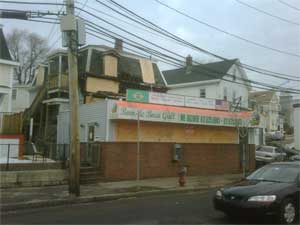

By Julia Fairclough Making Prospect Street and Webster Avenue two-way roads, adding bike lanes and snaking a lane of traffic through the existing plaza are just a few measures that planners threw out during the first Union Square transportation planning meeting on Wednesday night. Held at the Argenziano School on Washington Street, there was standing room only in the cafeteria, as residents gathered to talk about a passionate issue in the historic-yet traffic plagued-square. In general, residents liked what the city and consultants from Howard/Stein Hudson Associates mapped out. Concerns for the most part addressed the finer elements, such as how the plan will alleviate the cut-through traffic and how the flow of traffic will loop around the square and out onto Webster and Prospect Streets. The transportation plans and roadway improvements are just part of the entire package for Union Square, said Monica Lamboy, who heads the city's strategic planning and community development office. The Board of Alderman last April approved a rezoning package for Union Square that examines private uses for businesses and residents. This plan is looking at the public land and how to preserve the history of Union Square plaza while cutting down on the congestion, promoting equity amongst bikers, motorists and pedestrians and improving the public space. The transportation plan will ultimately address how to draw people from the new Green Line Extension T stop by Prospect Street and into the square, Lamboy said. Feedback given on Wednesday will help planners shape a more final draft by September, and hold more community meetings. Planners want to implement the improvements by the time the Green Line Extension is built in 2014. The project boils down to the following options: o Make Webster Avenue and Prospect Street two way roads, which will alleviate traffic clogs in the center of Union Square. One option involves bike lanes on both sides of Webster Avenue, which will call for getting rid of 21 parking spaces along Webster Avenue. However, 37 parking spaces could be added along Prospect Street in the area of the new T station. The other option entails having parking (five spaces) on both streets on the West side of the road. Instead of bike lanes on Webster Avenue, there will be "sharrows," which indicate bikes share a lane with a car (a picture of a bike is painted on the side of the road). People need to decide whether it is more important to have bike lanes or parking, said Keri Pyke, the director of transportation planning for Hudson. o Make Somerville Avenue a two-way road by Bow Street, heading west. More sidewalk space will be added in the area by the Reliable Market. The "passive" open space traffic island on Bow Street would be removed. A bike lane would be added along the eastbound lane on Somerville Avenue. The pro is gaining 26,000 square feet of usable open space in the form of sidewalks, which could host bike racks and art work. The plan would call for losing four parking spaces on Bow Street. There are three options to reconfigure traffic in the heart of Union Square, which are as follows: Option 1. Existing conditions modified-The significant change here entails taking the 15-space parking lot in front of the Independent and making it into open space. There would be enough width to add a bike lane in both directions on Somerville Avenue. Traffic signals (which will also be true for the next two options) will feature a bike detection signal. Bike parking will also be added. Option 2. A One-way pair-This option entails a more radical alignment, with a one-way road passing through the plaza in front of the Independent, parallel to the existing Somerville Avenue. The road will be curved to add a "traffic calming" affect. The new road would line up with Bonner Avenue, and there would be a traffic light at Bonner Avenue. Bike lanes would extend along the road and new pedestrian crossings would be added. While this option would nearly double the open space (to total 10,300 square feet), it would reduce on-street parking from 60 to 25 spaces. Option 3. Washington Street two-way with a Somerville Avenue Woonerf-This option calls for reconnecting Washington Street through its center, with a "woonerf" running down Somerville Avenue. A woonerf is a street where pedestrians and cyclists have legal priority over motorists, such as Winter Street in Downtown Crossing. The advantage to building a woonerf is that the street can be closed off on weekends to use for festivals; and still allow partial access. The disadvantage is that traffic on the est side of the square would be heavier in the afternoons. Adding the woonerf would result in losing half the parking spaces along Somerville Avenue. |
||||
By Beecher Tuttle On Wednesday July 8th, Somerville's Public Health and Public Safety Committee met in the Aldermanic Chambers at City Hall to discuss a variety of local issues. The committee, chaired by Alderman Bill White, is also represented by Aldermen John Connolly and Rebekah Gewirtz. Other active participants in attendance included Ward 5 Alderman Sean O'Donovan, Assistant City Solicitor David Shapiro, Superintendent of Inspectional Services George Landers, and Deputy Police Chief Paul Upton. A few concerned Somerville residents sat in on the meeting to continue the discussion on the house at 31 Wilton Street. The two family building located on Wilton St. has been classified by the owner as a sober house that accommodates recovering addicts for short and long terms stays. The issue at the forefront of the meeting concerned how many residents are legally allowed to stay at the building at one time, and whether or not all residents are officially recovering from substance abuse problems. Under state law, only 4 non-related adults are legally allowed to reside in a one family facility, making the maximum residents for 2 family homes to be limited to 8 people. The home at 31 Wilton Street is said to be exempt to this rule under the Fair Housing Act concerning people with disabilities, and commonly houses 10 people at a time. This issue was brought to the Board due to resident's concerns over the validity of 31 Wilton Street's claims that it is a true sober house and that there is no regulation on who comes and goes from the facility. Deputy Upton stated, "the fact that we don't know who's in there concerns us, but not as much as other properties." He also added that there have been no recent police reports coming from that area. One resident who attended the meeting said he had found a hypodermic needle in the area and had reported it to police. Aldermen O'Donovan's major concern is over the fact that there is no verification process currently in place for sober or half-way houses. The committee had asked the City Solicitor's Office in the previous meeting to look into possible solutions. Assistant City Solicitor David Shapiro reported back to the committee on Wednesday, stating Somerville has the right to request a 3rd party verification that the residents of a particular facility are entitled to protection under the Fair Housing Act. The committee asked the City Solicitor's Office and the Superintendent of Inspectional Services to put together a form that will force owners of such facilities to verify the eligibility of its tenants in accordance with the law. Alderman O'Donovan feels that dealing with the issue is an important precedent. "This is way bigger than Wilton Street," said O'Donovan. "What scares me is that it is all incumbent on the housing provider to do the right thing." The City Solicitor's Office will come back to the committee with a form to be approved at their next meeting in August. In other business, there have been complaints of trespassers in the old Max Pak factory site. Alderman O'Donovan quoted reports of children on the roof and felt it needed to be secured for safety reasons. Deputy Chief Upton stated that the area is now being patrolled and is on their watch list. Superintendent Landers responded to complaints about health inspectors entering private property without permission. Landers stated that all inspectors denied such accusations, but were reminded of proper protocol. Another issue brought forth by Committee Chairman White was the problem of dog breeding in residences. Currently there is a maximum number of dogs that one home can legally own, but that does not include puppies that are under six months old as they are not forced to be licenced. Aldermen White asked the City Solicitor's Office and the Superintendent of Inspectional Services to look into the zoning code to see if any changes should be made. The next Public Health and Public Safety Meeting is tentatively scheduled for August 26th. |
||||
All Meters to Go to $1 per Hour until 8 p.m.; Magoun Square Lot, Meacham Road and Dover Street Meters to Join Davis Square Lots in Providing 3-Hour Parking Limit; New Fees and Fines Approved by Aldermen and Traffic Commission Also to Go Into Effect. SOMERVILLE – Acting Director of Traffic and Parking James Kotzuba announced today that, starting on Monday, July 20th, the City of Somerville will begin reprogramming its parking meters to accommodate new rates and hours of operation. In keeping with the recently released Phase I recommendations of the City's 14-member Parking Solutions Task Force (PSTF), the new rate for parking will be one dollar per hour, and meters will operate from 8 a.m. to 8 p.m. In addition, Kotzuba announced that the City would extend the parking time limit to three hours for the curbside meters along Meacham Road and Dover Street in Davis Square, and in the metered lot in Magoun Square. (City-owned lots in Davis Square already offer a three-hour limit.) "As is typical with these adjustments, we will start in the western end of the city and work our way east," said Kotzuba. "It's not a good idea to open up the electronic meters when it's raining but, weather permitting, the whole process should take about two weeks." Other PSTF recommendations for Phase I are: Extending the hours for current daytime business permits to 6 p.m. Creating a new "second-shift" business permit that allows local business employees to park in designated areas from 6 p.m. to 3:30 a.m. Publicizing the city's permitting system for non-profit performing arts groups that allows their patrons to park in permit areas for arts performances. Continued negotiations with owners of private lots throughout the city to make additional parking available to patrons and businesses. A citywide assessment and inventory of available parking spaces as well as an analysis of the impact of all new parking policies. "We will be generating a scope of work for the parking assessment and inventory within the next week or two," said Kotzuba. "We want to get this study underway so that, based on the results from this first phase, we can continue to adjust and fine-tune our implementation plans in order to optimize the accessibility and convenience of our available parking supply." July 20th will also mark the date of implementation for adjusted parking fees and fines (see list below) authorized by the Board of Aldermen and Traffic Commission. OFFENSE FINE Unattached Trailer $40.00 Traffic Island/Safety Zone $30.00 Taxi Stand $30.00 Restricted Zone $30.00 Permit Parking $50.00 Wrong Direction $30.00 Overtime Parking $25.00 Over 48 Hours $30.00 Over 1 Ft. From Curb $30.00 On Sidewalk $30.00 Obstruct/2 ft. Driveway $30.00 No Stop Zone $30.00 Parking Meter $30.00 Loading Zone $30.00 Leave 10 Ft. Passage $40.00 High School Concourse $25.00 Double Parking $50.00 Construction Zone $30.00 Commercial Overnight $40.00 Bus Stop $100.00 20 Ft. Intersection $40.00 RMV Surcharge $40.00 A copy of the full Parking Solutions Task Force Report and Recommendations is available online at the Traffic and Parking Department web page at www.somervillema.gov For more information, please call 311. |
|||
By Joseph A. Curtatone (The opinions and views expressed in the commentaries of The Somerville News belong solely to the authors of those commentaries and do not reflect the views or opinions of The Somerville News, its staff or publishers.) So, Boston is planning an iPhone application that lets some residents send pictures of municipal problems to the Mayor's Office of Constituent Services for follow-up. That's an interesting concept and I will look forward to seeing it in action. But I have to say I'm concerned about the long-term prospects for the new application, because Boston has never built up the constituent service infrastructure to deliver the timely coordination, tracking, responsiveness and accountability needed to support this new technology. (And I'm also worried because it won't work unless you have an iPhone: Verizon, Sprint and Cingular customers need not apply.) It'll be cute, but will it be widely adopted and successful without a full-blown 311 and stat program to back it up? Boston has so far shied away from such programs. Meanwhile, over in Newton, SomerStat has become an issue in the budget debate and the mayoral campaign. An independent Citizens Advisory Group has recommended that Newton start developing a "stat"-style performance management program on the Somerville model (which we adapted from the Baltimore CitiStat model), but some aldermen are resistant to adding analytical staff to the mayor's office. By contrast, all four candidates to replace outgoing Newton Mayor David Cohen have endorsed the performance management concept and are now arguing about who would be best qualified to make it work. Given the great results for Somerville and other communities that have adopted 311 and stat programs, you might wonder why some local elected officials remain so resistant to these cost-effective innovations. In both Boston and Newton, one possible explanation is "Not Invented Here" (NIH) syndrome. If you look up "Not Invented Here" on Wikipedia, here's what you'll find: "a term used to describe persistent social, corporate or institutional culture that avoids using or buying already existing products, research or knowledge because of its different origins. It is normally used in a pejorative sense." Harvard Business School professor Henry Chesbrough says that a crucial key to success in our technology-driven era is to take the opposite approach, which he calls "open innovation." That's why Somerville is so willing to borrow best practices from other municipalities and adapt them to the needs of our community. A good idea is a good idea, wherever it comes from – and we shouldn't be shy about giving credit to others, and sharing ideas we know can work. In fact, one of the reasons that Somerville was named a 2009 All-America City (like "President Barack Obama," "2009 All-America City" is a phrase I never get tired of repeating) is that we have taken good ideas from other communities and made them our own in ways that hold lessons for other small and mid-sized cities across the state and nation. For example, prior to our adoption of the 311 concept in 2006, it was considered to be a service that only the biggest cities could deliver: it had a multi-million dollar price tag and required expensive proprietary software. Similarly, the "stat"-style performance management program, which collects and uses data to manage allocation of service resources in real time, was once considered too technically complex and analytically demanding to be deployed in communities that lacked sophisticated IT and number-crunching resources. I was still an alderman back in 2003 when I saw Baltimore's CitiStat and 311 programs in action (Baltimore's Mayor at the time was Martin O'Malley, who is now Maryland's Governor). I immediately recognized their potential to make Somerville government more efficient, more accountable, and more transparent – and I made them part of my campaign platform. Six years later, I can say that the success of these programs has exceeded even my high expectations. SomerStat has transformed our budget process. It has helped us create a goal-based budget with measurable goals and outputs, giving our Board of Aldermen and our resident more ability to scrutinize and understand the way we spend money. In good times, SomerStat has helped us expand services while controlling costs. Today – even in the midst of a serious state and national fiscal crisis – it's helped us cut spending while reallocating resources to preserve core services. At the same time, 311 has become the cornerstone of all our customer service programming. Back in January of 2006, it started out as a service that tracked resident inputs to only one department: Public Works. It only worked with landlines (no cell phones), had full operational capacity only in the daytime and had limited language capacity in Spanish and Portuguese. Today, 311 works from any phone in Somerville, including mobile phones; it provides service in English, Spanish, Portuguese and Haitian Creole; it fully supports DPW and Traffic and Parking while handling most constituent queries for Inspectional Services, the City Clerk's Office and many other City Departments. 311 representatives staff the very popular Welcome Desk at the entrance to City Hall and they update the City's award-winning website. But best of all, 311 tracks the nature and the outcome of thousands of requests for information and service each month, providing a vital stream of data to SomerStat, and helping senior managers throughout City government (and taxpayers and their elected leaders) hold government more accountable to the residents they serve. And 311 does all these things for less than $600,000 per year – less than four tenths of one percent of the City's budget. That's a great achievement and a terrific bargain – even if it wasn't invented here. |
|||
Some smaller, more We have great schools, plenty of police and What we also have close Which brings us around to sense of community. We have We owe a lot of this to a whole Some |
|||
By Aaron Crear A "The Somerville Tenancy Preservation Collaborative The SCC provides assistance in several areas including The Metro Boston Network gave out |
||||
(The I The City is celebrating it's recent victory I'm a lifelong Somervillian, working on 60+ years. Third generation; preceded by my grandmother and mother. I I must mention that back then we didn't We were all teenagers – school during the day and Eddie's Coke Shop after school – with weekends at the Broadway Show. For the most part our parents worked, so we were pretty independent, and looking back, street smart. Broadway Then there was Tony's Throughout the year, we really try to get together. These people are like no other – their Today, Broadway has changed, but it's Orsola Susan Fontano |
|||
| |
||||
City officials laud the successes and plans for Shape Up Somerville By Julia Fairclough Recognizing City Representatives "Everyone knows how important childhood Somerville is at the forefront of the In particular, o Offer healthy o o Survey food retailers to see how they can add fruit and vegetables to their product lines. o o Expand walking and biking opportunities. A "Think Past Shape up Somerville initiatives include Most of the time it's the affluent or homogeneous "Somerville is working to change its culture and The leading sites for the The It "You need to change the DNA in the It also boils The schools are also urging The Shape Up Somerville |
||||
By Hillary Coughlin Reading As for the Barefoot Books is one of the The Reading If you or anyone you know may want to become an |
||||


Reader Comments