


Governor Patrick unveils $28B FY 2010 budget plan – including $375M in local aid cuts

On January 28, 2009, in Uncategorized, by The News Staff


Bob Katzen – Beacon Hill Roll Call

Gov.
Deval Patrick unveiled his proposal for a $28 billion fiscal 2010
budget that includes a $375 million or seven percent reduction in local
aid. His fiscal 2010 budget plan and $375 million cut are only
proposals and can be changed by the House and Senate when they draft
their own versions of the budget.

The governor's proposal also
offers initiatives that he says would generate revenue to help reduce
the $375 million local aid cut. These ideas include a one-cent increase
in the statewide meals and room occupancy taxes and allowing cities and
towns to impose an additional one percent local option meals and room
occupancy taxes.

The governor's package also proposes imposing
the state's five percent sales tax on some currently exempt items
including alcohol purchased at liquor stores and other outlets, candy
and sweetened beverages. He also calls for raising Registry of Motor
Vehicle fees and expanding the five-cent recycle deposit to plain and
flavored water, coffee-based drinks, juices and sports drinks.


Snow Emergency Lifted Effective 5:00 P.M

On January 28, 2009, in Community/Arts, by The News Staff
 
Residents Must Move Automobiles From City Lots by 7:00 P.M. Wednesday

The City has lifted its snow emergency regulations effective 5 P.M. this evening (Wednesday). Residents parked in municipal or school lots during the snow emergency have a two-hour window starting at that time in which to move their vehicles. Cars still parked in city lots at 7 P.M. tonight may be subject to ticketing and towing. Residents, landlords and business owners are required by city regulations to shovel their sidewalks but may not shovel snow into the street.

For additiional information, please call 311.

 
SOMERVILLE – Mayor Joseph A. Curtatone announced today that he has convened a special Financial Advisory Committee (FAC) to provide expert advice on both cost-saving and revenue-producing measures designed to help the City maintain its financial strength in the face of a deepening economic recession and impending mid-year cuts in state aid to Somerville and other cities and towns. The new committee, which will convene later this week, includes Samuel Tyler, President of the Boston Municipal Research Bureau; Jonathan G. Sloane, President and Co-CEO of Century Bancorp; Geoffrey Hargadon, Sr.Vice President for Investments, UBS Financial Services; Ronald Bonney, Jr., President of Bonney Automotive and Executive Committee Member of the Somerville Chamber of Commerce; and Professor Daniel Richards of the Tufts University Economics Department.

"We began preparing an internal review of cost-saving and revenue options back in late October, but the new round of anticipated cuts in local aid means that we have to find a way to close an additional $3 million gap in the current fiscal year," Mayor Curtatone said. "Somerville may be in better fiscal shape than many other cities and towns in Massachusetts, but we're still faced with some painful choices – and we don't expect much if any improvement in 2010. We could complete this process internally, but why shouldn't we draw on the wisdom and expertise that's available all around us? We've never been shy about turning to outside experts for advice about municipal best practices, and I welcome the fresh perspective this distinguished outside group will bring."

Curtatone explained that the FAC would have the opportunity to make cost savings, cost recovery and financial management recommendations in all areas of city government, and would address both operating costs and capital spending. "All options are on the table, but my charge to this new committee is to help us avoid service cuts and layoffs if at all possible," Curtatone said.

"In the end, this new advisory group can't make the tough decisions for us, but they can offer helpful guidance, and I am pleased that the Mayor is establishing this special committee," said Ward 2 Alderman Maryann Heuston, who chairs the Board's Finance Committee. "I also think that having an outside group involved adds an extra measure of transparency to what is going to be a challenging process – and that's important if the public is going to have confidence in the final plan that the Mayor and the Aldermen develop."

"Even as he proposes cuts in local aid, Governor Patrick has been careful to argue that cities and towns should be given more management tools to control costs and develop a more balanced revenue base," said Curtatone. "But even if we gain the option of a modest increase in meals or hotel taxes, and even if the legislature is finally able to close the obsolete and pointless Telecommunications Tax loophole, we won't see any new revenue from these changes until next year. We need to act now to make up for these cuts – and we will."

"Somerville is a regional leader in adopting municipal best practices to improve service efficiency," said Samuel Tyler. "However, the size of the state aid cuts this year and next will require creative but hard choices and I am happy to join the Advisory Committee members in bringing outside thinking to address this challenge."

Curtatone said the group would be convened as quickly as possibly and would report back with recommendations by mid-March at the latest. "We'd be happy to act even faster on interim recommendations that the committee may choose to make before their final report," said Curtatone. "I'm sorry to impose such a tight timetable, but we really don't have a choice. We have to begin closing the local aid gap well before the end of the current fiscal year on June 30th.

"In the meantime, I will also begin talking directly to our union leaders across city government," said Curtatone. "We want to partner with organized labor on developing realistic approaches to keeping cost under control while maintaining core services. I anticipate their willing cooperation."


Mayor Curtatone names special committee to advise on city finances

On January 28, 2009, in Uncategorized, by The News Staff


(a note from the City)

5-Member
Panel Composed of Local Business, Academic and Policy Professionals;
Outside Experts Will Recommend Revenue and Savings Measures in Response
to Decline in Regional Economy and State Aid Cuts

SOMERVILLE –
Mayor Joseph A. Curtatone announced today that he has convened a
special Financial Advisory Committee (FAC) to provide expert advice on
both cost-saving and revenue-producing measures designed to help the
City maintain its financial strength in the face of a deepening
economic recession and impending mid-year cuts in state aid to
Somerville and other cities and towns. The new committee, which will
convene later this week, includes Samuel Tyler, President of the Boston
Municipal Research Bureau; Jonathan G. Sloane, President and Co-CEO of
Century Bancorp; Geoffrey Hargadon, Sr.Vice President for Investments,
UBS Financial Services; Ronald Bonney, Jr., President of Bonney
Automotive and Executive Committee Member of the Somerville Chamber of
Commerce; and Professor Daniel Richards of the Tufts University
Economics Department.

"We began preparing an internal review of
cost-saving and revenue options back in late October, but the new round
of anticipated cuts in local aid means that we have to find a way to
close an additional $3 million gap in the current fiscal year," Mayor
Curtatone said. "Somerville may be in better fiscal shape than many
other cities and towns in Massachusetts, but we're still faced with
some painful choices – and we don't expect much if any improvement in
2010. We could complete this process internally, but why shouldn't we
draw on the wisdom and expertise that's available all around us? We've
never been shy about turning to outside experts for advice about
municipal best practices, and I welcome the fresh perspective this
distinguished outside group will bring."

Curtatone explained
that the FAC would have the opportunity to make cost savings, cost
recovery and financial management recommendations in all areas of city
government, and would address both operating costs and capital
spending. "All options are on the table, but my charge to this new
committee is to help us avoid service cuts and layoffs if at all
possible," Curtatone said.

"In the end, this new advisory group
can't make the tough decisions for us, but they can offer helpful
guidance, and I am pleased that the Mayor is establishing this special
committee," said Ward 2 Alderman Maryann Heuston, who chairs the
Board's Finance Committee. "I also think that having an outside group
involved adds an extra measure of transparency to what is going to be a
challenging process – and that's important if the public is going to
have confidence in the final plan that the Mayor and the Aldermen
develop."

"Even as he proposes cuts in local aid, Governor
Patrick has been careful to argue that cities and towns should be given
more management tools to control costs and develop a more balanced
revenue base," said Curtatone. "But even if we gain the option of a
modest increase in meals or hotel taxes, and even if the legislature is
finally able to close the obsolete and pointless Telecommunications Tax
loophole, we won't see any new revenue from these changes until next
year. We need to act now to make up for these cuts – and we will."

"Somerville
is a regional leader in adopting municipal best practices to improve
service efficiency," said Samuel Tyler. "However, the size of the state
aid cuts this year and next will require creative but hard choices and
I am happy to join the Advisory Committee members in bringing outside
thinking to address this challenge."

Curtatone said the group
would be convened as quickly as possibly and would report back with
recommendations by mid-March at the latest. "We'd be happy to act even
faster on interim recommendations that the committee may choose to make
before their final report," said Curtatone. "I'm sorry to impose such a
tight timetable, but we really don't have a choice. We have to begin
closing the local aid gap well before the end of the current fiscal
year on June 30th.

"In the meantime, I will also begin talking
directly to our union leaders across city government," said Curtatone.
"We want to partner with organized labor on developing realistic
approaches to keeping cost under control while maintaining core
services. I anticipate their willing cooperation."


Contact:

Tom Champion 617-625-6600, ext. 2620

Lesley Delaney Hawkins 617-625-6600, ext. 2615

Jaclyn Rossetti 617-625-6600, ext. 2614


Lyndell's(home of the half moons)has been a local staple since 1887 and Bill Galatis intends to keep it that way. ~Photo by Bobbie Toner
At Lyndell’s Bakery moons have been handmade for over 100 years.

By Doug Holder

Bill Galatis is a native Somervillian who doesn't have any half-baked ideas. Several years ago, he bought Somerville's iconic bakery Lyndell's in the Ball Square section of our city. Galatis is also the co-owner of 35 Dunkin' Donuts stores in the greater Somerville area. Galatis, a man in his mid-fifties, lived in Somerville until he was 13 years old and has never lost touch with the 'ville. Besides owning Lyndell's and the Dunkin' Donuts stores, he is also a member of a prominent Greek Orthodox Church in our city.

In spite of the economy, Dunkin' Donuts remains a steady business because of its low prices and quality products. Galatis admits that Dunkin' Donuts occupies a different niche than the stylish Starbucks, and he has no problem with that.

Although Galatis was a corporate accountant for many years, the food service industry was in his blood. As a young man, he worked in his father's diner and liked the idea of being an entrepreneur. So, in 1990 he and some partners bought a franchise of Dunkin' Donuts, and that has expanded into a fleet of stores.

Galatis told The Somerville News, at their Friday editorial meeting, that his grandfather, an immigrant from Greece, settled in the Brickbottom section of the city, now home to the famed Brickbottom artists' residence.

The Lyndell's bakery acquisition was an emotional one for Galatis. He is well aware of its history, dating back to its inception in 1887. His sister Karen runs the store and he leaves the baking to the long employed bakers who know the biz like the back of their powdered hands.

Lyndell's has many bakery favorites like Ricotta Pie, Cannolis, Fruit Tarts, Lobster Tails and many others, as well as the much-in-demand Honeycomb Bran Bread (get in line folks!)

Galatis has long-range plans to remodel Lyndell's. He has the idea to restore it to its original 1800's grandeur. He has already consulted with an architect and seems committed to the idea.

Galatis is much more than a savvy businessman. He is a well-known philanthropist, on the board of trustees at Anatolia College in Greece, and involved n public service initiatives in the area.

Galatis is optimistic about his business and other interests and remains strongly committed to Somerville, the city of his birth. As he told the News: "Somerville will always have a special place in my heart."


SCAT’s annual meeting/awards night a big hit

On January 28, 2009, in Community/Arts, by The News Staff
 
The SCAT Annual Meeting and Awards Ceremony was very well attended.
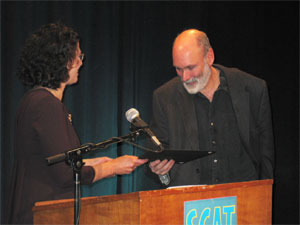
Outstanding Producer: Doug Holder for “Poet to Poet” ~Photos courtesy of SCAT

By Vladimir Lewis

A celebration of a successful year and concerns over pending legislation were the highlights of SCAT's Annual Meeting and Awards Night, Thursday, Jan.22.

Mayor Curtatone, the SCAT Board of Directors, and many contributors met to honor achievements in the past year and to report on the organization's well-being at Somerville Community Access Television's Union Square headquarters. A catered buffet dinner was served and then the televised awards ceremony began.

Candace Dostert, outgoing president of the board, spoke first. "This is a good time to come together to celebrate our accomplishments over the last year," she said. Dostert praised her talented staff and also plugged for new members. "If you're watching at home and are thinking about this, please do come down and check us out. We're always looking to grow our membership."

Mayor Curtatone praised the community television station. "For more than a quarter of a century SCAT has played an important role right here in Union Square."

The night was mainly a light-hearted event, but there was a serious tone when the mayor continued. "We're working hard with RCN to renegotiate a franchise (contract). But, Verizon is, as we speak, organizing legislation to get rid of local franchising and to go to the statewide system…we need to be tenacious about this. Stations like SCAT will be silenced if we allow this to happen. We will get the deal done and it will be fair and equitable, but we need (all of) you to step up and support us all,." he said.

Curtatone said, "If anyone from Verizon is listening (currently) we invite you to come to Somerville and meet us." Richard Scheiferdecker, the new board president, gave a huge bouquet of flowers to Mrs. Dostert and said,"Candace will be a tough act to follow." Dostert praised her colleagues. "After 7 years on the board, I'm sad to be leaving, but I want to thank everyone from the very talented and dedicated staff as well as the endless stream of volunteers and interns…SCAT will be in good hands."

Scheiferdecker also said," I look forward to keeping SCAT as a really vibrant human resource." Current board members were acknowledged. New and leaving members were mentioned. John Carreiro, member representative, was leaving the board. "John will be missed. He always had great ideas and served as a liaison for us with the Portuguese community," said Wendy Blom, SCAT Executive Director. Eta Shrestha was announced as a new board member.

Blom presented a status and treasury report for absent treasurer Mimi Graney "I thought you'd appreciate some good news and that's what you're going to hear. We are financially sound and conservatively sound. There were just over 450 thousand dollars in expenses for the year with a modest surplus. 62 thousand was spent on new equipment. Our investments are diversified and in low-risk funds, so our organizational savings are still secure. Our bread and butter remains the franchise fees that Somerville collects yearly from RCN and Comcast."

Blom said, "It's wonderful to have such talented people in our studio and


The View From Prospect Hill

On January 28, 2009, in Uncategorized, by The News Staff


Politics
is a funny game of chess. In this city, we are no stranger to people
playing games and making moves, but even by our local standards, Sal
DiMasi this past week set the bar a little higher. Like previous
Speakers of the House, he left amid a cloud of controversy.

What
made it surprising was that it was only a few weeks after he moved
heaven and earth to ensure he would be reelected Speaker. What's even
more surprising is that within minutes of his letter to his colleagues
on Saturday afternoon announcing that he would resign on Tuesday, Bob
DeLeo and John Rogers were doing the dance for the chance to replace
him, with DeLeo pulling out all the stops and announcing he had the
support of 92 of his colleagues to replace DiMasi by midday Monday.

That
was enough for Rogers to back down by midday on Tuesday. That's fast,
people. At least around here, people can see you coming for a few
months before they start to become concerned. Or not.

We are
hopeful that under Speaker DeLeo's leadership, the issue of casinos in
Massachusetts will be reconsidered, along with a number of other
potential revenue-generating ideas that have been squelched under the
previous Speaker. Couple that kind of hope with a leader who is
sensitive to his member's needs and our notably progressive delegation
could get some real work done in the areas of equality, education and
infrastructure development, to name a few.

So it's a win-win with DiMasi resigning and DeLeo taking over – for the Commonwealth and for Somerville.


On Capitol Hill, solutions to housing crisis sought

On January 28, 2009, in Uncategorized, by The News Staff

Congressman Dennis Cardoza

By Keith Cheveralls

A
new bill currently before the Congress offers a new solution to the
on-going housing crisis. The bill, sponsored by Congressman Dennis
Cardoza of California's 18th District, seeks to alleviate the steady
stream of foreclosures across the country by offering homeowners the
opportunity to refinance their mortgage at a lower interest rate.

Entitled
the Housing Opportunity and Mortgage Equity (HOME) Act, the legislation
would allow homeowners to refinance to, and prospective home-buyers the
opportunity to apply for, a 30-year mortgage at the below-market rate
of 4 percent. By targeting homeowners and home-buyers alike, the bill
would both reduce the foreclosure rate and stabilize housing prices,
according to a press release from Rep. Cardoza's office.

"Anybody who has a 7 or 8 percent mortgage now could refinance and get
the 4 percent rate," explained Donald Norton, of ERA The Norton Group
of Somerville. "It will save people with 7-8 percent mortgages now
upwards of $500-700 a month."

Many existing homeowners cannot
currently refinance their mortgage to obtain a better rate and lower
monthly payments, because the decrease in housing prices has left them
owing more on their mortgage than their home is worth.

Typical
monthly payments on a 30-year, $300,000 mortgage at 7 percent total
over $2,000, while at 4 percent, the same mortgage would require only a
$1,400 monthly payment.

"I've been doing this for 30 years, and
I've never seen it this bad," Norton said, referring to the housing
crisis. He added that about 20 percent of homeowners in Somerville
currently have mortgages with interest rates over 6 percent, most of
whom could, consequently, benefit from the bill.

The bill comes
on the heels of the 700-billion-dollar Troubled Asset Relief Program,
or TARP, established by Congress to address the sub-prime mortgage
crisis in late 2008.

"I think it's a great bill; its part of
what we should be getting for all the money that is being given out.
There are people out there who would benefit," Norton opined, in
reference to TARP and its focus on the financial industry.

Somerville's
Congressman, Michael Capuano, expressed broad support for legislative
responses to the housing crisis, but was more reserved regarding the
HOME Act.

"There are a number of proposals designed to help
homeowners struggling to make their monthly mortgage payments. I am
closely reviewing all proposals, including H.R. 230, and will work to
advance those that I think stand the best chance of stabilizing the
housing the congressman explained in an email to the Somerville News.
H.R. 230 is the number formally assigned to the bill, or the HOME Act,
while it is under consideration in the House of Representatives.

The
legislation would work by exploiting the control the government gained
over mortgage giants Freddie Mac and Fannie Mae after it prevented them
from collapsing last summer. In effect, the government would require
both mortgage companies to purchase the new, low-interest-rate
mortgages, if lenders wanted to sell them. The security this guarantee
would provide to lenders would, in turn, enable lenders to more easily
offer new mortgages. Under this scheme, investors who currently own
mortgage-backed securities – securities which helped drive the
financial industry into its present state of crisis – could be paid
back in full, according to press releases from Congressman Cardoza's
office.

"This kind of a bill is good, because it's not giving
away money; it's just saying that the government will pressure banks to
refinance somebody who is having problems," explained Norton.

The
bill is currently before the House Committee on Financial Services. It
is not clear if the bill will reach the floor of the House.


Budget situation: Tough but survivable

On January 28, 2009, in Uncategorized, by The News Staff


By Joseph A. Curtatone

I
have already received some criticism for the confident, optimistic tone
in my Midterm Address. Apparently there were those who thought I was
insufficiently grim about the City's fiscal outlook, even though I
clearly said "I have no intention of sugarcoating our current
situation. Times are hard; businesses are hurting and we face a growing
mortgage crisis and a declining job market. State tax revenues are
down, and our leaders on Beacon Hill are looking at cuts in local aid
of up to ten percent. Here in Somerville, that would mean a loss of
five million dollars in the current fiscal year – or three percent of
our operating budget total."

Still, now that Governor Patrick
has announced his proposal to cut $3 million in Somerville's local aid
during the current fiscal year – and predicted that next year will be
just as bad or even worse – it's fair to ask if I still think
Somerville is in such great shape.

My answer is that, as a
community, Somerville will certainly experience some pain, and have to
make some hard choices, as a result of the current economy and the
associated loss of state aid. But we continue to be in much better
shape than many other communities – and we have no plans to retreat
from the service improvements we have made in recent years.

I
don't think we should back away from our recent progress because I
think it's clear that any cutbacks in city services will only increase
the problems now confronting our residents as a result of the national
economic situation. As I told a reporter over the weekend, I also think
it's clear that Governor Patrick understands that cuts in local aid
will simply make the local recession go deeper and last longer so, even
though he feels some cuts are unavoidable, he's going to do his very
best to protect cites and towns from unnecessary hardship. That's my
philosophy, too.

I am also grateful to the Governor for once
again requesting that cities and towns be given more freedom to
diversify their revenue sources through local option meal and hotel
taxes, and by closing the Telecommunications Tax loophole (the obsolete
1913 state law that allows telecomm companies to avoid paying local
property taxes). It's important for Somerville residents to understand,
however, that – even if the legislature approves the Governor's
proposal – these new sources of revenue won't begin to help us close
the state aid gap until next year.

So how, between now and the
June 30th end of FY 2009, do we make up the $3 million shortfall that
the state has reluctantly imposed upon us? Part of the answer comes
from changes we've already made. As soon as the state's budget
situation started to deteriorate back in October, we began to impose
restrictions on hiring. If a job doesn't help maintain revenues or core
services, we're letting it stay vacant. We also began cutting back on
the number of new initiatives previously planned for this year. For
example, we had planned to extend the hours at our branch libraries to
match the extended hours at the Central Library – but that service
improvement is now going on hold. On the capital budget side, we were
hoping to move ahead on a major upgrade to the Central Hill Park on
Highland Avenue that serves as home to our war memorials. Now that
project will have to wait.

Another part of the answer is that we
have been making city government steadily more efficient for the past
five years. By civilianizing clerical positions at the Police
Department, by becoming more energy efficient, by switching to an
internet protocol phone system, and making many other changes large and
small, we have been able to save hundreds of thousands of dollars a
year even as we expanded core city services. In making these changes,
we've put the analytical tools in place to help us prepare for a new
era of austerity.

But because the changes we have already made
won't be enough to close this latest gap, we are now preparing to take
additional steps to reduce spending and find new revenue. I have
already asked department heads to submit proposals in their areas of
city government. This week, I will be announcing the formation of a
special panel of outside experts to advise the City on revenue and
cost-saving measures – both long- and short-term – that will help us
get through the next two years with least possible impact on services.

I've
told this group (which includes local business and academic leaders as
well as outside specialists in local government operations) that
everything is on the table, and that we are willing to be creative
about changing the way we manage and spend in order to sustain, and
even expand, our current level of service.

That commitment is
very much in keeping with the progress we've made over the past five
years and in our willingness to look for, and adopt, best practices and
new technologies from the private sector and from other cities around
the country.

Here in Somerville, we will make whatever hard
choices are necessary to keep our city solvent and working through this
recession. And, as I said in my Midterm Address, what will pull us
through is that we have many advantages that other communities don't
have, including a solid economic development plan, more efficient
operations, an excellent credit rating and a strong cash position. Many
other cities in the Commonwealth are going to have cut police, fire and
teacher positions this year – and others will be closing school
programs and shuttering their libraries.

I still believe that we
can avoid those devastating choices. And if some residents think I'm
being overconfident, then I'll just have to live with that.


The Winter Hill Community School installs fire doors

On January 28, 2009, in Uncategorized, by The News Staff

Winter Hill Community School

By Cathleen Twardzik

After
two students, aged 5 and 8, departed from the Winter Hill Community
School (WHCS) alone, earlier this month, new fire doors have been
installed.

The new fire doors are working well, according to
Frank DiChiappari, District Administrator for Student Services. He has
not been otherwise notified to the contrary.

"Right now, we
really don't know exactly what happened. So for me to say that it's not
going to happen, I can't say that," said DiChiappari. "The children are
non-verbal, so they couldn't explain what happened. We basically
guessed how they left the building."

Allegedly, after having
left the after school program, which is held on the first floor of the
school, the children used a side door down the corridor from their
classroom "and up the stairs, to exit the building," according to
DiChiappari. "We just assumed that that's the door that they used," he
said.

Each year, the total enrollment of the after school
program depends on the number of participating students. However, the
classroom in which the two non-verbal children were placed during the
program was a General Education Classroom with eight other children,
all of whom are typically-developing.

Following the incident,
the program director and the school principal held a meeting with staff
regarding safety procedures, according to DiChiappari. After having met
with staff, proper safety and classroom procedures were reiterated with
students.

Currently, additional preventative measures, aside
from the fire doors, are being taken to ensure the prevention of
another similar occurrence.

How will the school attempt to
prevent a similar problem from re-occurring? "What we try to do is make
sure that the doors are closed at all times," said DiChiappari.
However, "It is a public building. People do ring the bell or knock to
try to get in because there are activities."

"After this
happened, the question was, 'How can we make sure all exits are
secured?' I know that the after school staff talked about putting large
red stop signs on all of the doors in the after school rooms," said
DiChiappari. "The importance of [student's] staying with the staff, at
all times, will be stressed."

In addition, student's files were
scrutinized "to see if there were any children that have any special
needs that would require special monitoring," said DiChiappari.
Further, each student's emergency contact information has been reviewed.

Before
the episode, precautionary measures were already in place, and the
installation of the fire doors had already been planned, according to
DiChiappari. "It's a constant training, staffing, concentrating on all
the students to make sure that students are safe in the classrooms," he
said.

The school installed the doors "because we're required
to by the fire department, by state law," said DiChiappari. For two
years, the WSCS delayed installing the doors, although, "the school
department has no control over the physical plant – that comes under
the supervision of the Department of Public Works."