TheSomervilleNews.com poll of the week

On April 29, 2009, in Uncategorized, by The News Staff


In
addition to breaking news, sports and opinion, TheSomervilleNews.com
also features a daily poll in which you, the reader, tell us where you
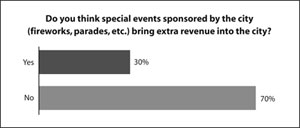
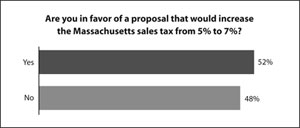
come down on local issues. This week's poll concerned your views on
whether or not you thought holding special events in the city brought
in extra revenue and if you were in favor of a sales tax increase. If
you don't agree with the results, simply log onto TheSomervilleNews.com.


The View From Prospect Hill

On April 29, 2009, in Uncategorized, by The News Staff


Ask
anyone around the city, and those that are actually paying attention to
the budget process have to concede that this year, under the most
extreme of circumstances, our city is producing the most open,
transparent and communicative discussion of the next year's fiscal
budget than anyone can remember. Watching the Mayor and the
Superintendent of Schools address the Board of Aldermen and the School
Committee in their first joint public forum was a terrific outreach to
the residents of this city and we hope this will continue in the future.

This
year the situation is very fluid, as the Mayor has stated, and the
circumstances change on a daily basis. Monday it looked like a 12+
million dollar budget gap, Tuesday it looked like a 6.5 million dollar
budget gap. Next week it could look completely different.

Even
with these variables, the message has remained the same from the Mayor,
the Board of Aldermen and the School Committee – although there will be
some pain, by managing the fiscal situation using past practical
practices and a vision for the future, along with a firm commitment to
keeping our core resources strong and not moving backward, Somerville
will get through this and be even stronger as a community.


Union Square rezoning plan approved

On April 29, 2009, in Uncategorized, by The News Staff

By Tom Nash

A
set of zoning laws aimed at reshaping Union Square passed the Board of
Aldermen unanimously last Thursday after Ward 3 Alderman Tom Taylor
made a final attempt at scaling back the project's scope.

City
officials said the rezoning, in the works for three years and often
marked by disagreements between neighbors and the city, would restore
the square's place as a commercial center and better position it to
capitalize on a proposed Green Line station.

"Union Square is
a hidden gem and we need to pay attention to it," Mayor Joseph
Curtatone said at the meeting. "Union Square is going to change."

The
new zoning would create three new areas: a commercial district that
would span Washington Street and Somerville Avenue, a transit district
around the proposed T stop and an arts overlay district that would
encourage artists to take up residence.

Taylor, who stressed
he is not against the rezoning as a whole, proposed an amendment that
would keep building height limits in an area between Warren Avenue and
Stone Avenue at 44 feet instead of the proposed 55 feet, roughly six
stories. He also asked that below-ground development be reserved for
parking and storage.

In explaining the requests, Taylor, whose
ward includes Union Square, expressed concern that laws allowing taller
buildings would leave the square's "quaint charm" endangered. "I don't
want Manhattan," he said. "I want a Greenwich Village."

"My fear is, decades to come our children's children will say, 'Who made this decision?'" Taylor added.

Monica
Lamboy, executive director of the Office of Strategic Planning and
Community Development, countered that buildings in Union Square were
once taller than they stand now, and that reducing the height limit
wasn't possible.

"I think we wouldn't agree to (the amendment)
because it wouldn't be consistent with what was there before," Lamboy
said. She also rebuffed Taylor's underground use amendment by saying it
would be a mistake to restrict possible uses that could develop in the
future.

Both amendments were rejected.

Aside from
concerns about the changing density, an ongoing criticism of the
proposal was that the property value increase could price many
residents out of the neighborhood. Save Our Somerville, a community
organization that promotes affordable housing, has lobbied the city to
make the rezoning more inclusive.

After the April 23 hearing,
Save Our Somerville member Adam Rich said city officials should make
more of an effort to keep Union Square and the city at-large
affordable. The rezoning proposal approved by the Aldermen would
increase the affordable housing percentage from 12.5 percent to between
15 and 17 percent depending on the area.

"Most people are
resigned to the fact that Somerville is going to be more expensive, and
there's going to be a lot of displacement," Rich said. "As a city, we
have to take on these issues in a comprehensive and serious way."


Community walks in name of homelessness prevention

On April 29, 2009, in Uncategorized, by The News Staff

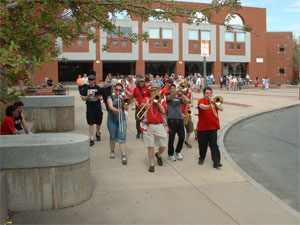
Led by the brass band Second Line, a little over 100 people
walked throughout Somerville neighborhoods for the 6th annual Save Our Homes walk to prevent Homelessness Sunday afternoon.
~Photo courtesy of Somerville Community Development Corporation

Elizabeth Sayer

A
crowd of a little more than 110 Somerville residents enjoyed stunning
spring weather while participating in the 6th annual Save Our Homes
walk to prevent Homelessness. Led by the brass band Second Line, which
contributed to the buoyant grassroots atmosphere, participants walked
3.1 miles throughout Somerville neighborhoods to raise money for the
Affordable Housing Organizing Committee (AHOC).

AHOC is an
advocacy coalition comprised of Somerville residents and community
organizations including Somerville Community Corporation (SCC),
Community Action Agency of Somerville (CAAS), Cambridge and Somerville
Legal Services (CSLS), and Somerville Homeless Coalition(SHC).

The
walk began and finished at Somerville High School, meandering through
Somerville's Prospect Hill neighborhoods, passing several low-income
housing developments and areas that are affected by the money raised
through the Save Our Homes walk.

The Funds that are raised
through the walk are given as emergency grants to Somerville residents
who are facing housing crisis, whether it is for rent, utility bills,
security deposits, moving expenses, or other various housing costs. The
individuals that receive the grants have often fallen behind on rent
because of unemployment, domestic violence or disability and would face
eviction without immediate financial assistance. In 2008, 68 Somerville
families and individuals received assistance from AHOC.

Mayor
Curtatone and Danny Leblanc, the CEO of SCC, each spoke briefly at the
beginning of the walk, touching on the generosity of the Somerville
community and the importance of grassroots community action. Mayor
Curtatone and Mr. Leblanc also touched on the particular importance of
collective action and support while we are facing strenuous economic
times and elevated utility costs.

State Representative Denise
Provost, Alderman Bill White, and several school committee members were
present to participate in the walk.

Many of the participants
in Sunday's were walking because they had a family member or a friend
that had been a recipient of the emergency grants, worked for an agency
that provided homelessness prevention assistance or had been a previous
recipient of the emergency funds and wanted to give back.

With
donations still coming in, AHOC reports raising $22,000, however they
expect that number to continue to grow exponentially and are still
accepting donations. The Save Our Homes walk raised $41,000 dollars in
homeless prevention money last year, and according to Mary Ann
Sclafani, SCC organizer, AHOC hoped to surpass that number this year.
Awards were given to Dennis Fischman and to the Cambridge and
Somerville Legal Services for being the individual and team that raised
the most money for the walk.


Harry Goldenberg, MD

On April 29, 2009, in Uncategorized, by The News Staff
 

Jimmy Del Ponte
On The Silly Side

(The
opinions and views expressed in the commentaries of The Somerville News
belong solely to the authors of those commentaries and do not reflect
the views or opinions of The Somerville News, its staff or publishers.)

In
one of my first articles, Somerville 101 – a primer, I mentioned our
beloved family doctor, Harry Goldenberg, MD. A lot of my childhood
friends were also patients of Dr Goldenberg. Thanks to the world wide
web, my article was recently read by the doctor's son, Ralph, who sent
me a very warm e-mail. Soon after that, his brother Jon also e-mailed
me a nice message.

The following are the recollections of Ralph
and Jon Goldenberg and myself. Grandson Michael also chimed in with
emotional memories of Harry, as he called him. The story you are about
to read is a collaboration of sorts dedicated to Doctor Harry
Goldenberg. I basically re-printed the touching e-mails I received from
the doctor's family members.

I remember the Doctor as a gentle
smiling man who spoke in an even, pleasant tone. He always made us feel
comfortable and he had a very calming effect on us. He used to show up
at our house at all hours, no matter what the weather was. He would
often give my family free samples of vitamins and other medicines.

I
recall an old photo of a younger Dr Goldenberg that hung in his office.
He was dressed in white along with some of his colleagues. I always got
a kick out of that photograph. When I was in St Clements, a couple of
times I went directly to his office at 771 Broadway because I felt sick
and didn't want to go to school (read-sick of school). He always talked
to me for a while and I would end up going to school anyways. Doctor
Goldenberg was an important part of my family and a role model that I
still hold dear to this day.

Ralph gave me the following short biography:

"Harry
was born on October 31, 1907. He was the first-born of three children
and the only son of Eastern European immigrant parents. As you might
imagine, he was the favored child, and he did not disappoint. He was an
exceptionally bright student, graduating Somerville High at the age of
16. He went on to Boston University for his undergraduate degree, and
then Tufts University School of Medicine where he got his MD in 1931.
During his years at these universities he made a number of life-long
friends.

Because his parents, Samuel and Esther, were not well
off, he worked his way through college and medical school. One of the
jobs he liked to tell us about was his work for Bushway Ice Cream as a
bookkeeper and ice cream taster! And ice cream always remained one of
his favorite foods.

Harry spent a lot of time helping run
Samuel's Cigar Store during these years. Harry loved children and wound
up specializing in pediatrics, as you must know.

When World War
II broke out, Harry decided to suspend his medical practice and enlist
in the Army as a Captain (doctors could do that rather than wait to be
drafted at a lesser rank). He spent about three years overseas, ran a
field hospital, and participated in the D-Day Invasion, as a Major.
When the war was over, Harry quickly restarted his medical practice,
renting space at 257 Broadway in Somerville and then 771 Broadway,
which my parents bought in 1947. In the ensuing years he devoted
himself to his patients, his family, and his friends."

Ralph's brother Jon adds this:

"My
father was among the last of a vanishing breed of doctors who truly
cared for their patients. He was a pediatrician, but he had many
patients who came to him as adults because they valued his advice, both
medical and practical. The setting may have been Somerville, but he was
a country doctor. The day before he died he was seeing patients until
the sun had gone down."

Harry's grandson Michael donates some of his beloved memories:

"It
is amazing how just the thought of 'Harry' can bring tears to my eyes.
To this day I miss him and feel cheated that he left us too soon. I
have always told those in my life who were not fortunate enough to know
him what a great man I believed him to have been. Having spent 16 years
of my adult life living in the Boston area, I constantly came into
contact with people who knew or were treated by Dr Harry Goldenberg.
Others told of one of the last doctors to make house calls.

The
most common story would be of stopping by his office to say hello and
spending an hour or two chatting. In particular I would like to share
the story of my father's cousin (by marriage) – Richard Mingolelli, who
owned Dick's Auto Body in Somerville. I used to go by his shop to talk
and he told me of being an Italian marrying into a Jewish family during
less tolerant times. He also told me of the hours spent at my
grandfather's office and of how my grandfather was the first to accept
him and make him feel welcome. Harry just had a way with people that
made them feel good. Perhaps that is why he became a physician.

As
a young boy, I used to look forward to our visits to Massachusetts to
see my grandparents – even though I knew that meant I was likely
getting a shot in the arm! Harry was the only doctor I have ever had
who made me look forward to getting a needle in my arm. Somehow it just
didn't hurt when he did it. Other fond memories I have are of the man
who always brought a fresh loaf of bread home from Lyndell's Bakery
after work or of the man who would get down on the floor to wrestle
with his grandchildren even though the very act was incredibly painful
due to his arthritis.

My grandfather – Doctor, Soldier,
Gentleman, Friend, Boxer, Husband, Father and Grandfather – it is
amazing how much respect he earned, deserved and could command. And yet
he still insisted that his grandchildren call him "Harry" rather than
sir or granddad."

I would like to thank Ralph, Jon and Michael
Goldenberg for adding some wonderful facts and details to my memory of
one of the first positive influences in my life. The family doctor is a
breed that has just about vanished. Thankfully the loving memories I
have of Doctor Harry Goldenberg will stay with me forever.


You can email Jimmy directly at jimmydel@rcn.com.


Arbor Day Event Set for May 1st

On April 28, 2009, in Uncategorized, by The News Staff


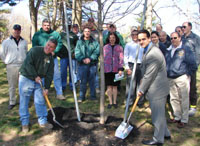
Mayor
Joseph A. Curtatone and Ward 7 Alderman Robert C. Trane invite all
interested individuals to attend Somerville's Arbor Day celebration on
Friday, May 1st at 10:00 a.m., at the West Somerville Neighborhood
School, 177 Powderhouse Boulevard. The event will include two tree
plantings in front of the school grounds, as well as a brief ceremony
acknowledging the renewal of Somerville's "Tree City USA" status for
the 14th consecutive year. The Arbor Day tree plantings are part of the
City's ongoing efforts to increase overall tree cover and improve the
health of the urban forest. For more information, please contact the
Mayor's Office of Strategic Planning and Community Development at
617-625-6600 ext 2500.


Another take on where Somerville’s name originated

On April 25, 2009, in Uncategorized, by The News Staff

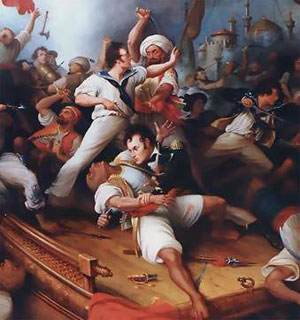
In the summer of 1804, Somers commanded a division of gunboats during five attacks on Tripoli.

Melissa Woods

A
report commissioned by the Somerville Historical Society has declared
Somerville to have a "purely fanciful name," not of any particular
origin. Somerville fire inspector Bob Doherty has ideas of his own,
however-and even better, they have to do with pirates.

The
Blessing of the Bay, the first seaworthy ship built in Massachusetts,
was armed in response to piracy and became, essentially, the first
Coast Guard. Aggressive action needed to be taken against the Barbary
pirates, however, if American ships were to sail in safety. This is
where a young Naval officer named Richard Somers enters the picture.

"Pirating
in Somerville goes way back," muses Doherty. After the Revolutionary
War, American trading ships could no longer fly under the British flag,
nor claim backing by the impressive British navy. The Barbary pirates,
just off the coast of Tripoli (in present-day Libya), then became a
threat.

Born on Somer's Point at Great Egg Harbor, New Jersey,
Richard Somers was one of the first Naval Lieutenants in the then-new
American Navy. Together with his two childhood friends Stephen Decatur
and Charles Stewart, they fought together "like the three musketeers,"
says Doherty, against the Barbary pirates in the summer of 1804. Their
exploits at Tripoli are famously sung in the first line of the Marines'
Hymn: "from the halls of Montezuma to the shores of Tripoli." These
three friends protected the U.S.S. Constitution in equal parts,
commanding six small gunships apiece around the heavy frigate as if it
were "a modern aircraft carrier." Somers' performance as captain of the
schooner Nautilus after he arrived in the Mediterranean earned him
promotion to master commandant on May18, 1804. He afterward sailed
alongside Commodore Edward Preble -then of the Constitution-to Tangier,
and then in five attacks on Tripoli, once fighting five Tripolian
vessels at once at close quarters.

"Millions for defense, but
not one cent for tribute," said Thomas Jefferson when he entered
office, in reference to the pirate threat. As that summer of successful
campaigns drew to a close, Somers realized that the Americans had a
chance to squelch the pirates once and for all. Calling for volunteers,
Somers spearheaded a plan to load the fire ship the Intrepid up with
about 15,000 lbs of gunpowder and 200 loaded shells, and sail it into
the pirates' midst under the cover of night. The ship was to be set off
by remote detonation, but because this was so risky a venture, Somers
insisted that none of his volunteers be family men. This proved a wise
decision. The Intrepid sailed, as planned, into Tripoli harbor, but was
discovered before Somers and his men had time to escape. The ship was
detonated as was, killing all aboard, including Somers himself.

"A
fanciful name," exclaims Doherty, "Not on your life!" Richard Somers
was a nationally-known Naval hero whom has spent time on the United
States, the Boston, and had spent the last day of his life on the
Constitution, out of Charlestown harbor. Six ships in the U.S. Navy
have been named the U.S.S. Somers, since. Somerville, New Jersey, is
known to be named after Somers, as wells as Somers, New York and his
birthplace, Somers Point, but there is no hard proof that Somerville,
Massachusetts is the same case. It is unlikely, however, that an area
so dense with history as Greater Boston should have names of no
historical importance in its midst. Bob Doherty, with his argument for
Richard Somers, provides a defiant yet plausible alternate explanation
in the face of what the history books say.


Free helmets given away at the Mystic Activity Center

On April 24, 2009, in Uncategorized, by The News Staff

By Cathleen Twardzik

At
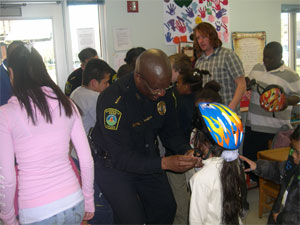
the Mystic Activity Center in Somerville (MAC), over 20 children were
given free helmets on April 13. The event was run by the Mystic
Learning Center's after school program, at which Chief Holloway and
Deputy Chief Cabral of Somerville Police Department distributed the
protective gear to the youngsters.

Recently, the Mystic
Learning Center, which is an after school program, started a bicycle
club, which has a ratio of 2 adult supervisors to 15 children.

"They
[the children] were riding and came across a community police officer,
and he thought that some of them didn't have helmets, and they had a
talk about helmet safety. Then, later that day, the Chief from the
Somerville Police showed up, Mr. Holloway, and two of his other
officers. They gave the children helmets," said Florence Bergmann,
Executive Director of The Mystic Learning Center.

The Somerville
Housing Authority serves as the umbrella organization, under which the
MAC is included. The Mystic Learning Center (MAC) in Somerville the
Mystic Learning Center, the Welcome Project, the Computer Education
Center, the Community Activity Room, The Mystic Tenants Association,
and Tenant Selection Department, and the Bunker Hill Community College
Somerville Satellite campus.

The center's idea concerning why
children should sport helmets is "to prevent any head injuries," said
Bergmann. "We certainly can't have children hurting their heads,
especially not while their in our care in our after school program —
and it's the law."

This year marks the first annual helmet
distribution event at the Center. "I would certainly like to see it be
an annual event," she said. Children, ranging from 5 and 13
participated.

What prompted the Center to hand out helmets to
children, at this time? "It seemed appropriate since we were starting a
[bicycle] club, to start on a good note, with everybody having
helmets," said Bergmann. Participants enjoy a ride on Mondays from 3:30
p.m. to 4:30 p.m.

Additionally, "Parents need to know that
when they buy their children a bike, they should also be buying a
helmet. I don't think all parents think about that, or maybe they've
scrounged the money to get the bike, and don't have the money for the
helmet."

Bergmann is unsure, whether the distribution will become a city-wide project.

Although
there was no monetary requirement for children to get a free helmet,
most of the children who are served by program are low-income,
according to her.

She thinks that children should "definitely"
wear helmets for activities, other than bike riding, such as ice
skating, skateboarding, and sledding. The reason is that, "It's just so
easy for them to hurt their heads."

Because this is the week
of April vacation for students, field trips will be plentiful. "At the
end of the week [on Friday night], we have a roller skating trip from 6
to midnight," said Bergmann. Participants of all ages are welcome to
attend because it will be a family event, according to Bergmann. The
bus, the final destination of which will be Rollerworld in Saugus, will
depart from the Activity Center. "And I'll be nervous because people
won't have helmets there," she said.


Senator Galluccio predicts gloomy economic forecast

On April 23, 2009, in Uncategorized, by The News Staff


State
Senator Anthony Galluccio feels the Assembly Square Project will
benefit Somerville and the surrounding area for years to come. ~Photo
by Bobbie Toner

By Elizabeth Sayer

Like
most governing bodies across the U.S, the current economic crisis has
sucked the legislative air out of Beacon Hill, according to Senator
Galluccio. The recent budget for the 2010 fiscal year shows that the
commonwealth is facing a 2 billion dollar deficit, to which Senator
Galluccio asserts that state employees and the general public are out
of touch with and unaware of the implications of such a large number.

"This
is the most serious economic situation in my lifetime," says the
Senator. "People have no idea. There are still state funded programs
that are asking for money. They don't realize that there is absolutely
no money to get out there."

Galluccio predicts that truly
difficult times are still ahead of us, and that the general public will
begin to feel the ramifications of the current state of the economy
over the next year as the middle class is more harshly affected.

"Poor
people know how to be poor. The working class that is suffering is
doing what they've always done. It's the middle class families that
will be affected over the next year that have the most to lose," says
the Senator.

Galluccio expresses very little patience for
exhaustive discussion about the current economic crisis. He aims to
effectively problem-solve and takes issue with legislators and pundits
that focus on the severity of the situation. "I can't sit around and
talk about the problems we're facing for hours. I want to talk about
what we are going to do about them and how we're going to make the
programs work with less money." The Senator believes that these are the
times in which legislators and activists have to get creative in order
to keep our communities moving.

Galluccio, a first term State
Senator, former mayor of Cambridge and long-time City Councilor in
Cambridge, is now the Chair of the Joint Committee for Higher
Education. This is an appropriate appointment for Galluccio after
chairing the Cambridge School Committee from 2000 to 2002. Galluccio's
sincere affection for and dedication to the school systems of
Massachusetts and the children within it is evident.

Massachusetts
has made education funding the top priority in discussions over the
budget and state funded programs so that education and the public
school system will remain level, while most other programs will suffer.
Galluccio anticipates that many social services and community programs
will lose all funding due to the deficit, and there will be cutbacks in
the fire and police departments all over the state.

The state
is also receiving a significant amount of money from the Stimulus
package, however Galluccio says that the stimulus money will be used
primarily to back up programs that are already struggling severely.
"The [stimulus] money will help. Don't get me wrong. But it won't dig
us out. It will backfill," Galluccio says, and hopes that it will
potentially provide the Massachusetts government with a little
breathing room.

The Senator supports the proposed sales tax
increase as well as increases in meal, gas and hotel taxes. "We should
have raised the gas tax six months ago," Galluccio says, "back when gas
prices were so low that I was walking away from the station wondering
what to do with all the money in my pocket."

Galluccio realizes
that Somerville residents have much different needs than those of
Western Massachusetts. "If you so much as breathe 'gas tax' in
Springfield, people will go crazy." Learning to legislate alongside
senators from all corners of the state has been a learning experience
for the Senator and it is something he has tenaciously and
enthusiastically applied himself to.

Galluccio is no stranger to
tenacity. Much of his political and professional careers result from
his willingness to apply himself whole-heartedly to a task,
communication with those around him, and little fear of rejection.
Galluccio conducted his first political campaign for city councilor
while in his first year at Suffolk Law School, which he lost. He has
lost several campaigns throughout his career, which have only propelled
him to try harder.

Galluccio was encouraged by a guidance
counselor to apply to college and for financial aid when he was
accepted to Providence College. This encouragement, which Galluccio
admits changed his life, is the origin of his affection and
appreciation for teachers, guidance counselors and those that shape the
lives of students and kids.

While focusing on his job as an
elected official and governing throughout the current economic crisis,
Galluccio still finds time to coach youth football and to spend time
with kids. "There is no bull with kids. It's refreshing."


Owner of Printing Company Also Charged for Alleged Role in Scheme

WOBURN
– Today, John Buonomo, the former Middlesex Register of Probate, was
arraigned in Middlesex Superior Court in connection with allegedly
stealing funds from his campaign committee and using those funds for
his own personal use. Buonomo, age 57, of Newton, is charged with
Larceny Over $250 (2 counts), Personal Use of Campaign Funds (2
counts), and Willfully Misleading Investigators. Buonomo pled not
guilty at today's arraignment and was released on personal
recognizance.

Co-Defendant Marc Piro, age 46, of Wilmington,
is charged with Larceny Over $250, Personal Use of Campaign Funds, and
Willfully Misleading Investigators. Piro is expected to be arraigned in
Middlesex Superior Court at a later date. Piro is the owner of Guy T.
Piro Printing ("Piro Printing"), located in Somerville.

In
April 2008, the Office of Campaign and Political Finance (OCPF) began
an initial investigation into suspected violations of campaign finance
laws by Buonomo. In November 2008, OCPF referred the matter to the
Attorney General's Office for further investigation. Authorities
believe that on various dates between December 2004 and July 2008,
Buonomo withdrew funds from the Committee to Elect John Buonomo for his
personal use. Buonomo allegedly stole these funds using two methods.
First, investigators discovered that Buonomo allegedly wrote checks to
himself from the Committee's account, falsely stating on the checks
that he was reimbursing himself for postage he had bought with cash.
Second, investigators discovered that Buonomo also allegedly stole
funds from his campaign account by writing checks from the Committee to
Piro Printing for fictitious print jobs. Authorities believe that
Buonomo wanted to make it appear as though the printing company was
printing materials for the campaign, when in actuality these services
were never rendered. Investigators discovered that after receiving the
money from the Committee, Piro would allegedly refund the funds back to
Buonomo immediately, minus approximately $500 for each transaction.
Authorities believe that Piro also allegedly participated in the
creation of fake invoices for these transactions, so that it would
appear as if Buonomo had indeed used the company's printing services.
All of these fake invoices were created on the same day, and were
entered into Piro's accounting system in an effort to make the
transactions appear legitimate.

During the course of their
initial investigation, OCPF found that Buonomo allegedly submitted to
OCPF forged and altered bank records, forged and altered printing
invoices, as well as false written statements he had obtained from
postal employees. Investigators believe this was an effort by Buonomo
to mislead OCPF and to justify the taking of funds from his Committee.
Investigators from OCPF and the Attorney General's Office believe that
Buonomo stole approximately $100,000 from the Committee.

A
Middlesex Grand Jury returned indictments against Buonomo and Piro on
March 31, 2009. Buonomo was arraigned today in Middlesex Superior Court
where he entered a plea of not guilty and was released on personal
recognizance. He is due back in court on June 18, 2009, for a pre-trial
conference. Piro is expected to be arraigned in Middlesex Superior
Court at a later date.