

Transportation Finance and Reform – Part 3

On August 12, 2009, in Uncategorized, by The News Staff

Op-Ed from State Representative Denise Provost

(The
opinions and views expressed in the commentaries of The Somerville News
belong solely to the authors of those commentaries and do not reflect
the views or opinions of The Somerville News, its staff or publishers.)

The
story so far – when Governor Patrick was sworn into office, he
inherited a poorly-maintained, chronically underfunded transportation
system. In March, 2007, an expert commission studying transportation
finance issued a damning report. In December, 2007, the federal
government disapproved the state's official transportation plans,
jeopardizing funding.

2008: Actions Short of Solutions, New Problems

The
one-year anniversary of the Transportation Finance Commission Report
arrived in March, 2008, with no signs of action on its recommendations.
Instead, the administration was urging the legislature to act quickly
on its Transportation Bond Bill, which included authorizations for $600
million for the full estimated cost of the Green Line extension. The
bond bill was enacted before the July 2008 end of the legislative
session, as gasoline prices climbed to $4.00 a gallon.

Despite
the high price of gasoline, many in the legislature recognized the need
to solve the problem of insufficient revenue to run – and expand – the
state's transportation system, which had not yet been addressed.
Issuing more debt to build the Green Line extension and other projects
represented progress towards making those projects happen. Paying back
that debt – with interest – was going to require a revenue stream.

Several
legislators – including myself – went to work on transportation bills
to file when the new legislative session opened. Representatives from
Metro West communities organized to forestall expected toll increases
for the problem-plagued Massachusetts Turnpike. Meanwhile, the nation's
entire financial system – and that of the world – was showing signs of
serious meltdown.

Still, no proposal for reforming
transportation finance came from the administration. Instead there was
a surprising announcement: Bernard Cohen would be leaving his post as
Secretary of Transportation as of January 2, 2009. He would be replaced
by James Aloisi.

2009: Crisis, Opportunity, Retreat

The
new year was full of transportation initiatives, with several of us in
the House filing transportation reform bills in early January. On
January 13, the Governor announced that he would view a gas tax
increase favorably. On January 14, the Massachusetts Senate announced
its plan for comprehensive transportation reform, filing a bill that
proposed no new revenue.

On February 20, 2009, the Governor held
a press conference to announce that he would be filing a transportation
reform bill that included a 19 cent per gallon gasoline tax increase,
and did so the following week. On January 25, the Speaker of the house,
a supporter of a gas tax increase, announced his resignation as of
January 27, 2009. With leadership in the House temporarily uncertain,
the Senate raised the volume on its insistent message: "reform before
revenue."

At hearings that the legislative Transportation
Committee held around the state on transportation bills, the public
testimony was overwhelmingly against a gas tax increase. The public,
however, did not know that the federal government had disapproved the
state's long term transportation plan (STIP) for insufficient funding,
nor, it would seem, did the administration inform legislative leaders
about the STIP disapproval, and the consequent jeopardy to expected
federal transportation aid. The whole legislative debate on
transportation reform occurred without reference to the potential loss
of the state's single biggest transportation revenue source:
Washington, D.C.

Being out of compliance with federal
transportation regulations could prove problematic especially in 2009.
Federal stimulus money became available for transportation projects
this year, yet Massachusetts has only been funding for funding projects
that are relatively minor in size and scale, such as road resurfacing.
Meanwhile, the state's application for federal grant funding of the
important Silver Line 3 project was rejected because of the state's
financial problems ("Green Line extension funding in question," Boston
Globe, July 21, 2009).

The legislature during its budget process
did add some funding to transportation projects. Part of the revenue
raised by the new sales tax increase will be dedicated to paying
transportation system costs. The amount of money involved, however,
adds up to a band-aid for our transportation funding shortfall.

EOT
knew that it had to do something to get state transportation plans
federally approved, and federal dollars flowing again. It took the only
course left: re-writing the state's Regional Transportation Plan (RTP)
and shorter term transportation plans to fit the amount of funding
available.

On July 3, 2009, EOT presented its scaled back plans.
These included a proposal for the Green Line extension which delays the
College Ave to Route 16 portion until a later date. The project's
estimated cost ballooned; pegged at $438 million in 2005, and budgeted
for $600 million in last year's transportation bond bill, is now casted
in EOT's finance plan at $934 million – and EOT wants to make the
project conditional on federal grant funding.

What next?

On August 20, 2009, EOT's final revised plans will be presented for
public comment. The comment period will end September 22, 2009. Anyone
concerned with the future of the Green Line extension, or any other
affected part of our transportation system, should think about
submitting comments.

In the longer term, we need to be
thinking about what we pay for our transportation infrastructure and
services, and what it actually costs to provide the roads, highway,
bridge, trains, and public buses that take us where we need to go,
everyday.


Car hits island on Broadway

On August 11, 2009, in Uncategorized, by The News Staff


~Photos by Donald Norton

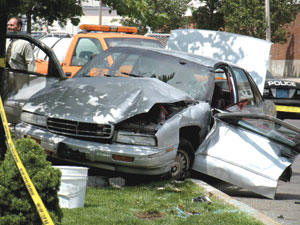
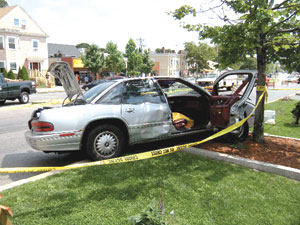
There
was a single car accident early this afternoon in the area of 277
Broadway. According to the Somerville Police, a woman's car struck the
island on Broadway and rolled over. She was taken to Mass General
Hospital; it appears she suffered non-life threatening injuries. The
accident is under investigation at this time.


Annual Metro Mayors Basketball Tournament draws typical huge crowd

On August 6, 2009, in Uncategorized, by The News Staff

The
annual Metro Mayors Basketball tournament, held at Trum Field Saturday,
brought together teenagers and law enforcement officials from all over
the greater Boston in an effort to combat youth and gang-related
violence.
~Photos by Derek James Whalen

Derek James Whalen

Teenagers
and law enforcement officials from all over the greater Boston area
gathered at Trum Field on Saturday to participate in the annual Metro
Mayors Basketball tournament in an effort to combat youth and
gang-related violence. Teams from Cambridge, Chelsea, Everett, Malden,
Medford, Quincy, Revere, Winthrop and Somerville all came to compete in
a five-on-five tournament organized by the Metro Mayors Coalition.

The
Metro Mayors Coalition is a group of mayors and city managers that work
together to facilitate collaboration among the Boston Metro area and
deal with common issues. Established in 2001 by the Metropolitan Area
Planning Council, the coalition has grown to accommodate 13 mayors and
city managers from Boston, Braintree, Brookline, Cambridge, Chelsea,
Everett, Malden, Melrose, Medford, Quincy, Revere, Somerville and
Winthrop.

Funding for the tournament came from the Charles
Shannon Community Safety Initiative, a state grant program designed to
aid government agencies, community organizations, and law enforcement
officials in their efforts to combat youth and gang-related violence.
The Shannon Community Safety initiative was established in response to
increased gang-related violence around the Metro Boston area, an issue
Saturday's tournament hoped to counteract by bringing police officials
and local teenagers together in a fun, mutual environment.

The
tournament was successfully kicked off last year at Revere High School
and Saturday's tournament was just the second year of what the Metro
Mayors Coalition hopes to become a long-standing annual tradition. The
weather was scorching hot as the nine teams squared off in the double
elimination event, followed by a three-point shot competition at the
end. Teams consisted of teenagers between the ages of 14 and 17, some
of who were joined together through their local high schools and others
who were matched up by community youth programs.

Attendance was
reportedly up from last year as the tournament brought together an
impressive turnout of players, police officials, and fans from all nine
towns and cities involved. Mayor Curtatone came with his three sons to
cheer on the players and support the event. When asked about the
tournament, he said that strengthening the relationship between youths
and local law enforcement officials in fun, communal events like this
is a critical part of the struggle against gang-related crime and
violence. He added that he hopes for the event to "grow exponentially"
over the next few years.

Police officials created a great
atmosphere for the event by coaching some of the teams, refereeing the
games, organizing the brackets, and shooting around with the players
between games. Mama Gina's Pizza in Union Square sponsored the event
and provided pizza for all players, law enforcement officials and fans
who attended. Chelsea emerged as the winner of the tournament, knocking
off Quincy in the finals, while a representative from Quincy won the
three point competition, making an impressive 17 three pointers in 1
minute and 30 seconds.

Amy Desrosiers, a manager with the Metro
Mayors Coalition, said the tournament is "a great event to bring kids
we work with in Shannon Grant together with police in a fun
atmosphere." This environment certainly seemed to be achieved as
Saturday proved to be a day when teenagers and law enforcement
officials from the Metro Boston area were able to play some basketball
and have fun as a group.


Rezoning of the Broadway corridor

On August 6, 2009, in Uncategorized, by The News Staff

To
help revitalize the Winter Hill and lower Broadway areas. the OSPCD is
in the process of fine tuning a proposal that will expand the current
zoning policy.
~Photos by Beecher Tuttle

By Beecher Tuttle

On
Wednesday July 29th, the Office of Strategic Planning and Community
Development held an open community meeting to discuss the potential
rezoning of the Broadway corridor in Somerville. The meeting, held at
the Elizabeth Peabody House, was the last of three neighborhood
meetings to educate residents on the effects and repercussions of the
proposed zoning changes.

The OSPCD is in the process of fine
tuning a proposal that will expand the current zoning policy in hopes
of attracting new commercial developments to help revitalize the Winter
Hill and lower Broadway areas. Generally speaking, the plan will allow
businesses to expand the square area of their property through an
increase in the allowable height and density of buildings along the
Broadway corridor.

Rob May, the Director of Economic Development
for Somerville, states that Somerville's "current zoning ordinance is
very limited in height, density, and the bulk of buildings. The new
zoning, which is based on the successful passage of zoning in Union
Square, brings these concepts over to Broadway and works with owners to
redevelop their property." The restructured zoning will also create a
series of incentives to make it more palatable for businesses to
redevelop their lots. "It is not financially feasible to redevelop
under the current zoning ordinances," says May. New zoning regulations
will also reward "green" developments and will attempt to discourage
vehicular traffic with underground parking regulations for certain
classifications of property.

The OSPCD and Ward 4 Alderman
Walter Pero admit that one of the main reasons for the change in zoning
is to help alleviate the issue of the vacant Star Market site in the
heart of Broadway. "The rezoning is really critical to the development
of Winter Hill, says Pero. "The catalyst for the rezoning was the Star
Market site which, unless it went through some zoning changes, could
only have been another market." The Office of Strategic Planning and
Community Development has contacted numerous supermarket chains over
the past few months but has found little interest in leasing the
property from its owner due to the current building specifications and
the close proximity of the Stop and Shop. "With the change in zoning,"
says Pero, "we can build something denser, bigger–maybe with mixed
use, and get the parking away from Broadway. Winter Hill looks tired
and it needs a boost."

Rob May and the rest of his team
believe the old Star Market site to be the lynchpin for the Hill and
feel that its current vacancy is a detriment to surrounding businesses.
"When you get into the Winter Hill area, all those businesses are
suffering because Star Market is empty-it is not bringing customers
into the community." Seven new businesses have opened their doors in
the last nine months along Broadway, but there have been few signs of
growth along that area of Winter Hill.

The Office of Strategic
Planning and Community Development will also be rolling out a program
called "Streetscape" next spring in an effort to further rejuvenate the
lower Broadway area. The initiative will widen sidewalks, provide
pedestrian amenities, and will make Broadway more of a bike-able route.
The OSPCD hopes that the new zoning regulations will help make lower
Broadway and Assembly Square "gateways" to Somerville through a
revitalization of architecture.

The meeting ended with some
questions from concerned local residents over the potential size and
scope of a new structure in the old Star Market location and how it
would affect the homes set below the back side of the lot. One resident
felt that a taller building would cast a shadow over the nearby homes
already set 15 feet below the vacant lot. Under zoning laws, the
Planning Board and the Design and Review Committee would have to sign
off on building changes that would affect the area.

There will
be a final community meeting to discuss the rezoning of all of
Somerville on August 12th and the OSPCD will submit their final
proposal to the Board of Aldermen in September.


Newstalk for August 5

On August 5, 2009, in Uncategorized, by The News Staff
The Mayor will be having his annual Boston Harbor cruise tonight – boarding
is at 6:30pm, this year it's a capacity crowd of over 300 who already
booked reservations, but if you still want to go, call Billy Tauro at
617-293-2016 for information.

***************

Mayor Joe
Curtatone's annual "Mayor's Senior Picnic" here in Somerville will be
Wednesday, August 12th from 11 am to 2 pm at the Nathan Tufts Park
(Powderhouse Circle) – there were be the usual dancing and
entertainment plus a lunch, along with a lot of prizes and fun for
everyone. This annual event has been going on since Gene Brune was the
Mayor. Call City hall at 617-625-6600 ask for the Mayor's Office for
ticket information.

***************

Our own Jimmy Del
Ponte is hosting Project Star – a summer theater arts and recreation
production of an original musical called "Back in the 'Ville." This
masterpiece was written and directed by Jimmy with the help of his
talented Co-Director Sophia Carafotes. It's at the Somerville High
School Auditorium on August 12th at 7 pm and admission is free – we
hear it's going to be fantastic.

***************

So for
the past few weeks we told you ahead of time who the PDSers were going
to endorse – and true to form – we predicted correctly. It's almost
like we are clairvoyant, but of course we're not. Why would anyone be
surprised that they endorsed their co-founder Rebekah, their long time
member and activist Mark and Marks hand picked PDS candidate in Ward 4
– Christine. Are you at all surprised? Come on, you know it's a set up
don't you? Oh, they will tell you that three other candidates that are
not PDS members didn't submit their replies…but would you if you were
those three people? It would be like the Appraiser's Association of
Somerville endorsing James and the remaining former residents of
Boston's West End endorsing Jim Campano. Give us a break. The only
endorsement that matters is on election day – let the chips fall on
either side.

***************

On another note in the
Alderman at Large race – Mr. Morales' literature looks so very
familiar…the layout, the wording and oh yes – even his slogan: "Your
Alderman, for One Somerville" – maybe it's just us, but we've seen this
someplace else in another election year – can anyone guess where and
when? Blog your guesses on our web site, and we will print next week
the correct answer.

***************

Wonderland Park's
rich history of dog racing is coming to an end on August 20th in Revere
– the voters narrowly banned dog racing last year. The Somerville
Lion's has booked the dinning club for the last night – only $35 pp and
all the proceeds go to local Somerville charities. Call Billy Tauro
617-293-2016 to get tickets for the event and a good evening of fun and
entertainment. By the way, if you are a business person here in
Somerville, call and talk to him about joining this great organization
– they meet every Tuesday at the clubhouse on New Washington Street for
a dinner.

***************

By the way have you seen how
empty the Farm Team paper has been lately? Take away the inserts and
count the stories – it's very little local news anymore. It's "totally
wicked small paper" – don't cha think? Check out for yourself what we
see – piles of the Farm Team paper on Monday/Tuesday and especially on
Wednesday (check the CVS at Magoun Square) still on the floor and on
the racks of several other stores they deliver to – they stopped
delivering to their two remaining boxes here in the City.

***************

How
does the Somerville Community Corporation get itself involved in the
Green Line train stops with another group Somerville Community Health
Agenda (we tried goggling this group and only found it on the web page
of the local PDSers members web site). They're holding a series of
meetings along the Gilman to Ball Square green line extension with the
so-called neighbors. There is actually a meeting tonight in Gilman
Square and we can tell you first hand the NONE of the immediate
neighbors were never notified about it, including both the Ward
Alderman and the School Committee person. Who is this group? If there
are meetings, why not meetings held by the City? Instead of a group
that is supposed to focus on housing issues? The last time the director
of SCC had his picture taken in Gilman Square he referred to it as East
Somerville, which goes to show you how much he knows about Somerville –
anyone that lives in Gilman Square has never been referred to as being
from East Somerville and never would be by someone who knows the
distinct difference.

***************

If you or anyone
you know has been a victim of bullying, SCAP (Somerville Cares About
Prevention) is holding a community discussion for youth, parents and
any interested Somerville residents to discuss bullying. Topics for the
discussion will include: 1. what is bullying; 2. types of bullying; 3.
tips for youth to assist them with bullying; 4. tips for parents to
assist youth with bullying. It will be held on August 27th from 6 to 7
pm in the 1st floor conference room at the City Hall Annex, which is
located at 50 Evergreen Avenue. For more information or to learn more
about what SCAP does for the community, contact Cory Mashburn, the
Director of SCAP at 617-625-6600 x. 2570 or email him at
cmashburn@somervillema.gov

***************

The 11th
Annual Massachusetts Breast Cancer Coalition "Against the Tide"
one-mile swim, two-mile kayak and three-mile fitness walk will be held
on Saturday, August 15th from 7 am to Noon at Nickerson State Park in
Brewster, MA. Against the Tide is a one-mile competitive or
recreational swim, two-mile kayak, and three-mile fitness walk to
benefit the Massachusetts Breast Cancer Coalition (MBCC). This fun and
inspirational morning statewide event brings swimmers, kayakers and

walkers
of all ages and abilities together with MBCC in efforts to stop the
breast cancer epidemic. The Massachusetts Breast Cancer Coalition is a
nonprofit organization committed to stopping the breast cancer epidemic
in Massachusetts through activism, advocacy, research and education.
Founded in 1991, the focus of MBCC is to find the causes of breast
cancer and to seek real prevention against this devastating disease.
For more information call 617-376-MBCC or visit www.mbcc.org/swim.
Donations may be sent to the following address: Against the Tide c/o
MBCC, 1419 Hancock Street, Suite 202, Quincy, MA 02169.


The View From Prospect Hill for August 5

On August 5, 2009, in Uncategorized, by The News Staff

For
anyone to think that there won't be some kind of health care package
approved by Congress by the time the November elections roll around,
you would almost have to be living in a cave. It has nothing to do with
whether you are a Democrat or a Republican, it is going to happen for a
number of reasons that quite frankly don't involve us at a local level.

It's
the terms of the health care reform, it will be the aftermath – the
devil in the details – so to speak, that will affect us here at home,
on Main Street, Anytown USA. Maybe President Obama wasn't upset that
the "Beer Summit" distracted the nation from his health care initiative
after all. This is just what he needed to tweak and make changes while
the nation cooled down about who drank what beer and talked about this
or that on the lawn at the White House – a nice, leisurely chat amongst
friends. And about 1,200 reporters with cameras, of course.

Not
to sound like alarmists, but, have you spent any time going over the
details of the Obama Health Plan 2009? It comes with a lot of bells and
whistles at first, but promises to be a bit more scary as the years go
on – and as you and I get older.

The first thing we thought
about when we looked into the plan, and then read the pro and con sides
of the issue, was that there is no way to get past the "Logan's
Run"-esque nature of the "special panel of experts" that could,
theoretically, decide that even though you are in perfect shape at 75
years of age, you cannot have the hip replacement you desperately need
to remain mobile under your own power.

Say hello to your new,
government issued "electric mobility scooter" – brought to you by
Easy-a-Round, a subsidiary of Haliburton.

The good news is that
the extreme portions of the health plan will most likely be the ones
modified in order to draw back in the "Blue Dog" Democrats and win over
some moderate Republicans. If they can somehow figure out how to keep
the long term costs down, then it may be a win-win for everyone from
the White House all the way down to the last house on the left.


Not-so-subtle changes to parking regulations in Somerville

On August 5, 2009, in Uncategorized, by The News Staff
 
Tension
and confusion ran high at Wednesday's Traffic Commission meeting when
concerned residents found out that topics outside of the specific
agenda of the meeting were not open to discussion. Photo by Jeremy van
der Heiden

By Jeremy F. van der Heiden

The
Somerville Traffic Commission held a Meeting on Thursday, July 26th in
the Tufts Administrative Building. The cafeteria was filled to the brim
with upwards of sixty persons composed of elected officials, resident
and non-resident business owners, and other concerned citizens from
Somerville. Right from the start, tensions were high. Alderman and
commission members battling with one another from across the humid
room, with background noises of applause, cries and yells, even jeers.

The
commission, headed by chairman Stan Koty, emphasized the fact that this
was a public meeting, not a public hearing. Ergo, the Commission does
not adhere to the persons attending to oppose decisions that the
Traffic Board had made in the past. Also, Mr. Koty stated that topics
outside of the specific agenda of the meeting were not open to
discussion. This is where the confusion seemed to begin.

First,
the Commission stated that some of those in attendance might have been
misled by a mass telephone communication. These phone calls alleged
that all tradesmen coming into residential areas for improvement tasks
or deliveries would be subject to ticketing in accordance with the
Commission's decisions. Mr. Koty apologized for any persons who came to
dispute this, because of the fact that it was not accurate. Later in
the meeting, multiple people who addressed the board cited that they in
fact came because of this mass communication.

Next, the
Commission later stated that the meeting's agenda did not include
residential permit parking, which absolutely proved to be the hottest
topic of the night. Some of the literature given at the meeting could
have been perceived as fuel to the frustrations voiced at the meeting,
as well as the fact that less than half of those in attendance had an
agenda in front of them. This was explained as being a result of
under-estimating the turnout.

The Somerville Parking Advocacy
and Reform Coalition (SPARC) handed out a pamphlet of sorts to those
present at this event. The pamphlet opens with the following statement:
"On May 21st, 2009, The Somerville Traffic Commission voted to approve
the following changes to City parking regulation: These changes are
slated to be instated this summer." Some of the changes listed include
residential permit parking only for any and all streets not currently
designated, as well as all metered spots changing to residential permit
parking only during non-enforced hours.

In the eyes of the
majority in attendance on Thursday night, this May 21st meeting was
vastly under-publicized relative to the precedent it set forth. Several
angered and confused Somerville citizens voiced their frustration with
the changes that were scheduled to take affect August 1st, 2009.
Obviously, these changes were not implemented nor enforced on this set
date, but the fact that most citizens of Somerville were not aware of
these changes, or the original meeting on May 21st worried the crowd.
In fact, when visiting the Somerville Government's website, the only
news or press release given for May 21st is in respect to a tree
inventory being taken.

When those in attendance would try to
voice their frustration about this error in communication, the board
would cut them off, stating that these said matters were "not on the
agenda." Ward 3 Alderman Tom Taylor expressed his concerns, battling
his way through the board's interruptions. He was told that he was "out
of order" by the board after he stated: "two weeks ago…the Traffic
and Parking Department sent communications to the Board of Alderman,
and they ask if you have any agenda items please let us know. I let the
Traffic and Parking Department know that I wanted to address these
issues, and lo and behold, these issues were not on the agenda." The
fact that even an Alderman couldn't address the biggest problem on the
table disheartened the majority of the crowd.

There were several
specific arguments by small business owners around the city that felt
that they would be gravely impacted by these changes. Some local art
galleries, along with merchants, yoga studies and a wide variety of
other business believed that these changes would force them out of the
city. If their notions are correct, this would mean fewer jobs and less
general revenue in the City of Somerville.

The question that
was stated multiple times at this meeting by various attendees, and
seemed to be on everyone's mind, was just how responsible the induction
of these measures is in the struggling local and national economy. When
a decision made by elected officials in order to better the City is
perceived by the citizens therein to be trumping their business, there
should be a call for revisions. Those in attendance understood this,
but had trouble accepting it considering the unwillingness of the board
to entertain pertinent questions.

The disagreements and disorder
in the Tuft Administrative Building Cafeteria raged on for a little
over an hour. Barely anything was covered on the agenda until after the
room cleared out for a five-minute recess, and never filled back up.
Once the room was all but empty, the board quickly went through the
nine-or-so items on the agenda.

As cited by the Commission, if
there are discrepancies to decisions they have made, a petition with at
least fifty signatures from registered voters leads to a public
hearing. For any more information on this topic, visit either the City
of Somerville's website (www.somervillema.gov), or SPARC's at www.somervilleparc.blogspot.com.


Transportation Finance and Reform – Part 2

On August 5, 2009, in Uncategorized, by The News Staff
 

2007 – From Bad to Worse – Officially
(The
opinions and views expressed in the commentaries of The Somerville News
belong solely to the authors of those commentaries and do not reflect
the views or opinions of The Somerville News, its staff or publishers.)

Op-Ed from State Representative Denise Provost

In
March of 2007, details of the scandalous fiscal mess in the
transportation sector reached a wide audience. The Massachusetts
Transportation Finance Commission issued its long-awaited report,
"Transportation Finance in Massachusetts: An Unsustainable System." [http://www.eot.state.ma.us/downloads/tfc/TFC_Findings.pdf]
The Commission, established by the legislature in 2004 and composed of
a dozen respected experts, found that the state's transportation
departments, and independent authorities had relied too much on debt
and chronically underfunded maintenance system-wide.

The
Commission estimated the resulting funding gap to amount to almost $20
billion over 20 years. It found that some practices of transportation
agencies, such as employee benefits, were simply too costly to
maintain. Yet the Commission didn't suggest that internal reforms and
economies alone could put our transportation system back on a sound
financial footing.

The antidote to years of neglect and
excessive borrowing was straightforward. To restore our transportation
system to a decent condition, and keep it functional, additional
revenues would be required. Prominent among the Commission's
recommendations was that the tax on gasoline be increased by twelve
cents per gallon.

This revenue boost was aimed at bringing
maintenance and operations up to an acceptable level of service. It
would not fund new construction of either highways or transit – what
are known as capital projects. About the latter, the Commission had
cautionary words:

"The MBTA has a variety of projects in
planning that many people would like to move forward. The Silver Line
Phase 3 is considered essential by the City of Boston and the

Greater
Boston business community. The Commonwealth has committed to design the
Blue Line/Red Line Connector and to construct the Green Line to
Somerville project as part of the Artery mitigation program. No
commitments have been made to actually construct these projects, and
there is no finance plan for them. And even if these projects were to
be built, the MBTA could not afford the additional operating expenses."

Their
message could not have been clearer that Massachusetts needed to
establish a capitol plan for financing transportation improvements.

It
was especially important to plan financing for the transit improvements
that Massachusetts was required to provide as mitigation for the
increase in highway travel that the Central Artery project would
provide. Massachusetts has been in violation of the Clean Air Act for
so long that the fact rarely surfaces in public discourse, but the
violation was the basis for a series of successful lawsuits by the
Conservation Law Foundation (CLF). CLF secured an agreement that the
state actually built the Big Dig Mitigation projects on a fixed
schedule – including completion of the Green Line Extension by December
31, 2014.

On May 31, 2007, however, Transportation Secretary
Bernard Cohen asked the legislature to hold off on advancing any
transportation bills until the administration could complete its review
of the system and its finances. In late November, 2007, the
administration filed a Transportation Bond Bill – a three year
borrowing plan for the Commonwealth to take on $4.8 billion more in
debt, with no clear repayment source. There was still no transportation
finance or reform plan in place by the time the other shoe dropped.

In
early December 2007, Secretary Cohen received a pair of letters from
the Federal Transit Administration (FTA) and the Federal Highway
Administration (FHWA). Federal officials informed the Commonwealth that
its State Transportation Improvement Program (STIP) for 2008-2011 had
been disapproved for lack of adequate state funding. This
innocuous-sounding message was in fact a bombshell – it meant that
projects in the disapproved program were not eligible for federal
funding.

Typically, the federal government pays for at least
80% of qualifying transportation projects; the federal share can be
even higher if the project has federal earmarks, or qualifies for a
grant, so the amount of federal aid in jeopardy was enormous.

This
federal decision was big news, except that it wasn't in the news; there
were no press releases or other publicity. As 2007 turned into 2008,
the FTA/FHWA letters stayed buried, viewable on an obscure website by
those who knew to look for them there. The administration had still not
proposed a transportation finance plan.


Residents envisioned what they would like life to be like when the Green Line comes to their neighborhood.

City holds community meeting for Brickbottom and East Somerville residents

By Julia Fairclough

People
envisioned walking down a well-landscaped street on their way to the T
station by Joy Street, lined with ethnic restaurants and cafes, a movie
theater featuring independent films, and the chirping of various birds
flocking amidst the newly-created green space.

Motorists,
bikers and pedestrians shared the roadways via clearly delineated
pathways. No longer was the view looking down Washington Street marred
by the McGrath Highway overpass, as that had been leveled as part of
the Green Line Extension and landscape improvement project.

Sounds
pretty nice, eh? Well, that's what the group of 30 or so residents
thought when they gathered at the Holiday Inn last Wednesday night
during the fifth of six interactive community meetings to talk about
the six new Green Line stops in Somerville.

This meeting was
for the Innerbelt/Brickbottom T-Stop along the Green Line Extension,
which is planned for the Joy Street area leading out of the Brickbottom
Gallery. Most people who appeared lived and/or worked in the
Brickbottom complex at 1 Fitchburg Street, while others reside on
neighboring streets. Most residents were long-timers, claiming an
average of 15 years and more, with the range running from three to 54
years.

Lisa Gimbel, the special projects assistant for the
Somerville Community Corporation kicked off the meeting by asking
people to close their eyes and envision the Joy Street area in 2019,
five years after the Green Line project is complete.

People
could really see the landscaping and focus on green areas that would
encourage more diversity in nature, such as bird life. One resident
said it will be very important for businesses to maximize their
properties, such as how the Neighborhood Restaurant in Union Square
turned its driveway into an outdoor seating area.

People
envisioned "mom and pop" restaurants that celebrate the rich diversity
of Somerville residents, as well as the nostalgic return to soda shops.
One person hopes that there will be a zoning change for office
buildings in the Innerbelt area to encourage new business. Currently
that area is industrially zoned, but is an underutilized area that
could bring in tax revenues.

As Somerville is one of the most
congested cities around, a lot of emphasis was placed upon bike paths,
such as one leading from the Brickbottom area to the new T stop, as
well as connecting around the rest of the Green Line stops. People
optimistically saw themselves living in a world where the pedestrian
has the priority to cross streets and weed through traffic.

It
was important for people to clean up the view that they currently have
on Washington Street and to do away with the unsightly McGrath Highway
overpass.

More greener pastures come with a price tag,
however. People also realistically predict that real estate values will
go up, with median prices of homes going from $450,000 to $600,000 and
three bedroom apartments starting at around $2,200.

And with a
more expensive city to live in, people feared that the immigrant
population may be forced out, especially in the East Somerville area
where this meeting took place. Many people raised their
hands-immigrants themselves-and said that they want to ensure the city
puts plans in place to allow them and their children to stay here.

Other
fears ranged from increased traffic, to the need for more parking
(though putting in the Green Line will hopefully move people away from
using cars).

"We hope to see redevelopment as a good thing," one resident said. "But what we don't want is over development."

After
batting around their visions, people came up with a list of principles
to keep in mind moving forward. Seeing as this is a community forum,
Gimbel stressed that holding community meetings like this allow for
peoples' voices to be heard during this critical time of planning. The
principles include the following:

o Create more amenities-Planning should include building stores, a movie theater, well lit streets and landscaping.

o
Create fluid access-Getting from one neighborhood to another should be
streamlined via pedestrian crossings and improved road plans to ease
the current choppy flow of traffic. A convenient, multi-modal transport
will be a priority, which includes bikes, pedestrians, wheelchairs and
cars.

o Restore, enhance and preserve the natural green
space-Ask builders to capitalize on any available open space. People
should keep in mind the adaptive reuse of properties.

o
Include the voice of the community-Planning should preserve and
encourage the diversity of residents and businesses. People should
consider affordable housing and rent control.

Somerville
Transportation Equity Partnership has joined forced with Groundwork
Somerville, the Somerville Community Corporation, and the Somerville
Community Health Agenda to form the CCP. The CCP is providing the
opportunity for continued community involvement in the planning stages
by organizing these six meetings in Somerville neighborhoods with stops
on the Green Line Extension.


Residents hash out alternative budgets

On August 5, 2009, in Uncategorized, by The News Staff

By Tom Nash

Somerville
residents had a chance to present their own city budgets last week in
an exercise designed by SomerStat to show how fiscal priorities and
"core values" can make for a painful decision process.

SomerStat
Director Stephanie Hirsch led a group of about 20 residents who met at
the the Dr. Albert F. Argenziano School on July 30 in a mock-budget
review session she said would give them a glimpse of how the budget
process works, especially in the face of the city's FY2010 $12.5
million deficit.

"The mayor and the Board of Aldermen over the
past five years have increasingly used data to make decisions," Hirsch
said. "We're going to ask you to recreate what the mayor and the Board
of Aldermen went through."

The group was divided into five teams
and told to create a budget using a spreadsheet that explained what
decisions could be made and how the costs would affect residents (many
items, such as the school budget, were left out). Among the rules were
that budgets had to be balanced and taxpayer costs kept low while
preserving the city's "core values."

The values, and the scoring
system given to them, attempted to match concepts such as "quality of
life" and "protect and support families and individuals" against
decisions such as whether to impose citywide resident parking or
closing fire stations. For citywide parking, SomerStat alloted 10
points for protecting families and subtracted five points from the
quality of life index.

Hirsch noted the reasoning and nature of
these core values was not up for debate, adding, "If you don't do
exactly what we did, you'll have to find other places to cut."

As the teams began to pore over the spreadsheets, both cuts and revenue additions came quickly.

Most
were in favor of the controversial citywide resident parking
initiative, which came under fire that night at a Traffic Commission
meeting, but came out against increasing meter hours. The teams were
also not squeamish about cutting employees.

The Department of
Public Works the most popular place for cuts, while the Inspectional
Services Division was also criticized as largely inefficient. One team
wanted half of the City Clerk office gone, while another group decided
to give 35 city employees pink slips – roughly 10 more than the city
has handed out.

The final results varied from running a
deficit of $6 million to a surplus of nearly $8 million, which came by
implementing a "Pay as You Throw" program that would charge $3 per
trash bag picked up in the city.

Ed Bean, Somerville's chief
financial officer, was on hand to watch as residents wrestled with the
budget and later critiqued their results. He said the exercise and
SomerStat meetings in general give city officials a chance to see how
residents view the decisions they make.

"It's easy to become
insulated," Bean said. "These (meetings) are very important to get the
pulse of the people. We're always open to new ideas."