Pages
Stay In Touch
More
© 2026 The Somerville Times. All rights reserved.


Review by Dennis Daly
Mnemonic sentiment, boiled down to its essential, tear-charged elements, cannot be ignored. It drives human nature. It mobilizes the emotions. It guides our unruly impulses toward goodness. Poets who completely excise sentimentality from their art do so at their own peril. Thankfully, Gary Metras is not one of those poets.
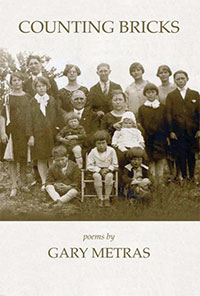
Counting Bricks
Poems by Gary Metras
Dos Madres Press
Loveland, Ohio
120 Pages
$21.00
Metras, in his new poetry collection, Counting Bricks, injects physical awe and unusual detail into the ordinariness of passion and its rolling tides of melancholy and elation. His precise, yet down-to-earth, verbiage contains and grounds any unseemly maudlin excess.
The poet’s opening piece entitled Splinter engages the peculiar bond between mother and child. He reduces the extraction of an everyday splinter into a series of detailed components. Using first his adult perception, then morphing into his child-memory, Metras nails the moment. From the beginning of the procedure to its end, specifics trump pain and fear (although both wait patiently in abeyance). Metras’ pre-teen protagonist concludes the poem this way,
it will not do to cry. I watch the needle
enter where the splinter entered.
The needle opens skin, probes beneath
the straight, dark path, snags it, lifts.
She does not take up tweezers.
She bends as if to kiss my finger,
but closes her teeth on the splinter,
draws it out, swipes it with the ball
of her middle finger. We stare
at the tiny slice of the world that yielded
such distress. I walk away healing
and remember the pain.
As poor Gloucester in Shakespeare’s King Lear laments, “As flies to wanton boys are we to the gods. They kill us for their sport.” Yes, the human condition accepts and to some extent submits to chance and nature’s blind cruelty. In Metras’ poem, The Ants, the poet paints these same boys at it again. This time with the help of lighter fluid the youngsters destroy a multitude of unsuspecting ants devouring a candy bar. Utter meanness or child’s play? The perpetrators of this massacre went on to live their anonymous, albeit somewhat messy lives. Metras redirects despair and all obvious bleakness, ending his poetic litany with an ironic flourish and a bit of karma,
… Shy-Dickie went
into the Air Force and never came
back. Adelle, we think, is still in jail
in Mexico. Jerry drives the school bus
and his cute sister was pregnant seven
times by five men. Know-It-All-Stanley
sweeps the floors at Merriam-Webster’s.
Susie is a nurse’s aide and a mother and a
grandmother and seldom sees her twin
brother. Holy-Roy retired from the Post Office
and walks his neighbor’s dogs.
Billy B. has ex-wives and inherited my father’s
worn bar stool at the Royal Café. And one day
walking into the drugstore in my 53rd year,
I step on a can of lighter fluid and
remember the smell of burning ants.
Counting Bricks, the title poem of this collection, dryly delivers its vital minutiae of clan history using the medium of an old photograph. The picture, portrayed on the book’s cover, includes the poet’s father and a host of his siblings. A family member had found the photograph and scanned it. Now every few years it surfaces and insists on being noticed and, with sentiment built in, remembered. As with most large families (and this reviewer has some firsthand knowledge of that subject), the odds and ends– marriages, pregnancies, poverty, drinking, union strikes, births, deaths, poker games, and sadness are tallied together with moments of fragile ardency. T.S. Eliot might call this associative device an objective correlative. In any case, it does the trick of turning conflicting emotions into a positive, even celebratory beauty. Consider this charged, detail-laden stanza at the heart of Metras’ poem,
… I remember
counting bricks and piling them as father built
a backyard barbecue for brother number ten,
and mixing mortar for the block foundation
of number eleven’s new house, while we lived
through the noise of the projects. I remember
holidays of whiskey-and-beer breath stories
of war, Memorial Days of fading photographs—
brothers in uniform, all in combat—number
three a POW, these brothers mentioned only once
or twice a year in voices charged with pride,
then remorse, then silence,
then tears.
Pointedly, in a second person poem entitled Making Pierogis, Metras conjures up a microcosm of labor and love in a mother’s kitchen. Daily cooking routine and repetitive meal preparation (meaning sore fingers and aching legs} merge with a doting mother and comforted, now cooing daughter, distracted by spoons and cups and a magic white dot of floury dough. Later the woman’s husband joins this hallowed scene. Everything seems well with the world! It cannot change. The poet has placed his spell on this composition. Metras conveys the wonder of it all in these lines,
The backs of your hands are splotched
with tiny blisters from the splash of boiling water
as you tossed into the pot raw pierogis.
You rescue each one from drowning and place them,
row upon neat row, in the glass pan that shines
with anticipation. As they cool, you clean.
When you lay the daughter in the crib for a nap,
you whisper that one magic word, pierogis.
Women, at their best, civilize all of us. Continuation and evolution of our species need the complexity of the female touch. In Thanksgivings, Metras’ tight, celebratory poem lauding clan continuation, mortality vies (or rather, combines) with genetics for spatial supremacy. Mankind, blessed with a higher consciousness, rises to its ritual moment in this very American holyday. The poet lovingly blesses his dual grandmothers in the poem’s opening,
My grandmother, bless her DNA, dead
When my mother was a child.
My fake grandmother, the real one’s twin,
Bless her hugs, also dead many years.
But I give thanks to both, one for
birthing, one teaching my mother
to roast the perfect turkey, bake
the perfect pie crust, delicious
even three days afterward.
Whether you love or lament this strange and affecting world that we live in, you’ll want to read this book and marvel at Metras’ poetic particulars and well-placed particles of dry sentiment and restrained passion. He’s genuine in his emotions and spot-on in his details.