
Pages
Stay In Touch
More
© 2026 The Somerville Times. All rights reserved.

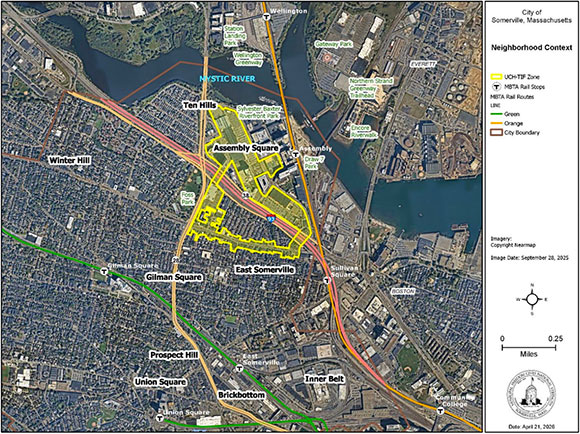
The proposed UCH-TIF zone.
By The Times Staff
The affordable housing crisis is a defining issue in Somerville. With the city facing acute shortages and high rental costs, Somerville is taking decisive action to increase its housing supply.
At the latest City Council meeting on May 14, the Wilson administration requested approval of an urban center housing tax increment financing (UCH-TIF) zone and plan to incentivize affordable housing development on vacant and undeveloped lots in Assembly Square and East Somerville.
The goal of this UCH-TIF plan “encourages the thoughtful redevelopment of vacant and underutilized sites into substantial new residential units and thriving commercial spaces, utilizing private investment to achieve public goals including improving neighborhood connectivity, access to civic and open spaces, and promoting anti-displacement actions,” according to the Assembly Square & East Somerville UCH-TIF zone and plan document.
The economic development division has completed the drafting of the UCH-TIF zone, where there is “potential to add mixed-use development with substantial housing production on a number of vacant and undeveloped lots,” according to a May 7 memo.
“We are proposing this tool for parts of East Somerville and Assembly Square,” said Katie Wiese, economic development planner with OSPCD, during the City Council meeting briefing.
According to the zone and plan document, “The Assembly Square and East Somerville UCH-TIF would address vacancy but also help connect people to businesses and housing opportunities on both sides of the highway.”
Furthermore, the UCH-TIF zone would advance city plans, including SomerVision 2040 and the Assembly Square Neighborhood Plan.
“The intention is to create affordable housing, and one of the ways that we can do that is to meet existing inclusionary zoning requirements, which in Somerville is 20 percent,” explained Wiese.
Approximately 13,000 units are required to meet the City of Somerville’s housing needs in the coming years, according to a 2025 housing needs assessment mentioned in the zone and plan document.
Executive Director of OSPCD, Tom Galligani, said on May 14 that the city is open to having discussions to “reach deeper levels of affordability” beyond what the existing inclusionary housing ordinance requires.
“To be very precise, yes, we’re looking to go a little bit deeper. That’s the mayor’s intention – to go a little bit deeper than our existing framework,” said Galligani.
The primary objective of the proposed UCH-TIF plan “is intended to spur the creation of new housing, including affordable units, in an area with strong transit access, employment opportunities, and capacity for greatly increased housing density,” according to the zone and plan document.
The item was referred to the Land Use Committee for recommendation.


















Reader Comments